1. Core Objective
MLA (Multi-Head Latent Attention) is an innovative attention mechanism designed to address the inference efficiency issues caused by the excessively large KV cache in traditional Transformer models. Its core objective is to significantly reduce memory usage (KV cache) during inference through low-rank compression and decoupled positional encoding, while maintaining or even improving model performance.
2. Technical Principles and Innovations
1. Low-Rank Key-Value Joint Compression
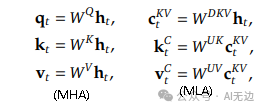
Problem: Traditional Multi-Head Attention (MHA) requires storing complete keys (K) and values (V) for each attention head, leading to a linear increase in cache size with the number of heads.
Solution:
Compress keys and values into a low-dimensional latent vector. For example, if the original key-value dimension is 1000, it may be reduced to just 100 dimensions after compression.
Formula Simplification:
Compression: Latent Vector = Linear Dimensionality Reduction (Hidden State)
Recovery: Compressed Key = Linear Projection (Latent Vector), Compressed Value = Linear Projection (Latent Vector)
Advantages: During inference, only the low-dimensional latent vector needs to be stored, rather than the complete key-value pairs, reducing cache size by over 90%.
2. Decoupled Rotary Positional Encoding (RoPE)
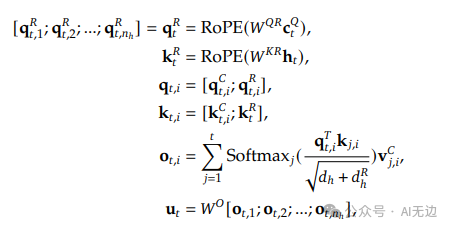
Problem: Traditional RoPE is applied directly to keys and queries, which may lead to loss of positional information during compression.
Solution:
Decouple positional encoding from content encoding:
Use independent rotary positional encoding to handle the positional information of queries and keys, avoiding compression interference with position sensitivity.
For example, the positional encoding for queries and keys is computed through separate paths and then concatenated with content encoding.
Advantages: Positional information can still be effectively preserved after compression, ensuring the accuracy of attention calculations.
3. Query Compression Optimization
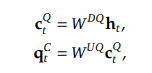
Although query compression has a minor impact on the cache, MLA still performs low-rank compression on queries to further reduce computational load.
Formula Simplification:
Compressed Query = Linear Dimensionality Reduction (Hidden State) → Linear Projection Recovery
3. Performance and Efficiency Comparison
1. KV Cache Reduction
MLA vs. MHA: The cache size of MLA is only 6.7% of that of MHA (for example, MHA needs to store 2000 elements/word, while MLA only needs 134 elements/word).
Equivalence: The cache efficiency of MLA is equivalent to GQA using only 2.25 groups, but with stronger performance.
2. Model Capability Maintenance
In benchmark tests like MMLU, MLA outperforms MHA and significantly surpasses GQA and MQA.
For instance, with the same number of parameters, MLA’s MMLU accuracy is 0.5-1 percentage points higher than that of MHA.
3. Practical Effects
In DeepSeek-V2, MLA increases the maximum generation throughput by 5.76 times (compared to the previous generation model), with training costs reduced by 42.5%.
4. Simplified Explanation of Key Formulas
1. Key-Value Compression Formula
Original key-value dimensions are high, MLA compresses through two steps:
Dimensionality Reduction: Mapping high-dimensional hidden states to low-dimensional space with a matrix (e.g., 1000 dimensions → 100 dimensions).
Recovery: Mapping back from low-dimensional space to the shape of keys and values while maintaining low-rank characteristics.
Intuitive Understanding: Similar to compressing a high-definition image into a thumbnail, occupying less space during storage and enlarging it when used.
2. Decoupled RoPE Formula
Traditional Method: Positional encoding is directly added to keys and queries, which may lose positional information after compression.
MLA Improvement: Positional encoding is calculated separately and then concatenated with content encoding.
Intuitive Understanding: Separating positional information (e.g., “which word number”) from content information (e.g., meaning of the word) to avoid confusion.
5. Technical Significance and Limitations
1. Significance
Efficient Inference: Provides feasibility for ultra-long context models (e.g., 128K tokens), suitable for real-time applications.
Performance Balance: For the first time, significantly reduces cache while enhancing model capability, breaking the “efficiency-performance” trade-off.
2. Limitations
Compression Dimension Selection: Needs to balance compression rate and information loss; extreme compression may lead to performance degradation.
Positional Encoding Complexity: Decoupled design increases computational steps, requiring hardware optimization support.
6. Conclusion
MLA achieves a “small yet powerful” attention mechanism through low-rank compression and decoupled positional encoding. Its core value lies in:
Reducing KV cache by 93%, greatly lowering deployment costs;
Maintaining or even improving model performance, providing key technical support for the practical application of large-scale language models.
Future exploration of more efficient compression strategies can further promote model optimization in the AGI era.