
Vietnam, a country with a population of over 100 million and a per capita GDP of approximately $4,700, shares borders with Guangxi and Yunnan. Let’s take a look at how the smart home market is developing…
When it comes to smart home technology, many people often think of Generation Z—this tech-savvy and experimental young demographic. However, actual data from Hunonic (the largest smart home platform in Vietnam) presents a different picture: the primary user age group is concentrated between 25 and 40 years old, with the 30 to 35 age range being particularly prominent.
Recently, the platform released relevant research to further explore the multi-faceted view of expanding the smart home market: how can technology truly be integrated into daily life? Who should brands engage with?
Key Point One
Smart Home Users Are No Longer Just “Tech Enthusiasts”
Analysis of over 600,000 platform users shows that most users are no longer simply “tech enthusiasts” who are passionate about new technologies. Instead, they are mostly over 25 years old, financially stable, and tend to seek improvements in quality of life and housing conditions, while beginning to build a sustainable living environment for their families.
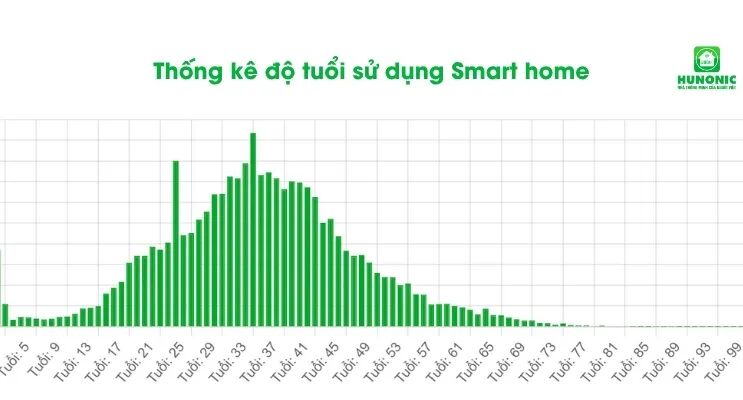
The 30 to 35 age group is becoming the largest and most dynamic demographic—they typically own their own homes or apartments, have established families, and are very busy.
Therefore, they are focused on solutions that save time, simplify operations, and provide peace of mind in their lives.
Key Point Two
Is the 25–45 Age Group the “Golden Users” of the Smart Home Market?

There are many reasons why this age group has become the focus:
They are the decision-makers responsible for finances and purchases in their households. Unlike Generation Z, who often live with their parents, this group actively consumes, invests, and manages household affairs.
They have access to high technology but are not overly experimental: they do not need overly novel or complex products, but prioritize stability, ease of use, and practical value.
They are potential loyal customers: once accustomed to using smart home products, they will gradually expand their ecosystem—from switches, bulbs, and sensors to cameras, air conditioning appliances, smart locks, entertainment systems, and home bathrooms.
Not only in the smart home sector, but the 28–40 age group is also becoming a “trigger point” for a range of high-end consumer goods industries in Vietnam:
-
Surge in first-time home buying demand (20 billion to 50 billion VND, approximately 50,000 to 135,000 RMB price range)
-
Significant investment in new furniture, kitchens, and bedrooms
-
First-time car purchases
-
Seeking improved housing suitable for children or elderly parents
In this context, smart homes play the role of a “virtual butler”—helping people save time, control everything remotely, and ensure home security. Smart homes are a reasonable extension of their journey to upgrade their living spaces. The prevalence of this age group has a significant impact on the trend of smart homes becoming mainstream in Vietnam.
Key Point Three
Is the Market Overlooking Young People?
One noteworthy point in the data: the groups under 20 and over 55 are almost absent from the user chart. The reasons are not hard to understand:
Young people under 20 do not own their own homes and have less decision-making power in spending.
Older adults are often reluctant to change their habits and find smart homes “complicated”.
This also indicates that brands have not done enough in terms of “personalization + convenience” in smart homes, failing to make them accessible to both young and older users. This presents opportunities for the future: if designs are simpler, voice assistants are smarter, or if “installation services” are offered, the market is expected to expand further into these two age groups.
Key Point Four
First Optimize Around the Main Age Group
From interface design to usage scenarios, smart homes need to “speak” the language of the 30-year-old demographic:
-
Clear and straightforward, not obscure or difficult to understand
-
Provide “one-stop solutions” without requiring customers to install devices themselves
-
Easy to install, convenient for sharing use with spouses
-
Integrate into scenarios that fit the work-pick-up-kids-rest schedule
In Vietnam, smart homes are not a future technology—they are gradually becoming a reality, shaped and enjoyed by people aged 25 to 40. Smart home brands should think more about and implement the actual experiences of their user groups.
-Recommended Reading-



-Summit Preview-