A few days ago, a Spanish laptop manufacturer accidentally leaked AMD’s internal roadmap. Such incidents are not uncommon in our industry, as internal documents often find their way out. However, this time is different because the information revealed is quite explosive.
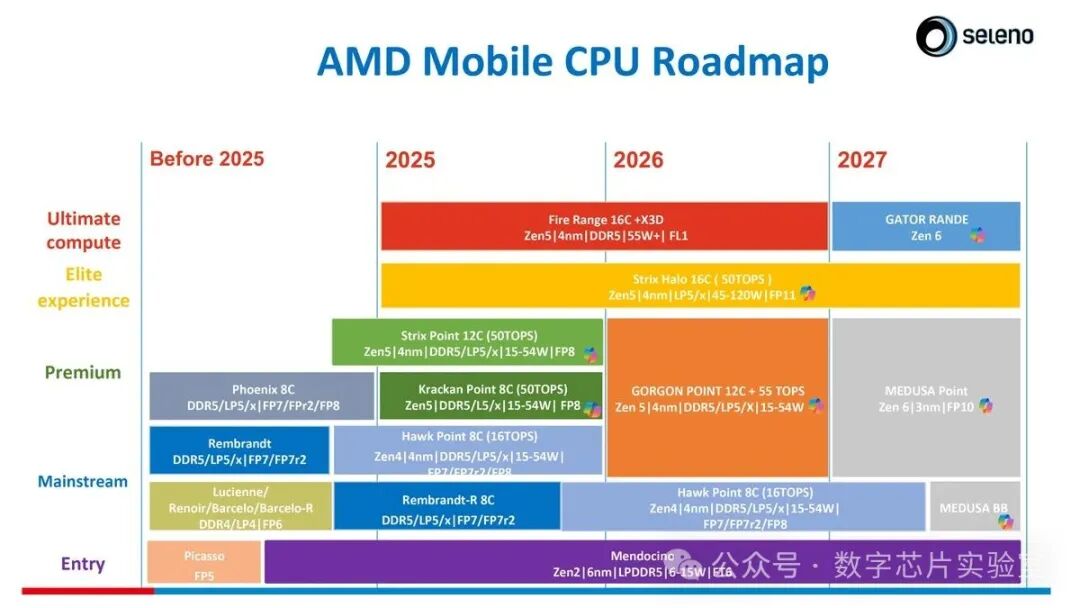
From Laptops to Mobile Phones: AMD’s Ambitious Plans
According to this roadmap, AMD will launch processors based on the Zen 6 architecture in 2027. You might think, isn’t that normal? AMD upgrades its architecture every few years; what’s so surprising about that?
The issue lies in the details. This time, the Zen 6 processor is codenamed “Medusa Point,” utilizing a 3-nanometer process with quite aggressive power management. More importantly, it features an NPU (Neural Processing Unit) with performance exceeding 55 TOPS, fully meeting the requirements of Microsoft Copilot+.
It still sounds like a laptop processor, right? But if you think about it carefully, you’ll realize that AMD is preparing to enter the mobile market.
The Zen architecture has already proven its strength in the PC sector, and now it aims to transplant this mature technology system to the mobile side. To be honest, AMD’s timing for entering the mobile market is quite precise.
Moreover, from a technological development perspective, the boundaries between mobile chips and PC chips are becoming increasingly blurred. The ARM architecture MacBook has demonstrated that mobile chips can perform desktop-level tasks, while the x86 architecture is also evolving towards lower power consumption. AMD’s entry at this time allows it to leverage its technological advantages accumulated in the PC sector.
Of course, establishing a foothold in the mobile market won’t be easy for AMD.
The biggest challenge is the ecosystem. Qualcomm’s Snapdragon is strong not only because of the chip’s performance but also due to its complete solutions. Baseband, RF, power management, various sensor interfaces—AMD will need to build all of these from scratch.
Additionally, there are customer relationships to consider. Mobile manufacturers have high demands for supply chain stability; you can’t just announce that you want to make mobile chips today and expect manufacturers to use your products tomorrow. It takes time to build trust.
In fact, if you think about it, AMD’s move into the mobile market reflects a trend in the entire tech industry— the boundaries are becoming increasingly blurred.
Previously, PCs were PCs, mobile phones were mobile phones, and servers were servers, each with their own playbook. Now, things are different; technological convergence is breaking down barriers between various fields.
AMD’s move may seem a bit risky, but in the long run, it could be an inevitable choice. After all, in this era of rapid technological iteration, if you don’t advance, you fall behind. Rather than waiting for others to disrupt you, it’s better to proactively disrupt others.
With over two years until 2027, we will wait and see. Perhaps by then, the mobile phone in your hand will be powered by an AMD chip.