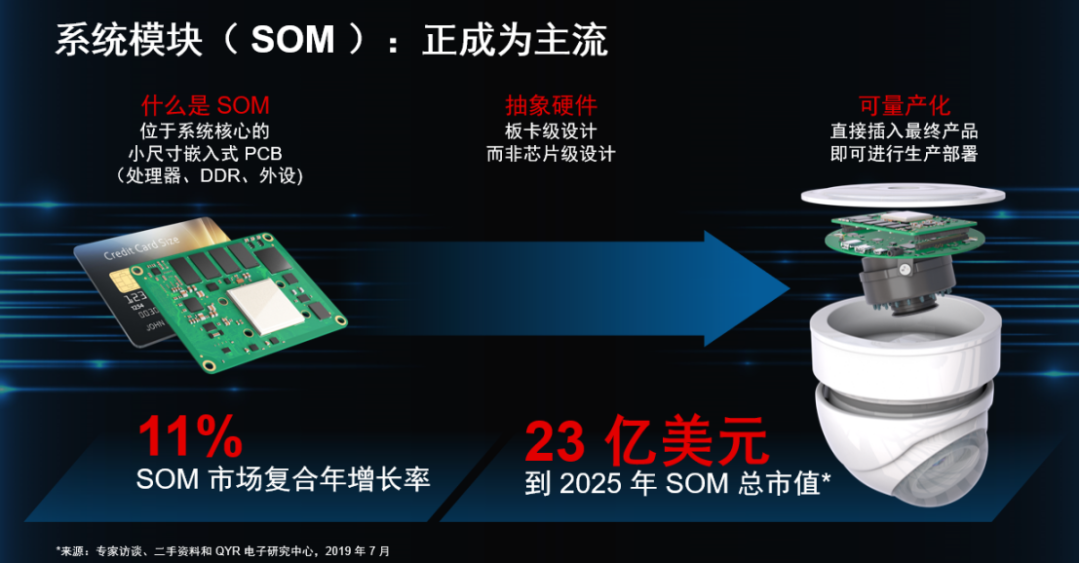
According to a report by Electronic Enthusiasts (by Cheng Wenzhi), the product development cycle is often quite short. Therefore, in China, both solution providers and terminal manufacturers prefer highly integrated chips, which speed up the development of new products.System on Module (SOM) is a highly integrated product. It is actually a miniaturized embedded board, about the size of a credit card, and typically contains a microprocessor (CPU, DSP, FPGA, or MPU, among others), as well as memory, power management, and other supporting circuit systems.In simpler terms, the role of SOM is to abstract hardware, allowing engineers to start designing products at the board level rather than the chip level, effectively shortening the product development cycle.For hardware engineers, it helps avoid repetitive, lower-end design work; for software engineers, they can work concurrently with hardware engineers without waiting for hardware to be fully developed before starting their work.
The SOM Market is Growing Rapidly
According to Chetan Khona, the market director for Xilinx’s Industrial, Vision, Medical, and Scientific (ISM) sectors, the SOM market has seen rapid growth in recent years. “According to industry reports, the compound annual growth rate of the SOM market is about 11%, and it is expected that by 2025, the total market size for SOM will reach $2.3 billion.”“We understand that while the SOM market is growing, existing embedded processors and GPU-based solutions often encounter issues, especially in the field of visual AI,” he pointed out. “This has created a space for higher performance and more flexible solutions, which our Xilinx products can fulfill.”Take the visual application market as an example; there are more than 70 types of visual applications, and the number continues to grow, with many applications utilizing AI and sensor fusion technologies.

As the accuracy of AI models continues to improve, these models are generally developed without considering hardware limitations, often directly on supercomputing platforms. However, when applying them to the mass production market, these AI models must be able to run on hardware-constrained terminals, such as edge devices, which require considerations of size and power consumption.Chetan Khona stated that innovative hardware solutions are needed in the visual AI market to help developers enhance their development capabilities. “To address this market, we launched the Kria series of products, with the latest being the production-ready Kria K26 SOM.”
Kria K26 SOM for Visual Applications
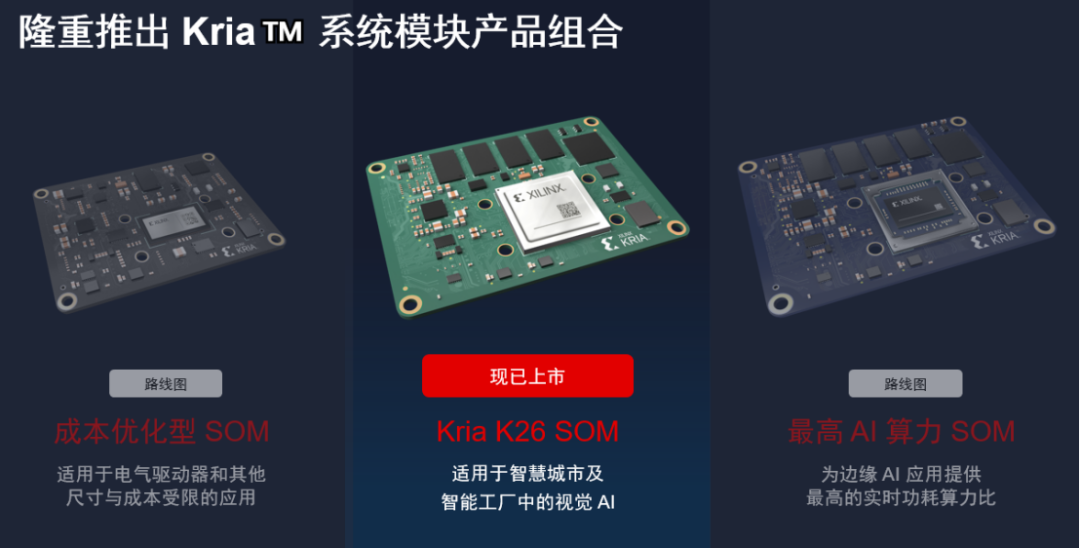
Based on insights into the market, Xilinx has utilized the advantages of Xilinx FPGAs in power consumption, performance, and adaptability to launch its first product, the Kria K26 SOM, targeting the visual AI field in smart cities and smart factories, including applications like security cameras, city cameras, traffic cameras, retail analytics, machine vision, and visual-guided robots.The K26 is Xilinx’s first SOM product, primarily aimed at the mid-range market, with plans to continue launching high AI computing power SOM products for the high-end market, as well as cost-optimized SOM products.
In terms of hardware configuration, the K26 SOM is designed based on the Zynq UltraScale+ MPSoC architecture, with an overall size of 77×60×11mm, equipped with a quad-core Arm A53 processor, 4GB of 64-bit DDR4 memory, 256K system logic units, 1.4 TOPS AI processing performance, and supports 4K60p H.264/265 video codec.
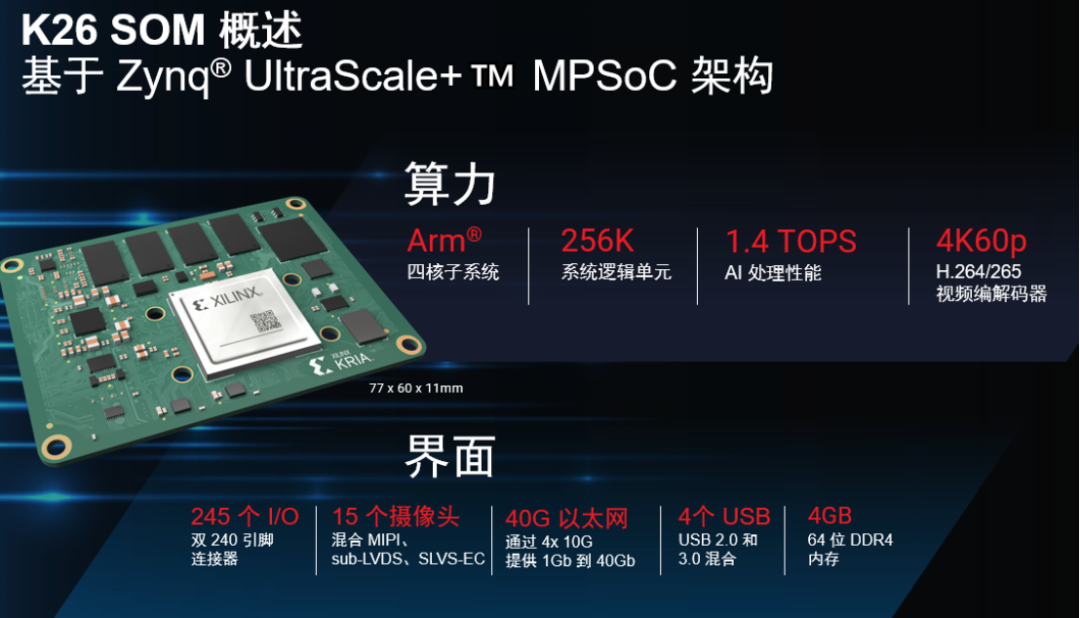
Additionally, the K26 SOM supports a rich array of interface standards and expandability, featuring 245 I/O, supporting MIPI, sub-LVDS, SLVS-EC, and connecting 15 cameras, while offering 1Gb to 40Gb Ethernet via 4x10G, and includes 4 USB interfaces.Chetan Khona emphasized that the Kria SOM is designed, manufactured, and tested as a production-ready product capable of withstanding various harsh application environments. Currently, Kria SOM is available in both industrial-grade and commercial-grade categories, with industrial-grade supporting higher vibration and extreme temperature conditions, as well as longer lifecycle ratings and maintenance.Moreover, he assured that Kria SOM is the most secure SOM on the market, as the K26 architecture itself includes a secure boot feature, and Xilinx adds a TPM module to every SOM to enhance security. Additionally, the K26 has passed all necessary certifications for industrial applications, preparing the product for global deployment.Besides the K26 SOM, Xilinx also launched the Kria KV260 Visual AI Starter Kit. According to Chetan Khona, Xilinx’s strategy is not only to produce mass-produced K26 SOMs but also to enhance business viability by providing cost-effective starter kits for users to implement visual AI applications.
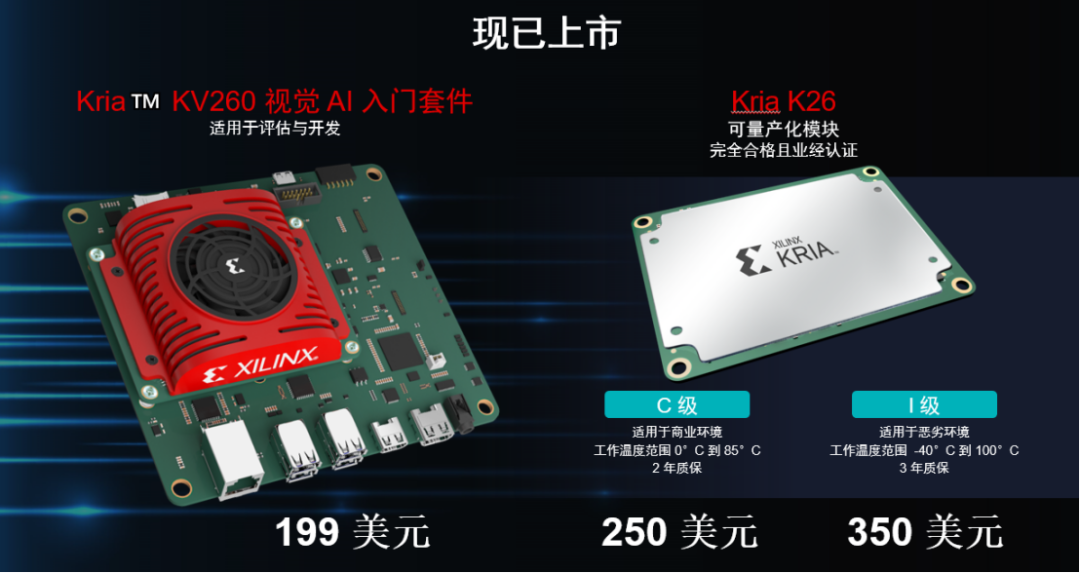
In terms of pricing, the Kria KV260 Visual AI Starter Kit is priced at $199, the commercial-grade Kria K26 is priced at $250, and the industrial-grade Kria K26 is priced at $350.
A Rich Ecosystem
In Chetan Khona’s view, creating a product is not just about a single item; it also requires building its ecosystem. For the K26, Xilinx is working with partners to build a rich ecosystem to help engineers get up to speed and use their products more easily.
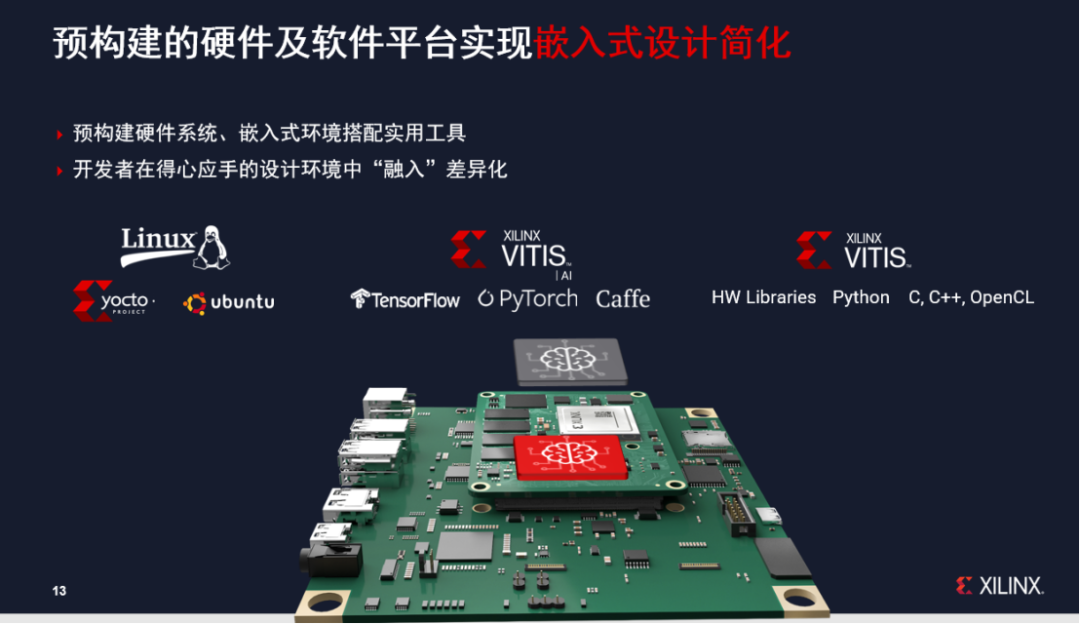
In terms of software, according to Chetan Khona, Kria continues Xilinx’s tradition of accelerating applications in software, supporting the integrated software platform Vitis and Vitis AI, while also supporting the design development environments familiar to developers.
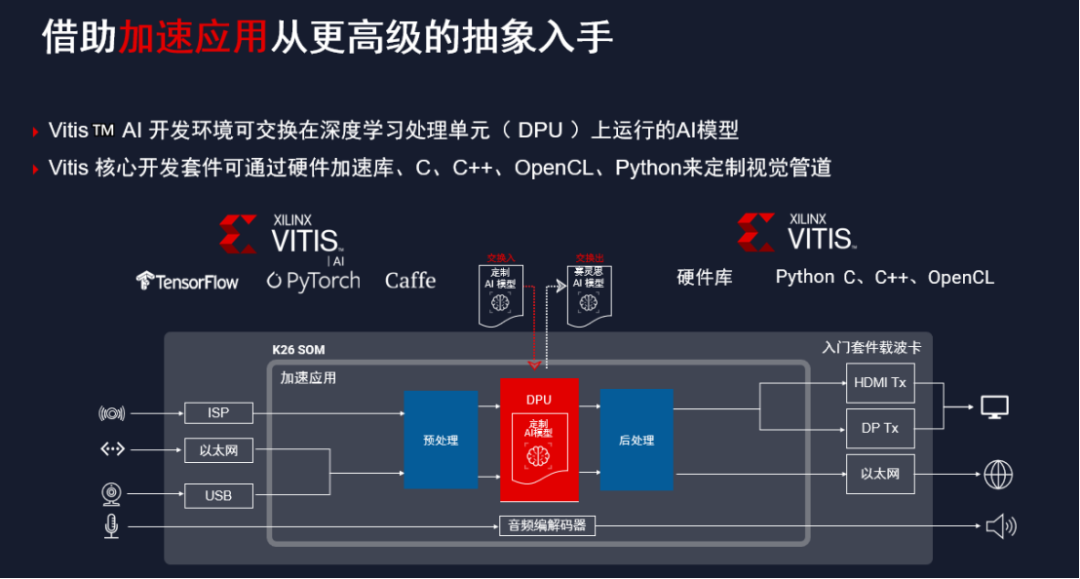
Kria provides four different development methods tailored to different depths and levels. The first is simple software writing; the second is replacing the device’s AI model with a user-trained AI model; the third is modifying the FPGA using familiar languages like Python, C, C++, and OpenCL; the fourth is making full-stack modifications to design models using traditional high-level FPGA languages.Additionally, Xilinx has launched the first embedded App Store for edge applications, greatly accelerating application deployment and enabling those without FPGA experience to quickly get started. Chetan Khona specifically pointed out that in the App Store, there are not only solutions provided by Xilinx but also turnkey and customized solutions offered by third-party partners.
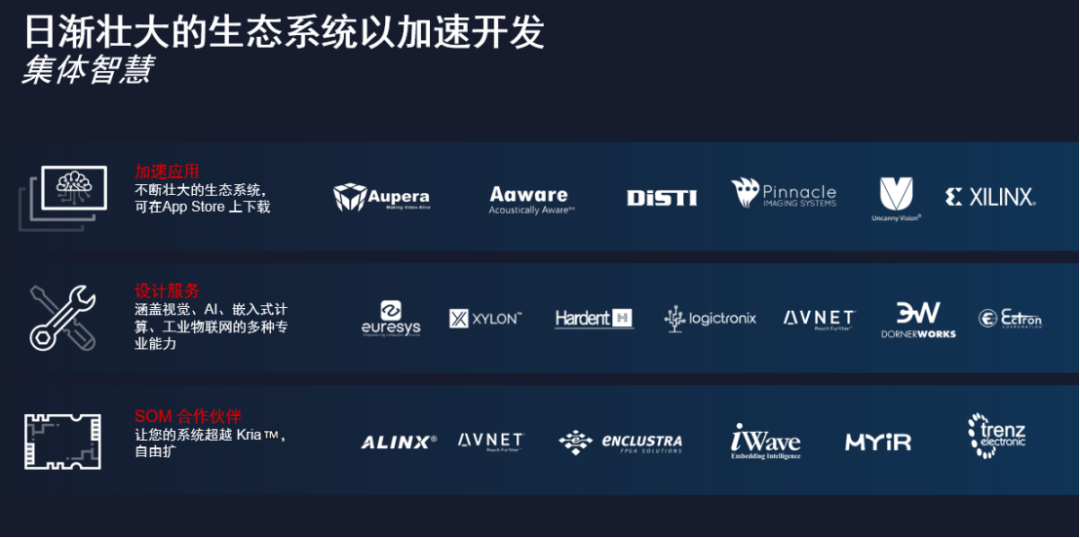
However, the concept of Kria SOM is not entirely new; it is similar to the approach of Alveo. Both Alveo and SOM can achieve faster deployment times, but Alveo is targeted at data center applications while SOM focuses on the edge, creating a complementary relationship. Some use cases indicate that the data center acceleration of Alveo and the edge applications of Kria have formed a very good acceleration application ecosystem.Chetan Khona emphasized that while SOM can be applied to many powerful solutions, the first batch of SOM products is primarily focused on intelligent vision applications.


Disclaimer: This article is original from Electronic Enthusiasts, please indicate the source above when reprinting. If your company wishes to obtain technology reports on new products, please contact Kevin Cheng, WeChat ID devil522c; for group discussions, please add WeChat elecfans999, for submission of interview requests, please email [email protected].
More Hot Articles to Read
-
Harmony OS Users Break 10 Million; BYD’s Wang Chuanfu Talks Xiaomi’s Car Manufacturing | Weekly Tech Review
-
Due to Huawei’s Mobile Market Share Dropping to 4%, Sony’s CMOS Image Sensors Are Being Outpaced by Samsung
-
Security Monitoring Giants Can’t Hold On! Hikvision Announces Price Increase! Chip Prices Have Exceeded Expectations?!
-
Component Shortages Enter the Second Half; Which Three Major Industries Are Gradually Showing Signs of Collapse?
-
Over 20,000 New Companies Enter in a Year; Can Three to Four People Manage It? Is the Barrier to Digital Chips Really Low?