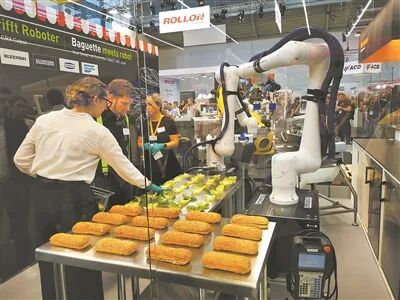
The robot manufacturer FANUC showcased robots making hamburgers at the exhibition.
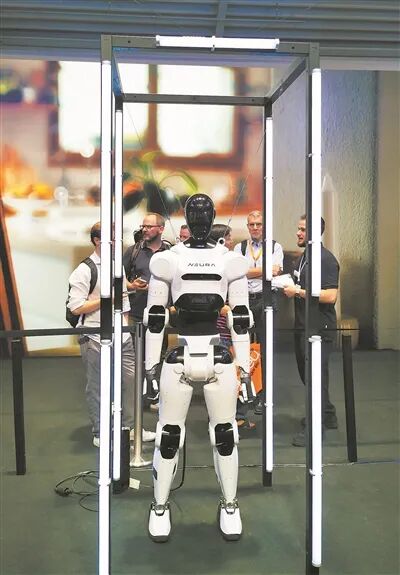
The German startup NEURA Robotics launched its humanoid robot 4NE1 Gen 3 at the exhibition.
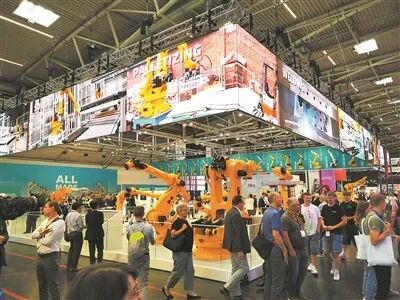
The Chinese robot manufacturer Estun showcased its products and technologies comprehensively at the exhibition.
Recently, a reporter from Science and Technology Daily attended the biennial 2025 Munich Automation Exhibition in Germany, deeply feeling that automation technology, enhanced by artificial intelligence (AI), is becoming smarter and driving continuous changes in industrial production and management. The integration of AI and robotics technology is accelerating across various fields, showcasing new ways of working and living in the future. Many companies have launched a new generation of humanoid robots, but based on the on-site performance, humanoid robots still have a lot of work to do in terms of technology and practical applications.
Making Automation Technology Smarter
Automation is the backbone of modern production and the engine of innovation. The displays from numerous exhibitors indicate that machines are increasingly taking on tasks that were considered too complex just a few years ago. For example, Google’s Intrinsic has introduced AI into the computer numerical control (CNC) machine tool market. The machine tool management solutions offered by related manufacturers can use AI-based perception technology to detect raw materials and utilize automated motion and grasping planning functions to automate the processes of picking and placing parts. Machine operators can manage processes, switch jobs, and import parts through a simple interface without the need for custom fixtures and robot programming.
Machine vision is widely used in industrial quality control and process control, with over 130 exhibitors from the machine vision and image processing fields at the exhibition. The organizers held more than 40 demonstrations on robotic vision, AI vision, and visual components and solutions. For vision providers, it is becoming increasingly important to offer 2D, 3D, line scan, and area scan camera technologies along with their suitable components. 3D visual perception sensors are becoming a key support for the new generation of smart hardware to achieve spatial perception and generalized operations.
AI and digitalization are continuously expanding the boundaries of traditional automation. For instance, automation solutions help save resources and reduce emissions. Intelligent systems that flexibly control processes and optimize energy consumption in real-time are no longer a distant prospect. In the new health technology field, areas such as laboratory automation, medical technology support, and optimization of healthcare logistics processes indicate that diversity and social relevance around this theme have emerged.
Making Robots Easier to Control
Although AI-based robotic technology is not yet widely used, AI has made the use of robots simpler and more flexible. Many manufacturers have integrated generative AI into robot programming, such as through intuitive voice control, making automation solutions more accessible. Starting with collaborative robots, there are increasingly more robots available on the market that can be used without specialized knowledge.
The intelligent automation solution provider KUKA aims to fundamentally redefine the way robots are controlled and has launched a scalable and flexibly adjustable robot operating system, iiQKA.OS2. This software and controller platform combines AI with vision systems, making robots more flexible without the need for complex programming. KUKA has also partnered with Microsoft to develop an AI chatbot that can convert natural language commands into program code. Additionally, KUKA aims to pave a relatively economical path for the digital production of small and medium-sized enterprises through a new cloud platform.
The Japanese robot manufacturer Yaskawa Electric showcased the concept of a “dynamic safety zone.” Robots can operate without protective fences while ensuring safety and high productivity. The relevant software dynamically adjusts the robot’s movements, slowing down or stopping when people approach the work area.
Enabling Humanoid Robots to Learn from Each Other
At the exhibition, the German startup NEURA Robotics prominently launched its humanoid robot 4NE1 Gen 3. This robot, standing nearly 1.8 meters tall, can lift up to 100 kilograms, possesses advanced AI technology, and has 360-degree omnidirectional perception capabilities, allowing it to collaborate safely with humans without a safety cage. This robot, designed for home, workplace, and service environments, is scheduled to be launched later this year. NEURA’s ambitious goal is to deliver 5 million robots by 2030.
Meanwhile, with the support of Vodafone, SAP, and NVIDIA, NEURA has launched an open software platform. This platform is not only used to connect robots but also to develop, distribute, and deploy robotic applications through an app store model. In this open robotic ecosystem, robots can share experiences learned from real-world use cases. The developers envision a scenario where what one robot can do, others can learn from.
Humanoid robots can provide new momentum for automation in manufacturing. As technology advances, these robots will become increasingly attractive to manufacturing enterprises. German automakers are actively researching this issue. BMW is testing the technology of the American humanoid robot company Figure at its Spartanburg plant in California. Mercedes-Benz is also using the Apollo humanoid robot from the American supplier Apptronik at its digital production innovation center in Berlin. However, as of now, there are still many challenges associated with the relatively new technology of humanoid robots in practical applications.
Chinese Companies Developing the German Market
At the exhibition, Chinese robot manufacturers such as Estun, KUKA, and Siasun showcased their products and technologies on a large scale. Representatives from Estun informed Science and Technology Daily that Estun’s robots have been deployed in battery assembly at the CATL factory in Erfurt, Germany. Through vertical integration of the supply chain and highly automated operations, Estun can provide robots in a very economical manner.
Since 2014, China has been the largest robot market in the world. In recent years, half of the robots sold globally have been installed in China. Over half of the listed companies in the humanoid robot supply chain come from China. German startups are also sourcing components such as robotic arms and joints with built-in force sensors from China. This indicates that China has become a heavyweight global player in the field of robotics and AI, poised to play a significant role in shaping the future of intelligent robots.
However, German media believe that Chinese robot manufacturers still have a long way to go to enter the German and European markets. Chinese manufacturers need to learn and understand local standards and dispel users’ doubts about the reliability of local services. Furthermore, AI is subject to strict regulations in Germany and Europe. There are still many unresolved issues regarding humanoid robots, and there are significant concerns about data security.
Source:Science and Technology Daily