Humanoid robots not only perform acrobatics on the sports field but also carry out precise tasks in factory workshops. A pressing question has garnered widespread attention: how far are humanoid robots from daily life?
To transition from laboratory breakthroughs to industrial applications, robots still need to overcome challenges in technological advancements, ethical standards, and cost control.
This month, Beijing hosted two world-class robotics events. On August 8, the 2025 World Robot Conference took place, with over 200 domestic and international robotics companies participating, during which more than a hundred new products were launched. On August 14, the world’s first humanoid robot sports competition kicked off, attracting 280 teams from 16 countries and regions. From the conference venue to the competition arena, humanoid robots showcased their abilities.
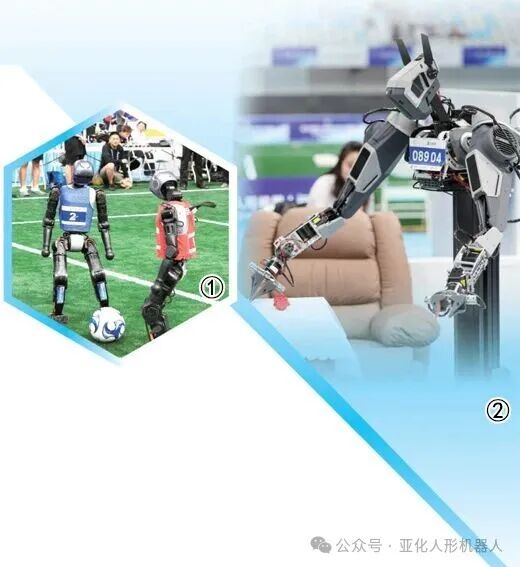
At a critical stage of transitioning from laboratory technological breakthroughs to industrial applications
Running, dancing, flipping, and overcoming obstacles… At the 2025 World Humanoid Robot Sports Competition, over 500 steel “athletes” took to the ice rink at the National Speed Skating Hall. In the final day’s 5v5 soccer match, the “Tsinghua Fire God Team” defeated the German team 1-0 using their self-developed algorithms and strategies to win the championship.
“A total of 48 teams from home and abroad participated in the soccer event, all using our robots,” said Dong Hao, Vice President of Technology at Beijing Accelerated Evolution Technology Co., Ltd. He highlighted that the robots are durable and developer-friendly, stating, “The participating teams develop their decision-making programs based on our framework.”
33.71 seconds and 394.40 seconds were the winning times for Yushu Technology’s G1 and H1 robots in the 100-meter obstacle race and the 1500-meter race, respectively. Although there is still a gap compared to human professional athletes, Wang Xingxing, the founder of Yushu Technology, believes this indicates that robots have great potential, saying, “It won’t be long before robots will definitely run faster than humans.”
When will humanoid robots be able to “run” into our daily lives?
Jia Baoxiong, a researcher at the Embodied Robotics Center of the Beijing General Artificial Intelligence Research Institute, believes that while humanoid robots have achieved a high level of motion capability in specific tasks like running and dancing, significant breakthroughs are still needed in several areas for them to truly enter daily life. “Their autonomy in general scenarios, the accuracy and stability of their movements and operations, and their safety during interactions with humans all need further enhancement.”
“Globally, the physical performance of hardware continues to break through, artificial intelligence is achieving generational leaps in decision-making capabilities, and supporting technologies like datasets and virtual simulations are being solidified,” said Xu Xiaolan, President of the China Electronics Society, at the 2025 World Robot Conference. She noted that humanoid robot technology is currently experiencing multiple breakthroughs and collaborative leaps, and is at a critical stage of transitioning from laboratory breakthroughs to industrial applications.
The development of the ‘brain’ is key
The research on humanoid robots can be traced back to the 1970s. Today, the “explosion” of humanoid robots largely relies on the development of embodied intelligence technology. Therefore, many people are not only focused on the movement capabilities of humanoid robots but also on their level of intelligence.
The “Little Rascal” from Songyan Power, which won the championship in the free gymnastics competition at the 2025 World Humanoid Robot Sports Competition, performed stunning flips on the field. Jiang Zheyuan, the founder of Songyan Power (Beijing) Technology Co., Ltd., stated that in terms of hardware and movement capabilities, China’s humanoid robots are among the best in the world, “but there are currently few breakthroughs globally in the development of humanoid robot ‘brains.’”
Why do some robots deviate from the track when running? Why do robots sometimes fail to locate or aim at their opponents in boxing matches? Such situations occur frequently, and while audiences may laugh, they also wonder about the underlying reasons. Part of the reason is that many robot competitors are remotely controlled by humans, and factors such as the operator’s skill level and the electromagnetic environment around them can interfere with the remote control signals, affecting the robots’ performance.
To encourage intelligence, the 2025 World Humanoid Robot Sports Competition was designed with specific rules. Many may not know that the Tian Gong Ultra robot, which won the 100-meter “Fast Man Battle,” was not the first to cross the finish line. However, it was the only robot in the competition to use a fully autonomous navigation system, operating without remote control. According to the competition rules, the time taken by the Tian Gong Ultra robot was multiplied by a factor of 0.8, thus achieving the highest ranking.
“Relying on the general embodied intelligence platform ‘Hui Si Kai Wu,’ robots can also complete tasks in industrial production, commercial services, logistics, special operations, and home services, achieving one brain for multiple machines and one brain for multiple functions,” said Xiong Youjun, General Manager of the Beijing Humanoid Robot Innovation Center. He noted that the intelligence of humanoid robots is a gradual breakthrough process, stating, “Continuously improving intelligence levels is essential to better assist and serve us.”
“While existing hardware still needs continuous optimization, it already possesses basic usability. Currently, the real bottleneck lies in the fact that embodied intelligence has not yet fully matured, which is the key constraint on the large-scale application of humanoid robots.” Wang Xingxing believes that it will take some time for humanoid robots to truly enter the daily lives of ordinary people.
Several hurdles remain for widespread robot application
The humanoid appearance of robots allows them to replace humans in various tasks. Material handling, drug sorting, hotel services… Unlike typical sports competitions, the humanoid robot sports competition has specially designed events for different application scenarios. These scenarios are considered the most likely areas for large-scale application of humanoid robots, serving as a “prelude” to their entry into everyday life.
“Currently, humanoid robots can provide emotional value in performance and entertainment scenarios. Combined with wheeled forms, they can also undertake sorting and handling tasks in warehouses, supermarkets, and pharmacies, alleviating human labor burdens,” Jia Baoxiong stated. However, for humanoid robots to truly enter the lives of the public, there are challenges beyond technological breakthroughs, including ethical and cost issues.
The price of humanoid robots poses a significant barrier to their entry into households. Xiong Youjun cited that training existing embodied intelligence large models requires a vast amount of operational trajectory data from robots. “High-quality data is not only scarce but also costly, becoming a major constraint on the development of embodied large models and increasing the training costs of humanoid robots.”
Not only is patience needed to overcome technical challenges, but there must also be a respect for ethics. “How do we ensure our privacy when humanoid robots enter our homes?” “How should we coexist with robots?” These questions have been hot topics at the 2025 World Robot Conference.
The International Federation of Robotics predicts that from 2021 to 2030, the global humanoid robot market will experience a compound annual growth rate of up to 71%. The China Electronics Society predicts that by 2030, the market size of humanoid robots in China is expected to reach approximately 870 billion yuan.
Humanoid robots are still evolving rapidly, and we look forward to the day they “run” into every household and integrate into daily life.
Fun Science
Look! The “Special Abilities” of Robots
Electronic Nose
The electronic nose (see image ⑤, reference image) is based on gas-sensitive units that convert the concentration of various gases in the environment into electrical signals through semiconductor, electrochemical, and optical principles. It then uses micro-electromechanical system technology to miniaturize the sensitive units and array them with different response characteristics to different gases. Finally, combined with AI algorithms, it qualitatively or quantitatively detects environmental gases based on the signals from the sensitive unit array. The electronic nose can identify common liquids such as beverages, alcohol, and vinegar. In the future, with advancements in materials and integration technologies, electronic noses will become more sensitive and intelligent, with a wider range of applications.
Dexterous Hands
Different types of Casia Hands (see image ⑥, reference image) each have their own focus. The humanoid dexterous hand has 21 actuators controlling 25 degrees of freedom, making it very flexible and capable of performing delicate operations such as threading a needle and brewing coffee. The highlight of the high-speed adaptive dexterous hand is its maximum joint speed of 720 degrees/second, ensuring operational efficiency, allowing it to perform well on fast-paced production lines. The three-finger dexterous hand uses four active degrees of freedom combined with a passive adaptive structure, capable of carrying 5 kilograms, with finger joint speeds exceeding 180 degrees/second.
Exoskeleton
The exoskeleton knee robot (see image ⑦, reference image) is primarily aimed at hiking and daily walking assistance scenarios. Its core feature is an AI adaptive algorithm-based motion recognition system that can collect gait, joint angle, and terrain information in real-time through sensors, constructing a model of the user’s walking intentions and dynamically adjusting the assistance mode during starting, accelerating, and descending slopes, achieving human-machine collaboration that fits personal rhythms. In terms of structural design, the force points at the knee joint use a bionic shock absorption mechanism to disperse impacts and reduce joint pressure, thus meeting the needs of outdoor sports and rehabilitation assistance.
Source: People’s Daily. If there is any infringement, please contact for deletion!