
Click the blue text above to follow us

01
Overview
The conditions of power swing in power systems can cause distance relays to take incorrect circuit breaker actions in certain situations. In this case, power swing blocking and power swing deblocking are two important functions of distance relays used to distinguish between power swings and faults, thereby maintaining system stability and continuity of power supply. This paper proposes a method based on Taylor series expansion for sample estimation and error calculation to enhance the performance of relay power swing detection. The performance of this method is compared with four conventional methods and one new method from the literature. The analysis is conducted in two systems: a single machine infinite bus system with parallel lines and the 68-bus New England test-New York power system, for faults, power swings, and fault conditions during power swings. Simulations and performance analyses are carried out using EMTDC/PSCAD and MATLAB, respectively. The results indicate that when considering the performance of correct operation, algorithm response time, output clarity, and the time taken for processor program execution, the proposed method generally exhibits the best performance. The study finds that the proposed method improves the performance of distance relays under correct operation and the speed of taking power swing blocking and deblocking actions.
Source:


02
Operating Results
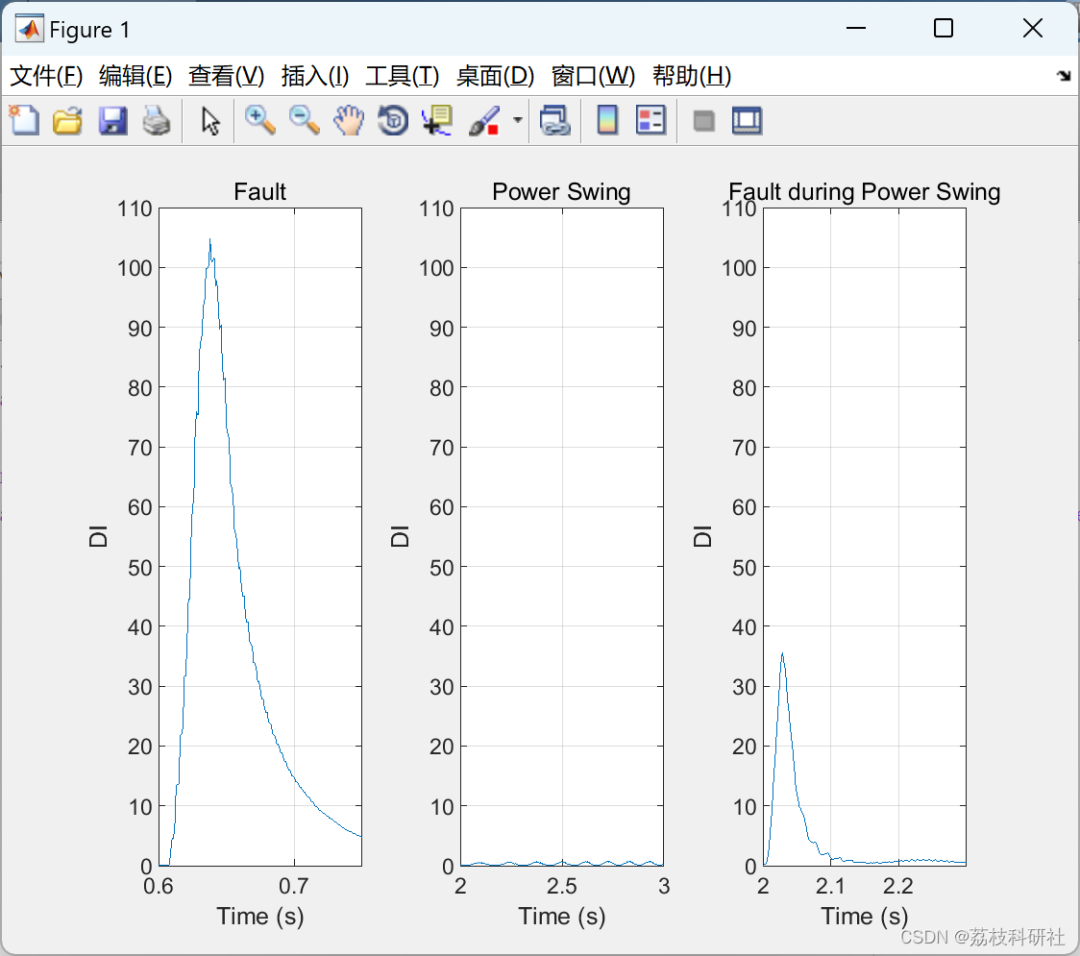
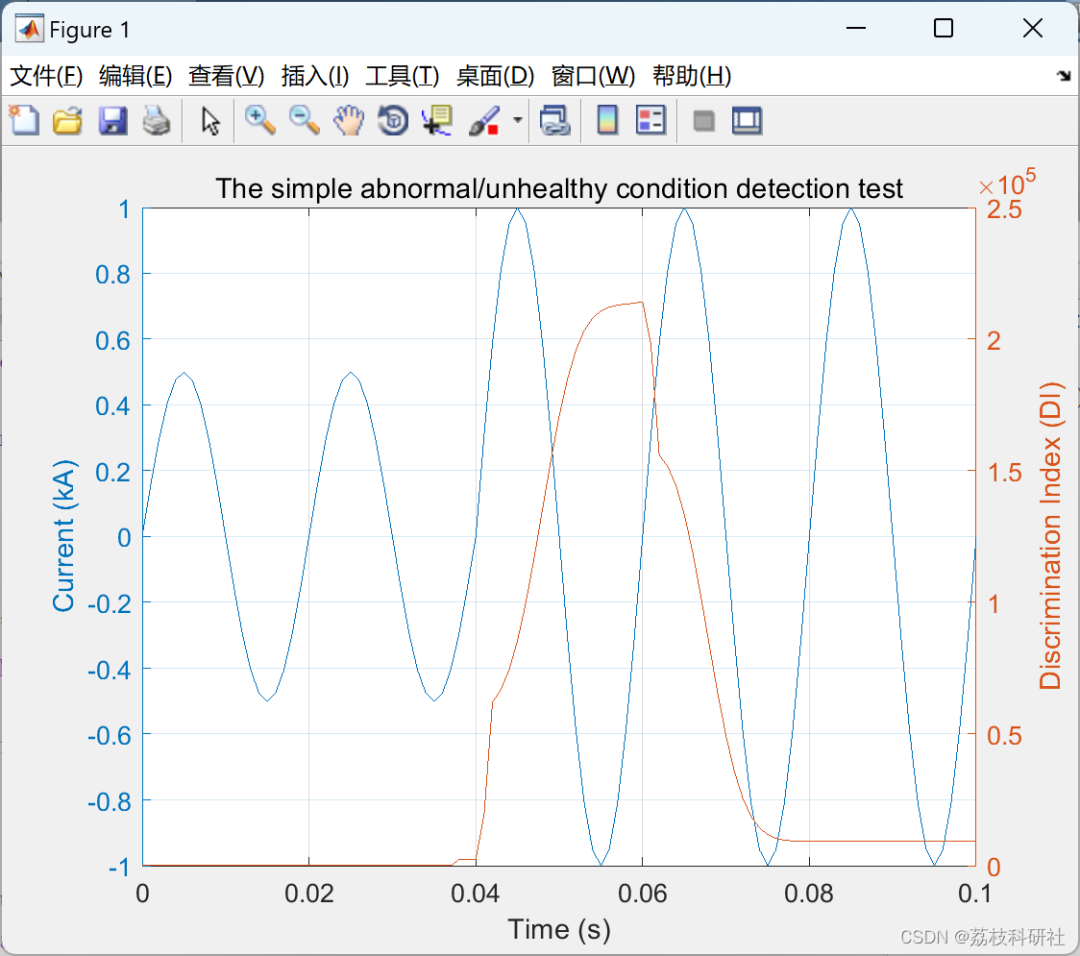
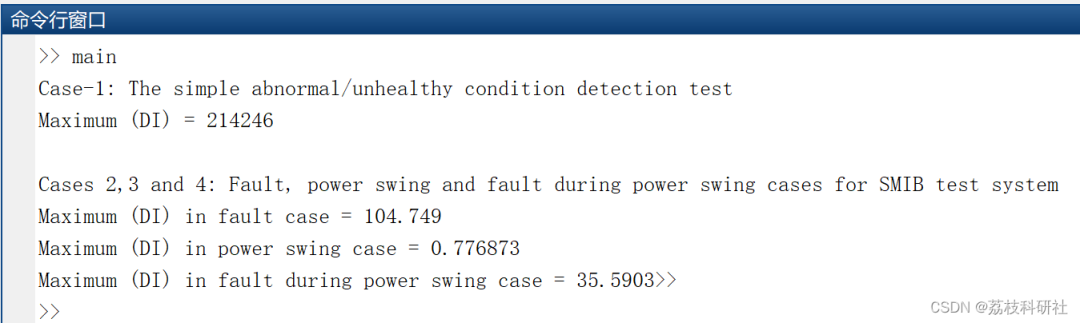
% Part of the code:
load('current_fault');time1=time;current1=current;
load('current_swing');time2=time;current2=current;
load('current_fault_during_swing');time3=time;current3=current;
N=20;%number of samples in one cycle
for p=1:length(time1)
    DI1(p)=0;
    if p>=2*N-1
        for q=0:N-1
            DI1(p)=DI1(p)+(current1(-q+p-3)-3*current1(-q+p-2)+3*current1(-q+p-1)-current1(-q+p)+mean(current1(-q+p-N+1:-q+p)))^2;
        end
    end
end
%fprintf('Minimum (DI) in fault case = %g\n',min(DI1));
fprintf('Maximum (DI) in fault case = %g\n',max(DI1));
for p=1:length(time2)
    DI2(p)=0;
    if p>=2*N-1
        for q=0:N-1
            DI2(p)=DI2(p)+(current2(-q+p-3)-3*current2(-q+p-2)+3*current2(-q+p-1)-current2(-q+p)+mean(current2(-q+p-N+1:-q+p)))^2;
        end
    end
end
%fprintf('Minimum (DI) in power swing case = %g\n',min(DI2));
fprintf('Maximum (DI) in power swing case = %g\n',max(DI2));
for p=1:length(time3)
    DI3(p)=0;
    if p>=2*N-1
        for q=0:N-1
            DI3(p)=DI3(p)+(current3(-q+p-3)-3*current3(-q+p-2)+3*current3(-q+p-1)-current3(-q+p)+mean(current3(-q+p-N+1:-q+p)))^2;
        end
    end
end
%fprintf('Minimum (DI) in fault during power swing case = %g\n',min(DI3));
fprintf('Maximum (DI) in fault during power swing case = %g',max(DI3));
subplot(1,3,1);plot(time1,DI1);
xlim([0.6,0.75]);ylim([0,110]);grid on;
xlabel('Time (s)');ylabel('DI');title('Fault');
subplot(1,3,2);plot(time2,DI2);
xlim([2,3]);ylim([0,110]);grid on;
xlabel('Time (s)');ylabel('DI');title('Power Swing');
subplot(1,3,3);plot(time3,DI3);
xlim([2,2.3]);ylim([0,110]);grid on;
xlabel('Time (s)');ylabel('DI');title('Fault during Power Swing');
saveas(gcf, '../results/testSMIB.png');
03
References
Some theoretical sources are from the internet; please contact us for removal if there is any infringement.

[1]I. G. Tekdemir and B. Alboyaci, “A novel approach for improvement of power swing blocking and deblocking functions in distance relays,” 2017 IEEE Power & Energy Society General Meeting, Chicago, IL, USA, 2017, pp. 1-1.

04
Matlab code, data, article explanation