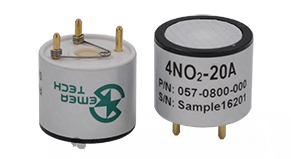
Product Description
This product can eliminate interference from sulfur dioxide gas and can serve as a replacement for the existing standard 4 Series nitrogen dioxide sensors on the market.
Performance Parameters
| Range | 0 ~ 20 ppm |
| Maximum Load | 250 ppm |
| Sensitivity (20℃) | -0.60 ± 0.15 μA/ppm |
| Response Time (T90) | ≤ 30 s |
| Baseline (20℃) | < ±0.4 μA |
| Baseline Drift (-20℃ ~ 50℃) | < 0.5 ppm |
| Resolution | 0.1 ppm |
| Linearity | Linear |
| Bias | 0 mV |
Product Dimensions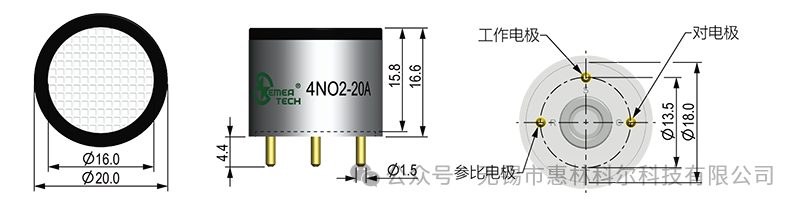 Operating Environment
| Temperature Range | -20℃ ~ 50℃ |
| Pressure Range | 1 ± 0.1 Standard Atmosphere |
| Humidity Range | 15% ~ 90%RH (No condensation) |
Lifetime
| Long-term Stability | < 2% Signal Value/Month |
| Storage Temperature | 10℃ ~ 30℃ |
| Service Life | 2 Years (in air) |
| Storage Time | 6Months (in dedicated packaging) |
| Warranty Period | 12Months |
Intrinsic Safety Data
| Maximum Current at 250ppm Nitrogen Dioxide | < 0.2 mA |
| Maximum Open Circuit Voltage | 1.3 V |
| Maximum Short Circuit Current | < 1.0 A |
Physical Properties
| Housing Material | ABS |
| Weight | 5 grams |
| Directionality | None |
Installation InstructionsPlease connect the electrode pins correctly; incorrect connections will affect the normal operation of the sensor. The sensor should avoid contact with organic solvents, paints, oils, and high concentration gases. Do not use adhesives directly on or near the sensor to prevent cracking of the plastic housing. If used in special environments, please contact us in advance.Cross Sensitivity
| Gas | Concentration (ppm) | Output Signal (equivalent toppm Nitrogen Dioxide) |
| Hydrogen Sulfide | 15 | -0.8 |
| Carbon Monoxide | 300 | 0.0 |
| Nitric Oxide | 35 | 3.4 |
| Chlorine | 1 | 0.4 |
| Sulfur Dioxide | 5 | 0.0 |
| Ethanol | 1000 | 0.0 |
Note: The above cross sensitivity includes but is not limited to the gases listed. This sensor may respond to other gases. The values of cross sensitivity may vary with different production batches and testing environments. Calibration should be performed with the target gas before use. If calibrated with cross-sensitive gases, the accuracy of calibration and measurement cannot be guaranteed.