
On September 23, the 2025 China International Industrial Expo kicked off in Shanghai. From the implementation of industrial AI to multi-form robots working in coordination, from green manufacturing solutions to cross-regional industrial collaboration, this year’s expo saw domestic and foreign companies showcasing their cutting-edge technologies at this industrial event.
Below is a video from the Yangtze River Delta Daily
At the exhibition site, reporters from the International Financial News observed that approximately 3,000 exhibitors presented their advanced technologies and innovative products, with notable achievements in artificial intelligence, robotics, and green manufacturing, outlining a clear path for the manufacturing industry towards intelligent, flexible, and green transformation.
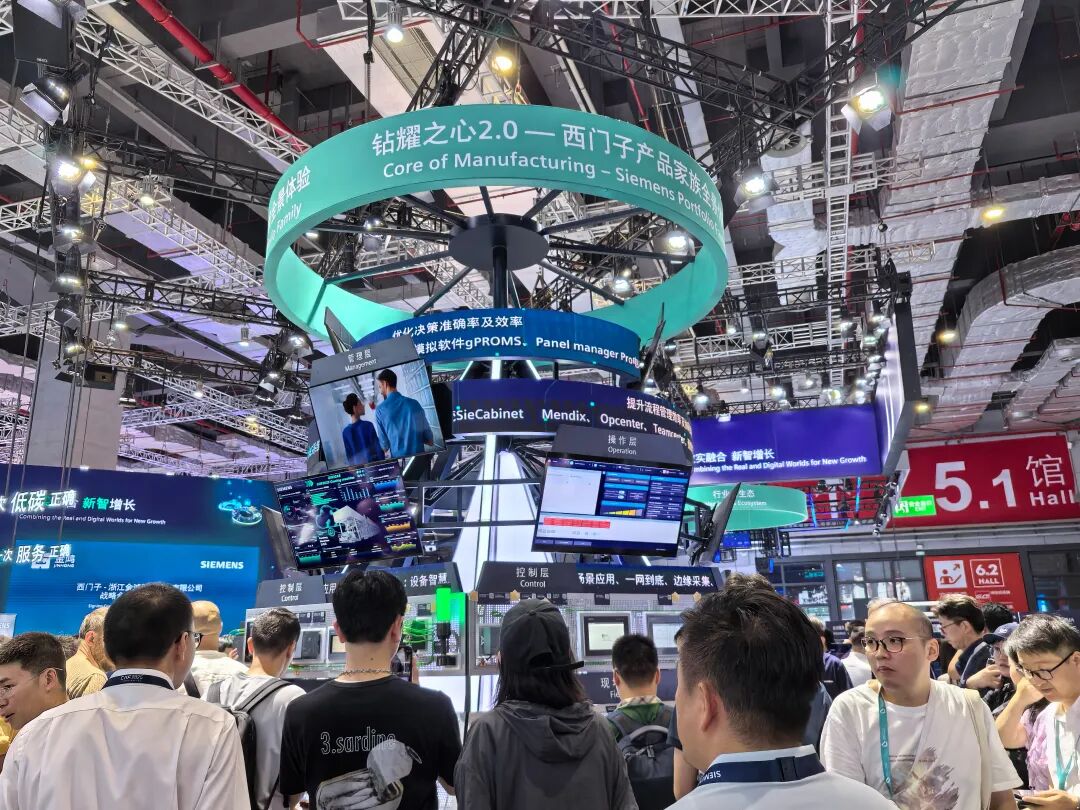
Siemens, in collaboration with Zhongke Motong, showcased a new generation of intelligent assembly equipment for electric vehicles, which became a focal point—this is the first pilot application of Siemens’ generative industrial AI assistant, Industrial Copilot, in the domestic market.
According to staff, during the equipment debugging phase, this AI assistant can assist engineers in developing automation programs, significantly reducing repetitive work. Leveraging Siemens’ standardized solutions and robot library, the program development time was shortened by 30%, the on-site debugging cycle was reduced by 30%, and labor and material waste decreased by 10%, clearly demonstrating the practical value of industrial AI in complex manufacturing scenarios.
The “super factory” platform at the Yujian Robotics booth impressed reporters. This multi-form general-purpose robot collaborative operational platform adopts a “centralized decision-making + distributed execution” architecture, with the “smart factory hub” at its core, where the “super brain” is responsible for planning and scheduling; at the execution level, humanoid robots shuttle for transport and perform precise operations, multi-legged robotic dogs patrol in complex environments, and collaborative robotic arms focus on high-precision flexible tasks, significantly enhancing production flexibility and reconstructing new paths for industrial intelligence implementation.
Bi-pedal and wheeled humanoid robots have become the “core strength” of the super factory, with Yujian’s humanoid robot DOBOT ATOM achieving the first nationwide application of industrial cross-scenario multi-task collaborative operations. It has made breakthroughs in key technologies such as human-machine action mapping and multi-modal perception, performing excellently in high-risk environments, serving as the core operator for the super factory in handling complex processes, and adapting to diverse industrial environments. Its wheeled humanoid new product ATOM-M combines dexterous operation with efficient mobility, achieving a ±10mm repeat positioning accuracy, capable of performing delicate tasks such as electronic component welding and non-destructive gripping.
Additionally, commercial solutions such as intelligent coffee robots and ice cream robots showcase Yujian’s expansion from industrial intelligence manufacturing to diverse service scenarios. A relevant person from Yujian stated that this platform aims to meet the manufacturing industry’s demand for flexible production, promoting the upgrade of robots from single tools to integrated multi-form intelligent entities capable of “perception, decision-making, and execution.”
As a long-time participant in the expo, Delta this year set up a booth of over 200 square meters featuring four major themed exhibition areas, including AI digital factories and AI data centers. Through scenario-based displays and interactions, visitors can closely experience how efficient and energy-saving technologies empower sustainable industrial development. Among them, the AI digital factory, relying on Delta’s own automation technology and manufacturing experience, creates a green intelligent manufacturing model covering logistics, production, and equipment management, integrating robots, AI, and digital twin (DIATwin) technology to achieve virtual-real integration, showcasing a factory-level green manufacturing solution; the AI data center targets future ultra-high computing power demands, integrating prefabricated, modular concepts with advanced liquid cooling technology, significantly enhancing energy efficiency and power density, laying a solid foundation for AI, HPC, and cloud computing eras.
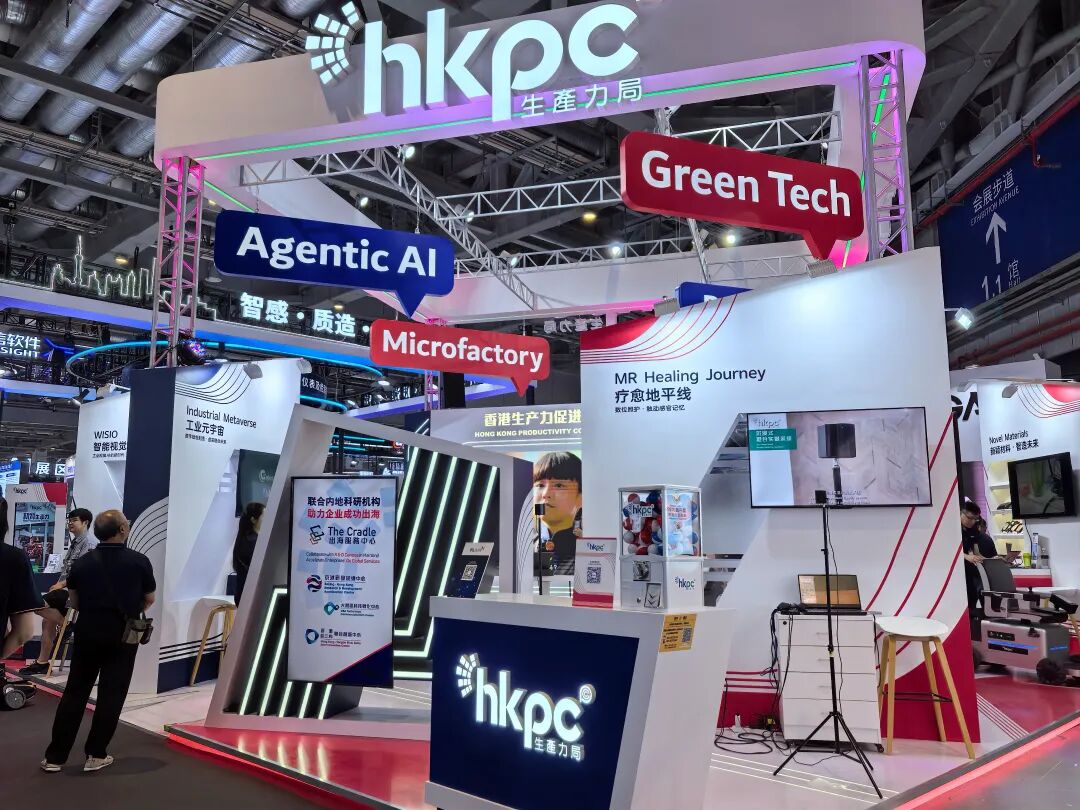
The Hong Kong Productivity Council, making its debut at the expo, also had plenty to showcase. As the only public institution from Hong Kong participating, the council not only brought AI-centered innovative technological achievements from Hong Kong but also organized a delegation of 54 Hong Kong enterprises to explore the forefront of new quality productivity with mainland companies. Among the four categories of achievements displayed, the globally leading agent-based AI technology was particularly eye-catching—the agent-based AI automation platform “Tian Gong Kai Wu” integrates real-time visual AI monitoring, RAG technology, and IoT devices, capable of creating a universal AI data management platform that empowers various industries to shorten development cycles and enhance manufacturing efficiency; the AI autonomous driving wheelchair integrates multiple cutting-edge technologies, enabling efficient barrier-free connections suitable for various scenarios such as airports and hospitals; the 3D scanning robot “Xun Zhan Bao” and industrial humanoid robots showcase human-machine collaboration solutions and capabilities for executing complex industrial tasks. A representative from the Productivity Council stated that this exhibition not only highlights Hong Kong’s industrial upgrading strength but also hopes to leverage Hong Kong’s international platform to assist in the “going global” of industries between the mainland and Hong Kong.
At the booth of Siasun, the demonstration of the RICO wheeled humanoid robot attracted many spectators—accurately grasping tea sets and steadily pouring tea, its dual-arm compliant control system allows for both flexibility and reach. Unlike traditional robotic arms that use a “hard collision” grabbing method, this robot employs flexible grasping technology, enabling it to accurately pick up objects while ensuring safety during human-machine contact, suitable for complex collaborative scenarios. Additionally, Siasun showcased various coffee robots and the “Song Yi” wheeled humanoid robot, collectively presenting the application potential of intelligent robots in diverse scenarios.
One of the “four major families” of robots, ABB Robotics, launched the OmniCore EyeMotion vision system this year, which can be mounted on all ABB robots equipped with OmniCore. By using any third-party camera or sensor, it can perceive the surrounding environment, even adapting in real-time in complex application scenarios.
“Over the past decade, we have continuously advanced AI vision technology to enable robots to ‘see’ the world through a 3D perspective, but this previously relied on specialized high-end camera hardware,” said Marc Segura, Global President of ABB Robotics. “The OmniCore EyeMotion vision system released by ABB breaks this limitation, allowing various robots to not only ‘see’ but also ‘understand’ their surroundings in 2D and 3D vision applications, significantly enhancing the autonomy and multifunctionality of robots.”
According to booth staff, compared to customized solutions, this software can reduce debugging time by up to 90%. “In more complex application scenarios, the OmniCore EyeMotion vision system can also integrate with ABB’s unique online automatic path planning technology, enabling real-time, continuous autonomous planning and execution of collision-free optimal paths while avoiding obstacles and dynamic objects without human intervention, enhancing autonomy in key tasks such as pick-and-place and reducing cycle time by 50%.”
(All images, text, and videos in this article were captured by reporter Pan Jie)
Reporter: Pan Jie
Editor: Pan Sheng
Layout: Pan Sheng