Detailed Explanation of Matlab Fitting
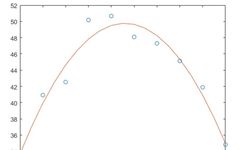
Detailed Explanation of Matlab Fitting

Polynomial Fitting clear x=1:1:10;y=-0.9*x.^2+10*x+20+rand(1,10).*5; % Generate test data plot(x,y,‘o’) % Plot and mark the original data points p=polyfit(x,y,2) p = 1×3 -0.7630 8.5343 25.9050 xi=1:0.5:10; yi=polyval(p,xi); % Calculate the fitting result hold onplot(xi,yi); % Draw the fitting result graph hold off clear x = linspace(0,4*pi,10)'; y = sin(x); p = polyfit(x,y,7); x1 = linspace(0,4*pi); y1 … Read more


C Language Algorithm – Permutation Problem

Today's algorithm problem is to solve the "permutation" algorithm using C language. Here are my algorithm ideas and implementation. Let's take a look. Algorithm Problem Given an array of integers nums without duplicate numbers, return all possible permutations. A permutation is a unique reordering of the elements in an array. Algorithm Idea To solve the … Read more

HTTP Programming in Go: Web Server and Client

HTTP Programming in Go: Web Server and Client

HTTP Programming in Go: Web Server and Client The Go language (also known as Golang) is an open-source programming language that is widely popular for its simplicity, efficiency, and support for concurrency. In this article, we will delve into how to perform HTTP programming using Go, including creating a simple web server and an HTTP … Read more

Go: Understanding and Integrating Plan 9 Assembly Language

Go: Understanding and Integrating Plan 9 Assembly Language

Go allows developers to directly use assembly language to integrate code into Go programs. This is a very powerful feature because it enables developers to optimize code and directly control hardware-level operations. Today we will learn and use the Go assembly language Plan 9, demonstrating its usage through a simple example. The go tool asm … Read more

C++ Daily Challenge Day 681

C++ Daily Challenge Day 681

Today is the 681th day of learning programming with the cool rain! Hello, everyone, this is the question from GESP. day681 GESP December 2023 Level 2 Question 2 Answer: START OF SPRING Solution #include <iostream> using namespace std; // Cool rain 666 int main() { int n, i, j; scanf("%d", &n); for(i=1; i<=(n+1)/2-1; i++) { … Read more

DSP Video Tutorial Episode 11: DSP Interpolation Algorithms and Curve Fitting

DSP Video Tutorial Episode 11: DSP Interpolation Algorithms and Curve Fitting

The DSP video tutorial hasn’t been updated for a while. Currently, the DSP library has been separated from the CMSIS software package and is being updated very frequently. Therefore, this episode of the video tutorial will first give a brief introduction to the new DSP version, and then provide a detailed introduction to the basic … Read more

Fast Fourier Transform Algorithm for 51 Microcontrollers

Fast Fourier Transform Algorithm for 51 Microcontrollers

A faster version can be found in the C language implementation of FFT and IFFT source code, which does not depend on a specific platform. The porting is very simple, does not rely on other libraries, and allows customization of the number of points. The algorithm is derived from the usage instructions of the FFT … Read more

Solving the Monkey Peach Problem with Python

1 Problem On the beach, there is a pile of peaches, and five monkeys come to share them. The first monkey divides the pile into five equal parts, but there is one left over. This monkey throws the extra one into the sea and takes one part. The second monkey divides the remaining peaches into … Read more

Daily Programming Challenge: C++ Soda Bottle Problem

Programming is a skill that is essential in many fields related to computer science and artificial intelligence. This programming ability plays an important role in both learning and work. Therefore, the beginner has decided to create a new section called “Daily Challenge,” where they will strengthen and exercise their programming skills by solving a programming … Read more

From Slow to SIMD: Discussing Go Bounds Check Elimination

From Slow to SIMD: Discussing Go Bounds Check Elimination

In the translated article from Slow to SIMD, a SourceGraph engineer discusses one optimization technique known as Bounds Check Elimination (BCE), and poses a question to the readers: “ Why use a[i:i+4:i+4] instead of a[i:i+4]? The first part of this article answers this question. The second part introduces a better method for bounds check elimination. … Read more