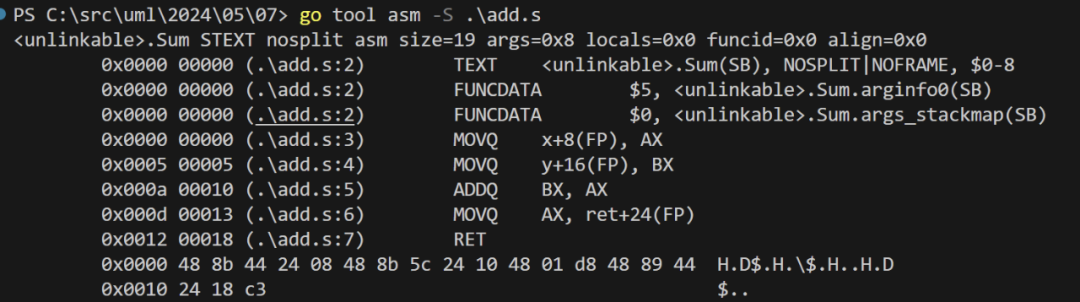
Go allows developers to directly use assembly language to integrate code into Go programs. This is a very powerful feature because it enables developers to optimize code and directly control hardware-level operations. Today we will learn and use the Go assembly language Plan 9, demonstrating its usage through a simple example. The go tool asm is an assembler tool provided by the Go language for debugging Go assembly code.
1: Understanding Plan 9 Assembly Language
Before we begin, we need to understand the basic concepts of Go assembly language. Go’s assembly language is slightly different from traditional assembly languages; it uses a style called Plan 9 assembly language, which is closer to high-level languages. However, Plan 9 assembly language is still a low-level language used to write machine code for the Plan 9 operating system. Plan 9 was developed by Bell Labs in the mid-1980s as a distributed operating system intended to succeed Unix and provide more modern and scalable features. Although Plan 9 ultimately failed to gain widespread adoption, it significantly influenced other operating systems, including Linux. The Go language has made several extensions and adjustments based on Plan 9 assembly language to support various CPU platforms. These extensions enable Go’s assembly language to run efficiently on different architectures, such as AMD64 (x86-64), ARM, ARM64, and more.

1.1 Location of Go Assembly Code
The Plan 9 assembly language used by Go is not the final assembly language; it is an intermediate representation that needs to be converted to the corresponding assembly language for the CPU platform to be directly executed by the CPU. The Go compiler uses Plan 9 assembly language as an intermediate representation because it has the following advantages:
-
Portability: Plan 9 assembly language is a relatively universal assembly language that can be ported to different CPU platforms. This allows Go code to run on various platforms.
-
Simplicity: Plan 9 assembly language is simpler and more readable than machine code, making Go code easier to understand and maintain.
During the Go compilation process, Plan 9 assembly code is converted into machine code for the corresponding CPU platform. This process is called assembly. The assembler translates the instructions in the Plan 9 assembly code into corresponding machine code instructions based on the architecture and instruction set of the target CPU.
For example, on the x86-64 platform, the Go compiler converts Plan 9 assembly code into x86-64 assembly code. The x86-64 assembly code consists of instructions that the CPU can execute directly.
Here is a simplified illustration of the Go compilation process:
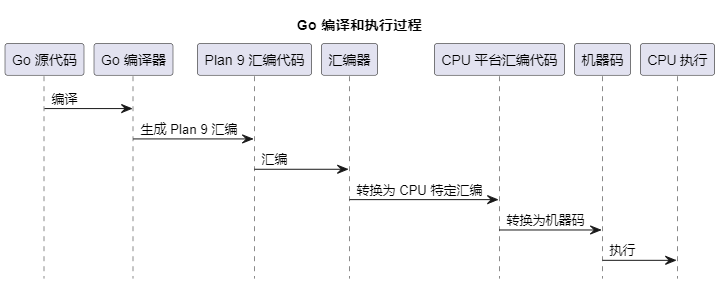
In summary, the Go language uses Plan 9 assembly language as an intermediate representation, which can improve the portability and simplicity of Go code. In actual execution, Plan 9 assembly code is converted into machine code for the corresponding CPU platform to be executed directly by the CPU.
2: The Significance of Integrating Plan 9 Assembly Language into Go
Integrating assembly language into Go programs is particularly important for performance optimization. Generally, assembly code is used to implement low-level system operations, optimize specific algorithms, or handle performance-sensitive tasks. The main advantages of using assembly language in Go programs are typically reflected in the following aspects:
2.1 Direct Hardware Operations
Assembly language provides the ability to directly manipulate hardware, which means precise control over hardware-level behaviors, such as CPU instruction flow and memory access patterns. This fine control is very valuable in scenarios requiring extreme performance (e.g., real-time systems, high-frequency trading, scientific computing).
2.2 Optimizing Specific Algorithms
Certain algorithms can be optimized using specialized instruction sets (such as SIMD instruction sets), and these optimizations are typically only achievable through assembly language. For example, algorithms in areas like encryption, compression, and image processing can achieve significant performance improvements through assembly language.
2.3 Avoiding Overheads of High-Level Languages
High-level languages like Go offer greater programming convenience and safety but also introduce some performance overheads, such as garbage collection and object abstraction. In extremely performance-sensitive applications, these overheads may be unacceptable. Using assembly language allows complete control over memory management and processing flow, thereby avoiding these overheads.
2.4 System-Level Operations
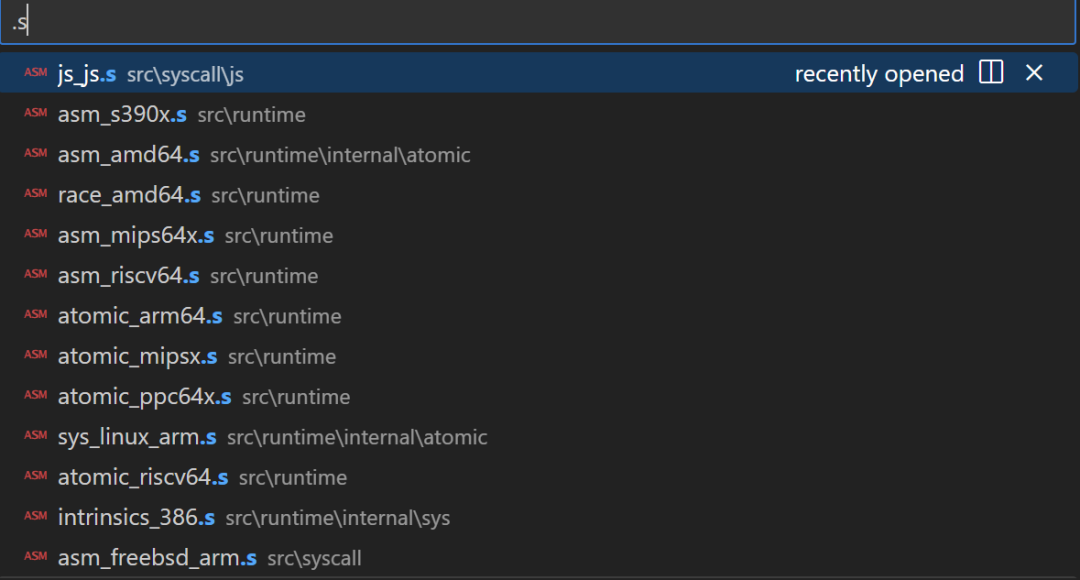
Assembly language is often used for executing low-level system tasks, such as operating system kernels and driver development. These tasks require a high degree of control and direct access to hardware, which high-level languages may find difficult or impossible to provide. Some low-level system calls and memory allocations in Go’s standard library are implemented in assembly language.
In conclusion, when integrating assembly language into Go programs, if used correctly, it can retain its performance advantages, especially in scenarios requiring tight control over hardware, optimizing specific algorithms, or handling high-performance tasks. However, this integration must ensure the correctness and safety of the assembly code, as erroneous assembly code may lead to program crashes or security issues.
The use of assembly language should target specific performance bottlenecks or technical requirements. For most everyday application development, high-level languages already provide sufficient performance while delivering better safety and maintainability. When deciding whether to integrate assembly code into Go programs, careful evaluation of the balance between performance gains and development and maintenance costs is necessary.
3: The Impact of Integrating Assembly Code
Integrating assembly code into Go language will affect cross-platform compilation. Although Go itself is very suitable for cross-platform development, as it can be easily compiled and run on different operating systems and hardware platforms, the situation becomes more complex when we introduce assembly code.
3.1 Compatibility Issues with Assembly Language and Platforms
3.1.1. Platform-Specific Assembly Code:
-
Although Plan 9 assembly language has a unified syntax, the specific assembly instructions and register operations differ across platforms (e.g., AMD64, ARM, MIPS).
-
Each architecture requires specific assembly code tailored for that architecture. This means that if our Go program includes Plan 9 assembly language, we need to provide corresponding assembly code versions for each target platform.
3.1.2. Impact on Cross-Platform Compilation:
-
When the Go program only uses Go code, we can easily cross-compile to other platforms from any supported operating system.
-
However, if the program contains platform-specific assembly code, we need to prepare and maintain different versions of assembly code for each target platform, significantly increasing the complexity of cross-platform compilation.
3.1.3. Maintenance Costs:
-
Maintaining assembly code across multiple platforms increases the difficulty of development and maintenance, especially when dealing with low-level hardware features, leading to a higher chance of errors and requiring greater assembly language proficiency from developers.
3.2 Solutions
If it is necessary to use assembly in Go programs to improve performance or access low-level system features, the following strategies are recommended:
-
Conditional Compilation: Go supports conditional compilation directives, allowing different code to be included based on the compilation target platform. This can be achieved through file name suffixes (e.g.,
_amd64.s,_arm.s) or using// +builddirectives. -
Platform Abstraction: Where possible, create an abstraction layer for assembly code, using pure Go code for platforms that do not require extreme performance optimization, while only using assembly code on critical platforms.
-
Third-Party Libraries: Consider using third-party libraries that have already addressed cross-platform issues; these libraries may have optimized implementations for different platforms.
While Plan 9 assembly language provides Go with powerful performance optimization capabilities and hardware-level access, it indeed increases the complexity of cross-platform development. When deciding whether to use assembly language in our Go projects, it is essential to weigh the relationship between performance advantages and maintenance and development costs, especially when supporting multiple hardware platforms.
4: Writing Assembly Code
Next, we will write a simple assembly program that performs addition. First, create an assembly file named add.s:
asm
// add.s
TEXT ·Sum(SB), $0-8
    MOVQ x+0(FP), AX  // Move the first parameter x into AX
    MOVQ y+8(FP), BX  // Move the second parameter y into BX
    ADDQ BX, AX       // Add BX to AX
    MOVQ AX, ret+16(FP)  // Move the result from AX to the return value location
    RET               // Return
Then, we need a Go language file to call this assembly function. Create a file named main.go:
go
package main

import "fmt"

func main() {
    x := 10
    y := 20
    sum := Sum(x, y)
    fmt.Println("Sum:", sum)
}

//go:noescape
func Sum(x, y int) int
4.1 Compiling and Running
Now we can compile and run our program. Enter the following command in the command line:
bash
go build
./add
If everything is set up correctly, the program will output Sum: 30.

Through this simple example, we can see the combination of assembly language with Go language, enabling low-level system-level programming. This provides great flexibility and control for performance optimization and hardware-level operations.