After the delivery of a previous design project, due to an operational error by the on-site debugging personnel, the exposed wire ends touched the circuit board (which was coated with a conformal coating) when the rear panel of the device was removed, ultimately causing a short circuit. The feedback from the site indicated that the microcontroller was not functioning, and a ‘ticking’ sound was heard from the circuit board when it was powered on.
The tense troubleshooting began…
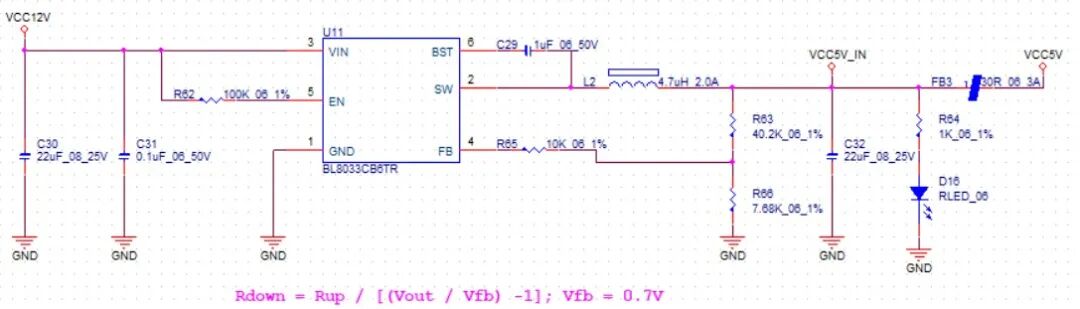
Power Supply Schematic
The power supply uses the BL8033 synchronous buck switching power supply. The maximum input is 16V, maximum output is 3A, and efficiency reaches up to 96%.
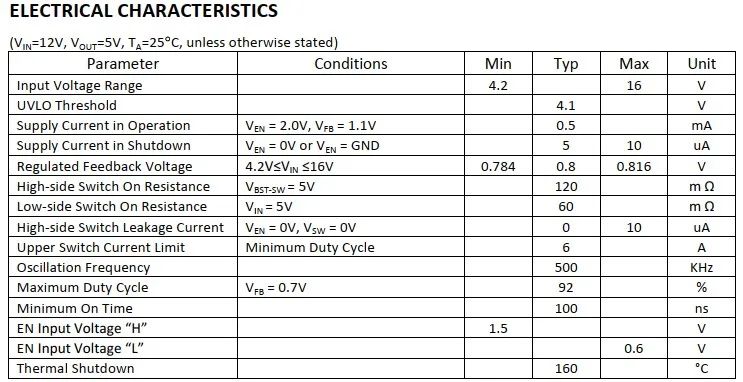
Electrical Characteristics of BL8033
According to the feedback, the ‘ticking’ sound on the circuit board was caused by the short circuit. Knowing this issue, it can be basically located that the sound occurs near the power supply, and further analysis can confirm that it comes from the inductor. So why does the power supply cause the inductor to make a ‘ticking’ sound when a load short circuit occurs? Let’s analyze it below.
Why does the inductor squeal?
1. High-power switching power supply short circuit squeal.When the switching power supply is operating at full load, if the power supply is suddenly short-circuited, a squeal may sometimes be heard; or when setting current protection, a squeal may occur when the current is adjusted to a certain level. The reason is that when the load approaches the output power limit of the power supply, the switching transformer operates in a non-steady state.
In the first cycle, due to the excessive duty cycle of the switch tube, the conduction time is too long, resulting in excessive energy being transmitted to the subsequent stage through the transformer; the energy storage inductor of the DC rectification circuit cannot completely release the energy stored in the first cycle within the second cycle; when the third cycle arrives, the power supply chip will not allow the switch tube to conduct, or the duty cycle of the switch tube is very small.
Thus, the energy stored in the energy storage inductor is released during the second and third cycles, leading to a decrease in output voltage. Therefore, when the fourth cycle arrives, the power supply chip will drive the switch tube to conduct with a large duty cycle, and this cycle will cause the transformer to produce low-frequency vibrations, resulting in a sound audible to the human ear.
When the power supply operates in a non-steady state, the output ripple voltage is also much larger than when operating in a normal state. When the number of cycles in which the switch tube is fully off reaches a certain proportion of the total cycles, the switching frequency of the power supply shifts from the high-frequency range to the audio frequency range, thus producing a sharp squeal. At this point, the transformer is already in a severely overloaded state and may burn out at any time.
2. Under no load or very light load, the switch tube may also exhibit intermittent fully off cycles. When the proportion of fully off cycles reaches a certain level, the switching frequency of the power supply shifts from the high-frequency range to the audio frequency range, thus producing a sharp squeal.
Additionally, in no-load or light-load scenarios, the back electromotive force generated by the transformer cannot be well absorbed, leading to many noise signals coupling into the primary and secondary windings of the transformer. When the low-frequency components of these noise signals coincide with the inherent oscillation frequency of the transformer, resonance occurs. To avoid the resonant frequency falling into the audio range and producing squeal, a selective frequency circuit can be added to the circuit to filter out low-frequency components.
3. Poor transformer potting, including no potting treatment. When the transformer is poorly potted, although the load capacity is generally not affected, it will produce squeal, and the output waveform will have spikes. It should be noted that poor transformer design may also cause squeal due to vibrations during operation.
4. Poor grounding of the primary voltage regulator chip.Poor grounding often manifests as intermittent faults (some products work normally while others fail). The fault phenomenon is an inability to carry load, or even unable to oscillate. At this time, squeal is often accompanied.
5. Grounding error of the secondary voltage regulator chip.The grounding of the reference voltage regulator chip on the secondary side of the transformer has similar requirements to that of the primary voltage regulator chip: it should not be directly connected to the cold ground or hot ground of the transformer. If connected together, it will lead to a decrease in load capacity and produce squeal. The larger the load, the more pronounced the squeal.
After locating the cause of the squeal, how to resolve the short circuit?
1. If hardware conditions permit, the channel between the power supply output and the load can be disconnected. In the power supply designed above, a “FB3” ferrite bead is used, so excluding the power supply short circuit is very convenient;
2. Check the configuration parameters of the power supply, then re-power the power supply to ensure the output meets design requirements;
3. If the power supply issue is ruled out but the short circuit phenomenon still exists, then the subsequent load needs to be analyzed to determine which component caused the short circuit (ultimately locating the microcontroller short circuit);
4. To eliminate the load short circuit, I generally start from small components to large components that are easy to solder, removing one point and measuring one point, and the removed chips themselves should also be measured.
5. Pay attention to the solder balls on the board (soldering residues);
Why does a short circuit still occur despite the application of conformal coating?
The conformal coating primarily protects against: mold, moisture, and salt spray.Therefore, it cannot effectively prevent short circuits. Many components on the PCB generate heat during operation, and if conformal coating is applied, it will significantly hinder the heat dissipation of the components. Additionally, the fact that connectors on the board cannot be coated increases the risk of short circuits.
Of course, this PCB short circuit incident should not have occurred. Due to the complexity of the on-site debugging environment and the carelessness of the debugging personnel, this low-level issue ultimately arose.
Disclaimer:This article’s material is sourced from the internet, and the copyright belongs to the original author. If there are any copyright issues, please contact me for removal.
 |
Sharing electronic-related technical articles, news, and communication meetings Subtle progress every day Gathering electronic technology |