
Click the blue text above to follow us

When setting up the wireless network in the router’s backend, you often find two WiFi signals: 2.4G and 5G.
So, what are the differences between 2.4G and 5G signals? Which one is better and faster?
Today, we will explain the differences between WiFi 2.4G and 5G.


What Does WiFi 5G Network Mean?
Traditional wireless routers only have one 2.4G frequency WiFi signal, while dual-band routers, such as the 360 Home Firewall 5S and 5 series, have both a 2.4G frequency WiFi signal and a 5G frequency WiFi signal.
So, what are the features of WiFi 5G?
1. 5G Has Less Interference and Stable Signal
Wireless interference mainly exists in three aspects: interference between wireless channels, same-frequency interference from other applications in the frequency band, and interference from devices that support wireless frequency bands.
Firstly, the interference between wireless channels: The 2.4G working frequency range is 2400-2483.5MHz, with each channel occupying about 20M, dividing 2.4G into 11/13 channels (depending on national standards). Interference and overlap between channels are inevitable, leading to instability in wireless connections. Let’s refer to a diagram to see the interference caused by overlapping 2.4G channels.
On the other hand, the 5G working frequency range is 5150MHz-5825MHz. This larger frequency range allows for 13 non-overlapping channels (with channels 100-140 unavailable), providing greater scalability and flexibility for 5G. The independence of adjacent channels is also one of the key factors that ensure its interference-free operation.

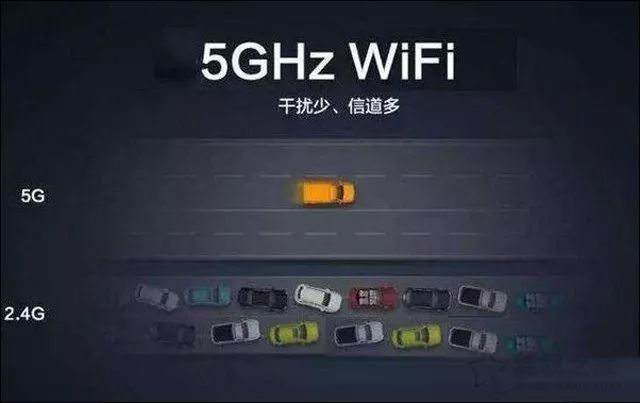
Secondly, in terms of application areas, the 2.4G working frequency band is used not only by wireless routers but also by Bluetooth, cordless phones, RFID, wireless data transmission, microwaves, and many medical RF devices. Therefore, this frequency band is prone to interference. Currently, the 5G band is only used for satellite radio measurement services and satellite fixed services, which do not involve daily household use, making the 5G frequency band a relatively clean environment, less prone to interference compared to the 2.4G band.
Lastly, according to incomplete statistics, 85% of Wi-Fi clients currently operate on the 2.4G band. This indicates that with so many devices interfering with each other, how can the 2.4G band maintain stability?
Compared to the 2.4G band, the 5G band WiFi, with its less channel interference, fewer application conflicts, and lower usage, allows you to enjoy a wired-like experience of speed even when surrounded by a sea of 2.4G wireless signals!
2. 5G Has Fast Transmission and Ultimate Experience
The router is not just an internet device; with the development of smart homes, the router plays a core role similar to a computer CPU, facilitating file transfers and video sharing within the home network.
Wireless transmission speed is a very important metric for evaluating home networks.
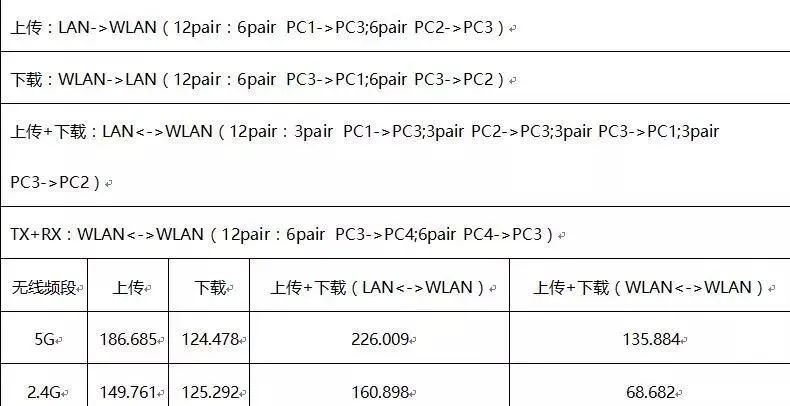
5G significantly improves wireless transmission rates through various underlying coding, channel bandwidth, and spatial streams, achieving nearly double the speed compared to 2.4G. In practical tests, the speed of 5G wireless transmission is about 40% faster than 2.4G when transmitting from wired to wireless, and nearly double when transmitting wirelessly.
The chart below shows the actual throughput data of the router:
Summary: Comparison of Advantages and Disadvantages of 2.4G VS 5G WiFi:
Advantages of 2.4G WiFi:
The 2.4G signal frequency is low, which results in less attenuation when propagating through air or obstacles, allowing for a longer transmission distance.
Disadvantages of 2.4G WiFi:
Currently, most devices use the 2.4G frequency band, leading to significant interference in crowded areas.
Advantages of 5G WiFi:
5G has a wider frequency bandwidth, a cleaner wireless environment with less interference, stable speeds, and can support higher wireless rates.
Disadvantages of 5G WiFi:
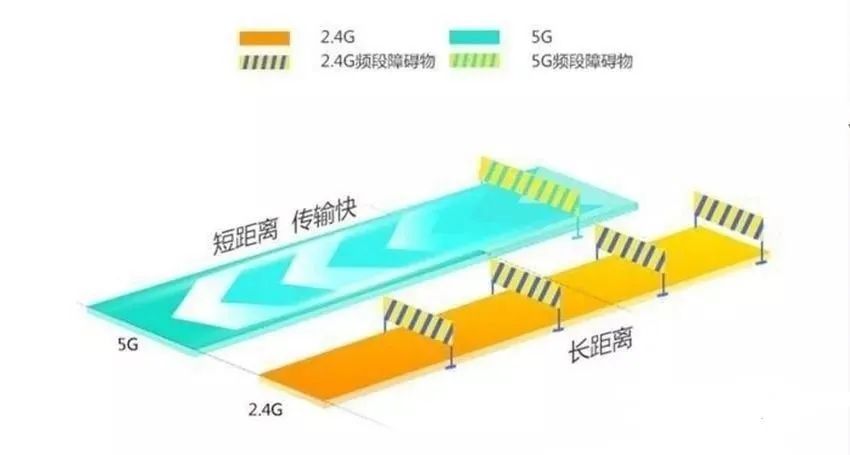
The 5G signal frequency is higher, leading to greater attenuation when propagating through air or obstacles, resulting in a slightly shorter coverage distance compared to 2.4G signals.

Which Signal Is Better for Users: 2.4G or 5G?
WiFi signals are transmitted through radio waves, with 2.4G and 5G being two different frequency bands. The WiFi signal is transmitted within these bands. The 5G frequency band has a higher frequency, carries more data, and currently has less application, resulting in lower interference, making it more effective, but with a shorter transmission distance.
If you move around a lot, it is recommended to connect to the regular 2.4G WiFi. If you are close to a dual-band router, it is advisable to use 5G WiFi for a more stable signal and faster speeds.
In summary, 5G WiFi is generally preferred.

Content compiled from the internet
 END
END