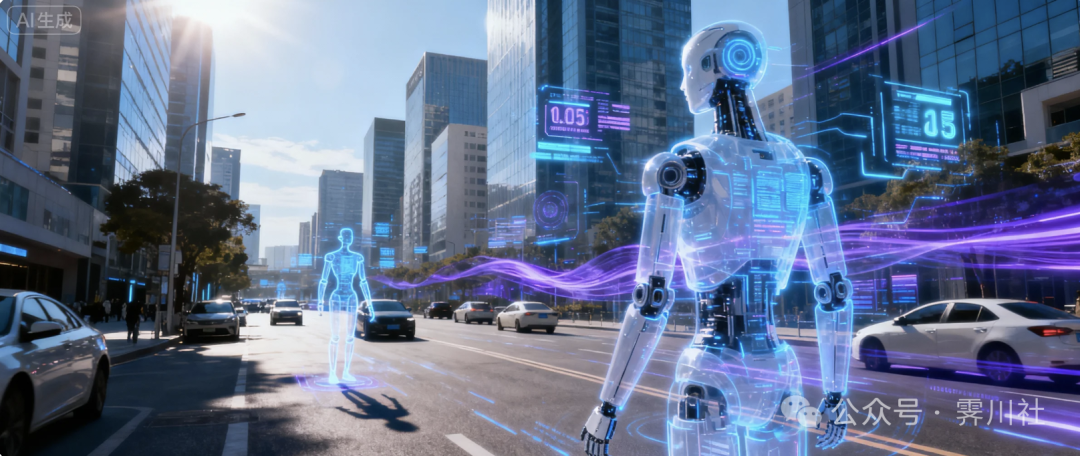
As Boston Dynamics’ robots autonomously transport goods in warehouses, as AI doctors complete thousands of imaging diagnoses in a day, and as it becomes difficult to distinguish between a real person and a machine on the other end of a customer service call — we are standing at or about to reach a critical point: AI and robots will take over almost all repetitive, procedural tasks, and those jobs that seem creative but lack uniqueness.
Walking on the streets of the city, the physical world operates as usual, calm and serene, but my body feels as if it stands at the intersection of the physical and digital worlds, sensing the calm before the storm. In the next 3 to 5 years, our lives and work will undergo earth-shattering changes due to AI.
In this transformation, the harsh reality is that the occupational structure of future society will be severely polarized — a large group of people will gradually be eliminated by the times; you will either be “useful” or “useless”.
We do not even need to wait for the arrival of true AGI; the latest AI large models like Gemini and Claude, along with embodied intelligence from companies like Tesla and Yushutech, are enough to show us the future forms of society and enterprises. Apart from governments and non-profit organizations, only three types of organizations will thrive at the center of the times; those not included will become the “useless class”.
First type: Creators of “gods” — the era’s creators who master the core technologies of AI.
They are the “Prometheus” of the new era, personally igniting the spark of the intelligent age.
This type of organization drives the iterative upgrades of AI architectures like large language models, establishing the “perception-decision-control loop” for robots, connecting the digital world with the physical world. They will become the platforms on which the efficient operation of society relies, providing computing power, algorithmic infrastructure, and even redefining people’s habits and moral codes.
Specifically, they provide GPU/TPU and data centers, offer general and industry-specific AI large models, tools, and intelligent agent platforms, and provide various forms of highly intelligent robots… including the upcoming quantum computing. When the core algorithms, computing power, and data encounter bottlenecks, the thirst for growth will drive them to shift from general capabilities to industry-specific capabilities, providing scenario-based solutions that will force other enterprises to either shut down or become subservient. The key to the development of this type of organization is leading computing power and algorithms. Data is also important, but I believe it will no longer be the key differentiating factor determining the level of intelligence in the future.
High-value talents in this type of organization need to have solid mathematical, algorithmic, and engineering skills, along with a curiosity about the essence of intelligence. These individuals do not just write code; they define the boundaries of “intelligence”, determining what AI can do, cannot do, and even what it “should” do.
Such talents will become the new tech elites of the coming decades, respected and well-paid, but also under great pressure. AI technology will not be monopolized by any one company; the result of full competition is “intense competition”. Just days after the launch of Gemini 3, Claude Opus 4.5 has already stolen the spotlight; Google’s CEO has just proposed to double computing power every six months, achieving a 1000 times increase in computing power over ten years. No one can rest easy on their laurels.
Second type: Operators of “tools” — large-scale production operators who control capital and resources.
AI and robots are tools, while they hold land, factories, energy, channels, and capital, enabling tools to be deployed on a large scale in the physical world.
This type of organization spans various industries, from large-scale mechanized agriculture, dark factories, intelligent logistics networks, unmanned hotels to autonomous taxis. In the future, any work that can be controlled by algorithms and completed by intelligent robots will inevitably be replaced by machines, a trend that is not subject to human will.
Although this type of organization does not master the secrets of intelligence, they possess capital and resources, are familiar with industry know-how, and are adept at integration and operation. Their operational methods will be thoroughly digitized. In the past, to achieve production scale, the number of employees would accelerate growth; the more people there were, the harder it became to manage, and the average efficiency decreased, with management costs limiting business scale. In the future, when many tasks can be completed by only a few people, the management will involve a robot army controlled by systems, easily breaking through current bottlenecks. The endgame is that each industry will ultimately form a few super-large oligopolies and chains, similar to the current layout of the internet industry. The key to the development of this type of organization is now only: capital and the resources they possess.
In this type of organization, apart from a small group responsible for customizing digitized solutions based on general AI capabilities, such as deploying AI capabilities, tuning models, governing data, and developing agents, most others need to be adept at applying AI technology to daily operational activities, possessing judgment and execution skills. For example, generating 100 marketing copies with AI, selecting the one that best fits the brand tone and attracts attention; monitoring thousands of robots at work, identifying risks from production data; and also including so-called “AI aftermath engineers”, who judge the code generated by AI, correct issues, and prevent loss of control. In the future, most young people will work in this type of organization; as long as they are good at learning and become proficient users of AI, they can have a relatively stable but not very interesting career.
Surrounding this type of organization, there may also be a group of suppliers providing digitized solutions, but I believe they will struggle to survive because, in the intelligent age, what matters is no longer the fixed processes embedded in systems, but data. With the support of low-code platforms and AI, the output of a team of hundreds will soon be achievable by a small group of ten.
Third type: Creators of “value” — individuals and small teams providing personalized value.
As mass production and standardized services are taken over by robots, human emotions, aesthetics, stories, and unique experiences will become luxuries.
For example, content creators using AI to assist in music and video creation; therapists and coaches providing deep companionship and customized experiences; artisans using AI design and robotic precision processing… also including experts and consultants solving problems for enterprises and providing personalized services. This type of talent needs to possess a unique worldview and expression, deep empathy, and connection abilities, and be adept at using AI to amplify creativity and improve creation efficiency.
In an era where AI is ubiquitous, productivity will be extremely advanced; in the future, the most expensive thing will not be “efficiency”, but “meaning”. When machines can write 1000 qualified songs, people will still be willing to pay for that song that “sings my heartbreak”. The truly decisive factors here are “creativity and uniqueness”.
This type of creative work will no longer require large organizations; more and more will come from individuals and small teams. On the contrary, large organizations may become obstacles to creative work. When trying to create something “interesting”, one must first persuade others and seek compromise, which has never been a good environment for continuous creativity. Even today, in a company, only a few individuals truly possess insight and creativity, while the vast majority are merely executing. What clients truly need is unique value, and they should not have to pay for the operational costs of large organizations.
Film production is a great example; in the past, limited by productivity, large teams were needed to bring ideas to fruition. Today, we can foresee that with the maturity of multimodal AI technology, a small team will soon be able to create a high-quality, interesting long video.
Giving rise to a large-scale “useless class” or “low-value group”
The revolution brought by general AI technology is fundamentally different from previous industrial revolutions: each technological advancement in the past enhanced the productivity of the physical world, while the revolution brought by AI technology significantly enhances the productivity of the information world, which is precisely the responsibility of the human brain.
Whether we are willing to accept it or not, AI and intelligent robots are a new species created by humans that can imitate us and even surpass us in many ways.
Let us consider a fundamental logic: within the resource limits that the Earth can bear, the supply needed by human society is determined by demand. A fixed population size determines an upper limit on demand, which also determines the required production scale; anything beyond that is waste. So, when AI and highly intelligent robots can replace most production, why do we still need so many people to work?
The conclusion is obvious: as AI and robotics technology develop, more and more people will be pushed out of their current jobs, unable to find work, especially those who:
-
Only follow instructions and execute processes, both white-collar and blue-collar workers
-
Traditional managers lacking sufficient technical understanding
-
Experts who reject AI and cling to old working methods
-
The majority who do not continue to learn and lack independent thinking
In the era of AI+ and robotics, “effort” no longer equals “usefulness”, because when it comes to effort, machines can work tirelessly.
So what will happen to this large number of “useless class”?
Some may join the large group of “flexible workers”. In recent years, the flexible labor market has been growing, and by 2025, the number of flexible workers in China is expected to reach 280 million, accounting for one-third of the total labor force, and this proportion will likely increase in the future. They will participate in unstable human services, temporary drivers, nannies, or construction workers, as robots still have a long way to go to achieve 100% perfect replacement of humans; some companies may still need skilled outsourced workers for AI supervision and aftermath work. Although there will be job opportunities, stability will be poor, income will fluctuate greatly, and jobs may be lost at any time due to market demand changes or technological updates.
Furthermore, the rules of social wealth distribution will undergo significant changes. Enterprises will be able to create much greater social value with fewer people, leading to two outcomes:
-
Product and service prices will drop significantly, allowing for affordability with less income (though some goods are limited by raw material and transportation costs, leaving limited room for price reduction)
-
The state will impose higher income taxes on enterprises and their high-income employees to ensure welfare for low-income groups
There will inevitably be more and more people who have to “lie flat”. For ordinary people like us, to avoid becoming part of the “useless class”, the most important thing is to possess the meta-abilities of continuous learning and independent thinking; otherwise, it will be difficult to escape the fate of marginalization.
Lastly, there will also be a fourth type of active organization: “public service providers”, typically governments and non-profit organizations. They are not producers of social productivity but serve the first three types of organizations and the marginalized “useless class”, continuing to play a unique social value in the future AI era. AI cannot fully replace jobs that rely heavily on situational judgment and value weighing, such as policy-making, ethical review, community mediation, and crisis intervention.
The future is coming, but it is unevenly distributed. Have we all thought clearly about what type of person we want to become in the future? What type of work can we engage in? How do we build our own career moat?