In the context of the rapid development of smart terminals, the Internet of Things, and security devices, traditional mainstream #RTOS requires significant effort in multi-platform porting, protocol stacks, and security. The future direction of real-time operating systems is towards being more reliable, modern, and secure. Among these, the RA Series MCU + Zephyr may be a solution that aligns better with development trends.
1
What is Zephyr?

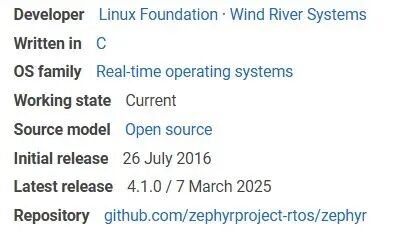
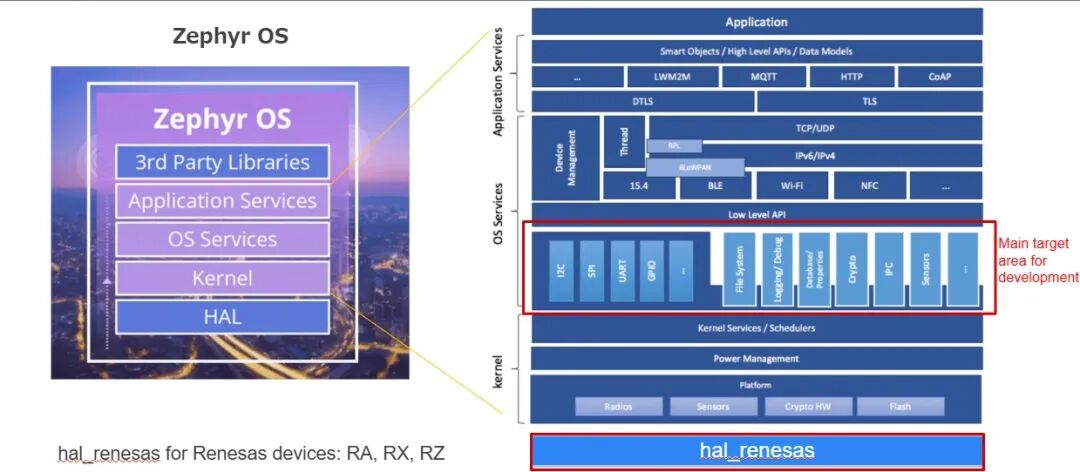
#Zephyr is an open-source real-time operating system (RTOS) led by the Linux Foundation, designed specifically for embedded devices. The biggest difference from traditional RTOS is that Zephyr is not just a scheduling kernel but a complete embedded software open-source platform. This allows it to provide a convenient and portable one-stop solution, with unique advantages in its ecosystem, attracting more and more developers and companies.
Click to view the full image
2
Features of Zephyr

1. Unified Cross-Platform RTOS
A single Zephyr kernel supports multiple MCU architectures, including ARM (Cortex-M, Cortex-R, Cortex-A), x86, RISC-V, ARC, Xtensa, etc. This allows application developers to focus solely on implementing application layer code without repeatedly porting code drivers for different hardware.
2. Fully Integrated Functionality
It comes with a driver framework, file system, and network protocol stack (TCP/IP, Bluetooth, LoRa, Zigbee), security components, etc., enabling most application functionality without relying on other external middleware or software.
3. Modular and Highly Configurable
Zephyr’s modular design allows developers to include or trim system components based on project needs, optimizing resource usage. Its footprint is very small, making it suitable for resource-constrained devices. Developers can also configure the system through #Kconfig and #Devicetree, defining required resources and modules at compile time, expanding the complex functionalities they need.
4. Security Features
Zephyr provides thread isolation, memory protection, and user space support, enhancing system stability and security. These mechanisms are relatively rare in traditional mainstream RTOS, making Zephyr more suitable for applications with high security requirements.
5. Open Source and Active Community Ecosystem
As an open-source software, users can freely modify and share, making it a good choice for those needing a customizable RTOS or integrating it with other open-source software. Additionally, backed by the Linux Foundation, Zephyr has one of the most active contributor communities, with abundant resources and support.
3
Unique Advantages of RA Series MCU + Zephyr

1. Ultra-Low Power Consumption, Energy Efficiency
The RA family features extremely low core power consumption, such as RA6M4 and RA6M5, with core power consumption as low as approximately 99µA/MHz (200MHz) and 107µA/MHz (200MHz) during CoreMark benchmark tests. The RA0/RA2 series can further reduce to 64µA/MHz, with standby power consumption as low as 0.2µA, making it ideal for battery-powered, wearable, and remote sensing scenarios.
The Zephyr kernel natively supports tick-less mode and dynamic voltage frequency adjustment (VDD control), which aligns well with the RA MCU’s fast wake-up mechanism (30µs), achieving sub-millisecond response while maintaining the lowest standby power consumption. The RA + Zephyr dual ecosystem means that complex protocol stacks or sensing applications can run under constrained resources without the need for additional external managers.
2. Rich Interfaces, Easy Direct Connection
The RA series optionally integrates communication interfaces such as BLE, USB (FS/HS), CAN/CAN-FD, Ethernet, etc. Zephyr provides a unified calling interface through its native protocol stacks (TCP/IPv4/IPv6, MQTT, CoAP, LwM2M, Bluetooth LE (Host+Controller), CAN-FD, etc.). This tight integration from hardware to software ecosystem allows developers to avoid introducing third-party stacks or adaptation layers, enabling efficient and easy communication from the bottom layer to the cloud.
3. Hardcore Security, No External Dependencies
The RA6 and RA8 series both feature built-in Arm-TrustZone and Renesas SCE9 security encryption engines, supporting AES/GCM, SHA/HMAC, ECC/DSA, TRNG, etc., and are equipped with independent RAM as a key storage area, ensuring that keys cannot be leaked, even if the bus is bypassed for sniffing.
Zephyr has integrated PSA Crypto API and platform-compatible MCUboot bootloader, combined with RA’s #TrustZone hardware isolation support, to achieve image signature verification, chain root-of-trust, OTA secure upgrades, and more. The entire security chain from BOOT to application sandbox and key management system can be “soft and hard integrated”.
4. Official Support, Moving Towards the Future
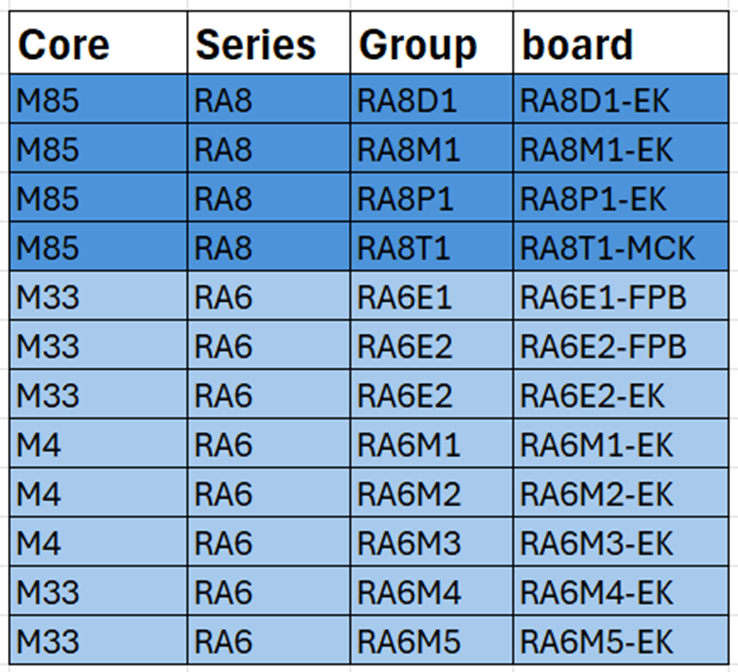
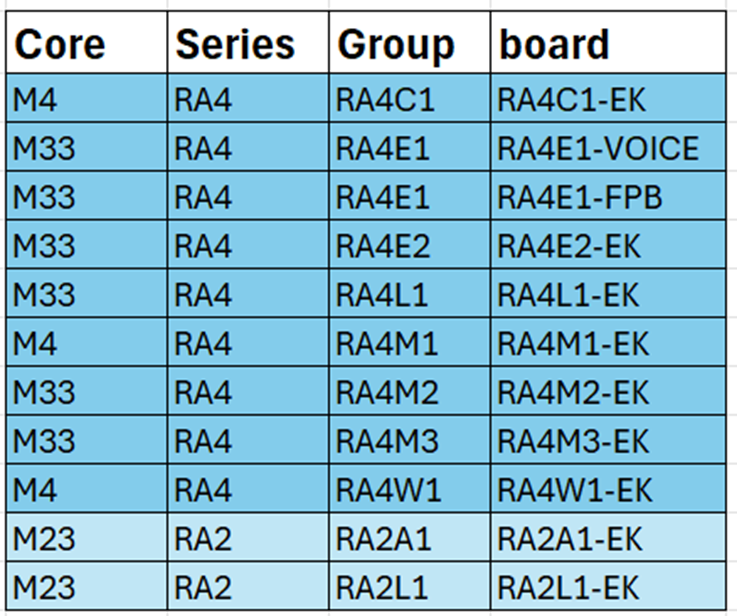
Renesas is a platinum member of the Zephyr project, supporting RA, RX MCU, and RZ MPU series devices and development boards. For the RA series, a software development kit (SDK) is provided for almost all mainstream products, along with reusable hardware design (HWIP) support for different mainstream application scenarios of the RA series:
RA4 Series representative boards such as RA4E1 have stable drivers implemented for core peripherals like GPIO, UART, SPI, I²C, PWM, ADC, DAC, making them suitable for basic control and low-power applications.
RA6 Series
such as RA6M5 further introduces Ethernet MAC drivers, supporting USB Full-Speed, achieving basic network communication capabilities, aiding industrial Ethernet and IoT nodes.
For the RA8 Series, Zephyr expands support for high-speed USB Host/Device, GMAC Ethernet, CAN-FD, Octo-SPI external flash, graphics display controllers, and other complex peripherals, meeting the growing demands for high-performance graphical interfaces and industrial communication.

Swipe left and right to see more

For the latest software and hardware support information, you can scan the QR code below or copy the link into your browser to view.
Renesas RA Zephyr Support · renesas/zephyr Wiki · GitHub
https://github.com/renesas/zephyr/wiki/Renesas-RA-Zephyr-Support

In the future, as the RA series hardware continues to upgrade, Renesas will continue to provide broader and more comprehensive support for Zephyr, continuously promoting the deep integration of software and hardware, bringing more flexible and efficient embedded operating system solutions to the fields of smart terminals, industrial IoT, and security devices, creating a unique ecosystem for Renesas + Zephyr.
Click to view the full image
Of course, developers are welcome to participate in the ecosystem construction with Renesas and the Zephyr community, discussing and solving the issues faced together, and benefiting from the development of Zephyr!
4
Getting Started with Zephyr

Due to the unique architecture of Zephyr, it cannot be directly compiled and developed in a single integrated development environment (IDE) like other RTOS.
Zephyr development is based on a command-line build system using West + CMake + Ninja + toolchain (available in Powershell, VScode), and unifies hardware description and functional configuration through device trees (Devicetree) and Kconfig, similar to the development approach of the Linux kernel, emphasizing cross-platform and modularity, allowing seamless migration of projects across various MCU and operating system environments.
This development approach may not be friendly for developers who have never encountered Linux before. Therefore, Renesas provides a quick start video, enabling even beginners to quickly set up their Zephyr projects and achieve a “Hello World” output.
The link is as follows; you can scan the QR code below or copy the link into your browser to view.
Zephyr RTOS | Renesas Electronics
https://www.renesas.cn/zh/products/microcontrollers-microprocessors/ra-cortex-m-mcus/ra-partners/zephyr-rtos?queryID=366270c388df49d34eb81d8c41b08875#videos_training

In addition, developers can also follow the official guidance from Zephyr to start their exploration journey.
The link is as follows; you can scan the QR code below or copy the link into your browser to view.
Getting Started Guide — Zephyr Project Documentation
https://docs.zephyrproject.org/latest/develop/getting_started/index.html



Need Technical Support?
If you have any questions while using Renesas MCU/MPU products, you can scan the QR code below or copy the URL into your browser to enter the Renesas Technical Forum to find answers or get online technical support.

https://community-ja.renesas.com/zh/forums-groups/mcu-mpu/
1
END
1
Recommended Reading

Q&A to Win Prizes | 1min Quick Understanding of Renesas HMI MCU & MPU
Giveaway of Development Boards, E-Cards | RA4M2 Development Board Evaluation Activity Launched
Open Registration | 2025 Renesas RA MCU Online Summit