
Author|Zibo Public Transport Co., Ltd. Wang Xiaobin
Source|“Urban Public Transport” 2022 Issue 01
 The intelligent scheduling system for public buses is a comprehensive application of technologies such as geographic information, global positioning, wireless communication, and computers, enabling real-time monitoring and scheduling of bus operations.This system has become widely adopted in public transport companies, significantly improving the operational quality of bus routes and facilitating passenger travel. The intelligent scheduling system has replaced traditional scheduling methods and has become the mainstream approach, with its advantages growing as information technology develops. Although intelligent scheduling differs from traditional terminal scheduling methods, the principles and management are fundamentally similar. Limiting the intelligent scheduling system solely to route scheduling greatly restricts its role in the intelligent management of bus routes.
1 Enhancing Intelligent Management Levels with Intelligent Scheduling Systems
The application of intelligent scheduling systems generates a large amount of operational data daily, such as planned departure times, actual operation times, vehicle trajectories, vehicle speeds, and driver behaviors. This data plays a significant role in the intelligent management of bus routes.
1.1 Using Punctuality Rates to Regulate Vehicle Operations on Routes
The punctuality of buses directly determines the reputation of bus routes. By using the intelligent scheduling system, standards for departure and arrival times at the start and end stations can be established, allowing for the calculation of the on-time performance rate of the route, including early and late departures and arrivals. By assessing the on-time performance rate, drivers can be encouraged to depart and arrive on time.Additionally, major stations can be set along the route, and data on early and late arrivals at these stations can be used to evaluate performance at major stations. This assessment can help drivers maintain a more balanced operation along the route.Combining these two punctuality metrics can effectively regulate the order of bus operations on the route, ensuring that passengers can catch their buses on time and arrive at their destinations punctually.
1.2 Using Anomaly Data to Ensure Safe Vehicle Operations
Ensuring the safe operation of buses has always been a top priority for public transport companies. Reducing bus safety incidents is also an important means of cutting costs and increasing efficiency. The intelligent scheduling system collects numerous safety indicator data. By monitoring bus speeds and intervening promptly with drivers who exceed the speed limit, the incidence of accidents can be significantly reduced, especially in controlling speeding at intersections.By analyzing the operational trajectories of bus routes, abnormal operations such as deviations from the route (Figure 1) can be detected in a timely manner. Some drivers may become distracted while driving, leading to route deviations. This group of drivers must be closely monitored to identify safety hazards at the source.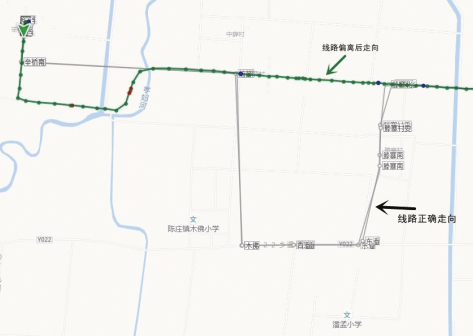
Figure 1 Route Deviation Illustration
By analyzing abnormal data from bus routes, issues in driver operations can be identified, allowing for effective and reasonable external interventions for drivers with safety risks, thereby addressing potential hazards at the source.
1.3 Improving Service Quality and Increasing Passenger Satisfaction
Bus service is a crucial evaluation metric for public transport companies. A major conflict in bus service is between drivers and passengers, particularly regarding whether drivers stop at stations when there are no passengers waiting. Many public transport companies require drivers to stop at every station, but some drivers may skip stops if they see no passengers waiting or if no passengers are alighting from the bus, leading to passenger complaints. Determining whether drivers stop at stations can be accurately assessed through the operational trajectory data from the intelligent scheduling system.By replaying the bus trajectory during complaint time periods, if a driver stops at a station, there will be a noticeable deceleration trend, with speed dropping to zero. Such a trajectory confirms that the driver stopped at the station. If there is no deceleration trend and the speed remains constant while passing the station, it indicates that the driver did not stop.Some cities’ intelligent scheduling systems include statistics on missed stops (Figure 2), which can identify which stations drivers are likely to skip and which drivers have a habit of not stopping, allowing for targeted adjustments that can significantly enhance service quality, reduce complaints, and increase passenger satisfaction.
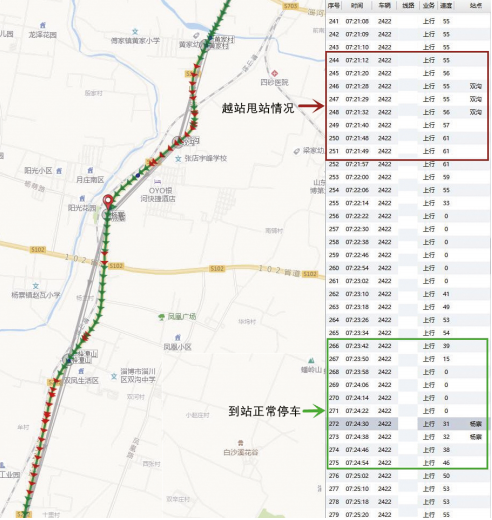
Figure 2 Missed Stop IllustrationBy analyzing the big data from the intelligent scheduling system, issues in route operations can be identified and optimized, leading to significant improvements in intelligent management of routes.
2 Challenges and Considerations in Enhancing Intelligent Management Levels of Routes
2.1 Shortage of Talent in Intelligent Public Transport
The application and popularization of intelligent scheduling systems have only been around for about ten years. Typically, the system is mainly used by dispatchers, while there is a lack of data analysis talent in public transport companies, hindering the ability to analyze big data and resulting in limited breakthroughs in intelligent management levels.
2.2 Lack of In-Depth Exploration of Intelligent Scheduling Systems
The intelligent scheduling system has achieved a visual connection between bus routes, buses, and drivers, and the entire system has rich functionalities. However, many companies currently limit their use to scheduling functions and do not explore other functionalities deeply. In fact, the system is often only utilized by the dispatch department, with minimal use by other departments, leading to a lack of diversity in system usage.
2.3 Lack of Comprehensive Thinking in Intelligent Management
The intelligent public transport platform has provided public transport companies with a channel for interconnectivity. Intelligent management should not only focus on scheduling but should encompass comprehensive management of the enterprise, requiring a holistic approach to intelligent management.In summary, the key issue in intelligent public transport management is the lack of specialized talent, particularly those who are proficient in data analysis, familiar with intelligent scheduling systems, and understand public transport operations. It is essential for public transport companies to cultivate such talent.The extensive management approach of public transport companies is no longer suitable for the demands of enterprise development. The application of intelligent system software presents an opportunity for public transport companies to significantly enhance management across various aspects through the use of intelligent software and corresponding data analysis.Public transport companies should effectively utilize the existing intelligent scheduling platform, deeply explore the functional data resources of the platform, collaboratively conduct big data analysis, achieve resource sharing, improve resource utilization, enhance the comprehensiveness of decision-making, and fully tap into management potential. Creating a new public transport system that is comfortable, satisfactory, and favored by passengers is the direction for the intelligent development of modern public transport companies.
end


Click and hold to scan the QR code
Follow “Urban Public Transport”
Public transport colleagues are reading