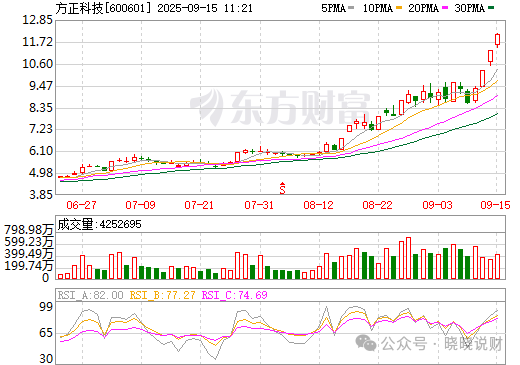
In 2024, a company shocked investors in the A-share market with a “90.55% surge in net profit“—it is not a hot new AI player, nor a star in the new energy sector, but Founder Technology (600601.SH), which has been deeply engaged in printed circuit boards (PCB).
Looking back three years, this company was still trapped in a “diversification trap” with stagnant revenue and a gross margin of less than 15%.
The current turnaround is no coincidence, but stems from a complete reconstruction of three underlying logics, which is the key to understanding its value.
Underlying Logic One: Subtraction is Harder than Addition, but Getting it Right Wins Half the Battle
The PCB industry has a harsh rule: high-end development requires “heavy investment + strong focus“; diversified players often fall behind in the technological race.
In 2021, Founder Technology was a typical counterexample—its business spanned PCBs, smart cities, and semiconductor distribution, seemingly “flourishing in multiple areas” but in reality, resources were scattered.
At that time, the revenue share of the PCB business was only 68%, and R&D investment was diluted to 3.2% of revenue, far below the 5% level of leading companies in the industry.
The turning point came in 2022 with a management reshuffle. After the new team took office, the first thing they did was to drastically “cut businesses“—first divesting the continuously loss-making smart city sector, then selling real estate in Shenzhen Futian in 2024 to recover funds, ultimately concentrating 92.46% of revenue on the PCB main business.
This kind of “amputation for survival” brought immediate results: in 2024, the proportion of R&D investment increased to 4.8%, high-end capacity construction accelerated, and gross margin soared from 14.2% in 2021 to 21.97%, surpassing the industry average by nearly 4 percentage points.
More importantly, the focus allowed Founder Technology to seize the “time window” in the market.
Starting in 2023, the demand for high-layer boards from AI servers surged, and the company quickly shifted 80% of its capacity to produce 8-40 layer boards, while peers still diversifying lagged behind by 6-8 months.
This precise matching of “demand–capacity” is the core secret behind its net profit growth far exceeding revenue growth.
Underlying Logic Two: Patents are Not “Ornaments“, but Real Competitive Advantages
When looking at tech companies, don’t just count the number of patents; consider whether they can be converted into ‘pricing power‘.
Founder Technology’s 290 patents each address industry pain points.
For example, its core “arbitrary layer HDI technology” breaks the monopoly of Japanese companies, allowing the line density of AI server GPU accelerator cards to increase by 30% while reducing costs by 15%.
With this technology, the company successfully entered the NVIDIA supply chain, capturing 25% of the orders for its GPU accelerator card PCBs, becoming one of the top three suppliers globally.
The “cost-reduction magic” of patents is even more intuitive.
In 2024, the authorized “copper sinking device” patent solved the industry problem of copper plating on anode plates in PCB production, extending the chemical replacement cycle from 15 days to 25 days, saving over 5 million yuan per production line annually; the “chemical recovery device” increased the recovery rate of production waste liquid from 60% to 85%, reducing environmental costs by 12 million yuan annually.
These “technology cost-reduction” measures allowed Founder Technology to maintain a net profit margin of 7.39% in the 2024 PCB industry price war, which is 2-3 percentage points higher than the industry average.
Underlying Logic Three: Binding with “Super Customers” Equals Grasping the Industry Growth Engine
The “Matthew Effect” in the PCB industry is becoming increasingly evident: the order share of top customers directly determines the ceiling for enterprises.
Founder Technology’s client list is considered “luxurious“—Huawei, Apple, and Tesla contribute 60% of revenue, but this is not simply a “dependency on big customers“; rather, it is a “strategic partnership binding“.
For example, with Tesla, in 2023, Founder Technology intervened early in the R&D of its 4680 battery PCB, specifically developing a “plug hole stepped graphic circuit board” to address the thermal management issues of the battery management system (BMS).
When Tesla’s 4680 battery went into mass production in 2024, the company became the exclusive supplier, securing 80% of the 6 billion PCB orders for the year.
This model of “early R&D + customized products” creates a high switching cost for customers, exceeding 30 million yuan, forming a solid “moat“.
In the AI sector, collaboration with NVIDIA has also been “rising tide lifts all boats“.
As the H200 GPU accelerator card goes into mass production, Founder Technology’s high-layer board orders surged from 120 million yuan in 2023 to 580 million yuan in 2024, a year-on-year increase of 383%.
This model of “binding with top customers – sharing industry dividends” provides clear “performance anchors” for the company’s growth over the next three years.
Future Logic: “Certainty Opportunities” in a $96.8 Billion Market
According to Prismark’s forecast, the global PCB market size will reach 96.8 billion dollars by 2025, with the three sectors of AI servers, new energy vehicles, and optical modules growing at over 15%, and Founder Technology happens to be positioned in these three “windfalls“.
In the short term, after the launch of the second phase of the Zhuhai high-end HDI project, capacity will increase by 50%, expected to support revenue exceeding 4.5 billion yuan in 2025; in the long term, the company’s market share of 25% in AI server PCBs and 18% in new energy vehicle PCBs will continue to grow with the industry.
Of course, risks cannot be ignored: for every 10% increase in copper prices, the company’s gross margin will decline by 1.2 percentage points; intensified industry competition may pressure high-end product prices.
However, from the underlying logic perspective, Founder Technology has established a “strategic focus – technological breakthrough – customer binding” triangular support, which is rare in the transformation and upgrading of the manufacturing industry.
The essence of investment is to invest in the underlying logic of enterprises. Founder Technology’s turnaround story tells us: in a restless market, companies that dare to subtract, focus on technology, and deeply cultivate customers will ultimately stand out in the industry reshuffle.
While the market chases short-term hotspots, perhaps these “quietly working” manufacturing leaders are the true value lowlands.
Do you have confidence in Founder Technology?
Feel free to leave your thoughts in the comments section~
Risk Warning: The content of this article is for reference and communication only and does not constitute investment advice. Investment carries risks; please proceed with caution.
Daily progress. Master practical financial knowledge and thinking, uncover the most fundamental wealth logic. Make financial management more comfortable and life more free.