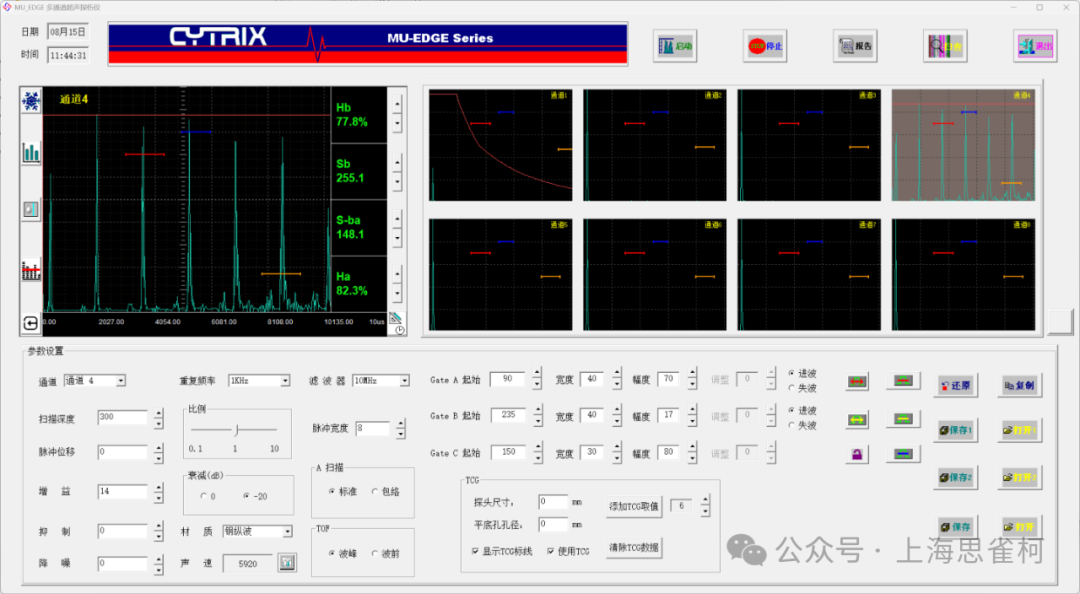
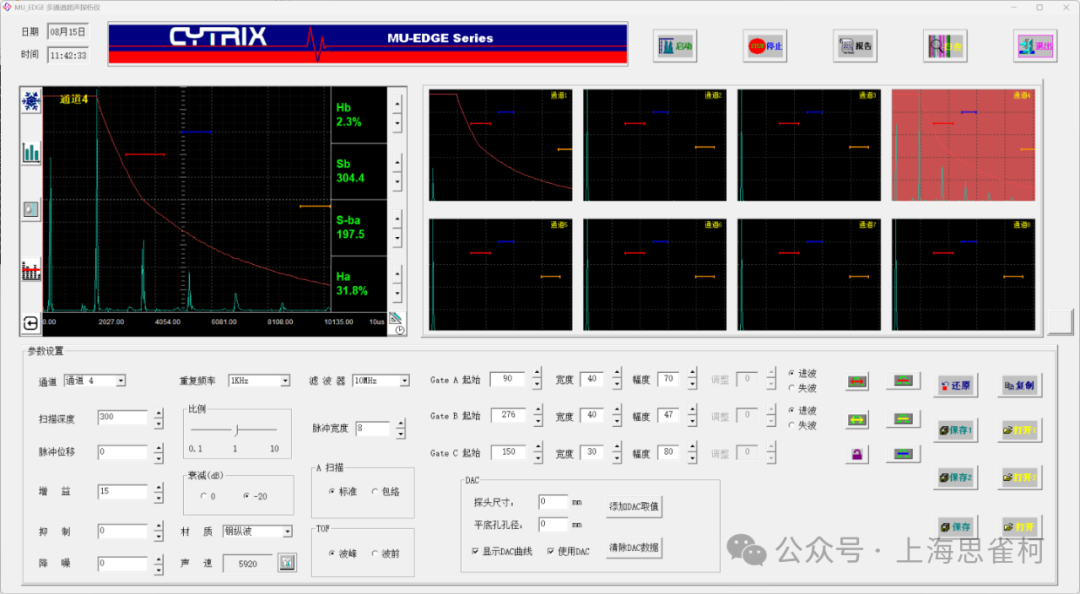
The ultrasonic testing instrument is an industrial non-destructive testing device that can quickly and conveniently detect, locate, evaluate, and diagnose various internal defects (such as welds, cracks, inclusions, folds, pores, and sand holes) in workpieces without causing damage. It can be used in laboratories as well as in engineering sites. It is widely applied in fields such as steel, power, petrochemicals, boiler pressure vessels, steel structures, military industry, aerospace, railway transportation, automotive, and machinery.
DAC (Distance Amplitude Curve) is a distance-amplitude curve. For the same equivalent defect, as the depth increases, the echo amplitude decreases exponentially due to signal attenuation, beam spreading, and other factors. The echo amplitudes of artificial defects of the same equivalent at different depths are connected to form a curve, which is the DAC curve.
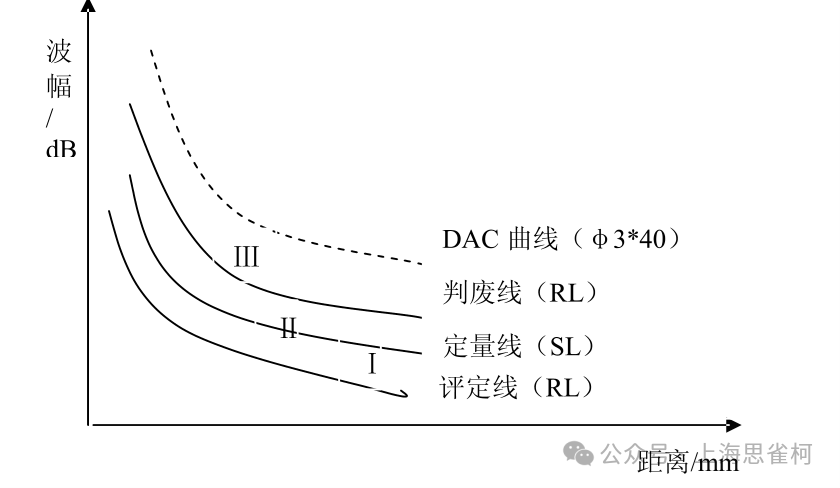
The function of DAC: The DAC curve is used to distinguish the amplitude changes of reflectors that are the same size but at different distances. The DAC curve is drawn point by point, usually selecting echoes from the same reflector at more than three different sound path distances. Generally, after the DAC curve is drawn, regardless of the position of the reflector in the material, the echo peak values produced by reflectors of the same size will fall on the same curve. Similarly, reflectors smaller than the size indicated by the curve will have their echo reflections below the curve, while larger ones will be above it. Therefore, the DAC curve is suitable for scenarios where defects are evaluated based on a certain rule of how many dB to add or subtract from the reflector size.
TCG (Time Corrected Gain) curve is a time (depth) compensation curve that compensates the echo amplitudes of reflectors at different depths based on the downward trend of the DAC curve along the depth direction, connecting all the depth compensation values to form a curve, which is the TCG curve.
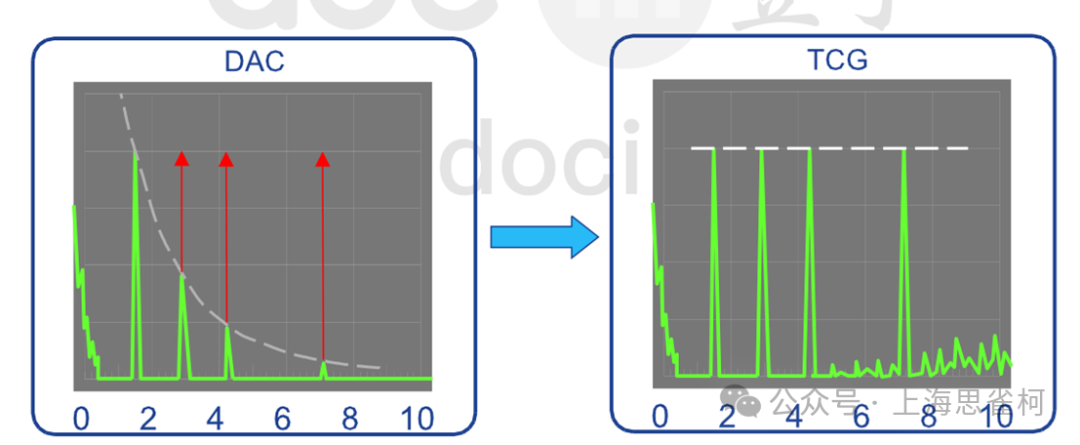
The function of TCG: By compensating the echo amplitudes of the A-scan after depth compensation, the echo amplitudes of reflectors of the same size become independent of their depth in the inspected material. Therefore, in TCG mode, when the gain conditions of the testing instrument remain unchanged, it is more favorable to detect defects located deeper within the material.
The relationship between DAC and TCG: The general DAC curve is a monotonically decreasing smooth curve, while the DAC curve transformed by the TCG function of the instrument becomes a straight line, and the TCG curve itself is generally a monotonically increasing curve.
In the MU-Edge/MU-5000 software, both DAC and TCG can be configured according to specific testing conditions to achieve optimal detection results.