If you find this helpful, please click the above ↑↑↑ “Chemistry Basics” to follow our public account. Your encouragement is my motivation to keep updating.
A teacher asked about the hybridization of carbon atoms in C60. This time, we will analyze it through literature research.
Viewpoint 1: The carbon in C60 belongs to sp2 hybridization.
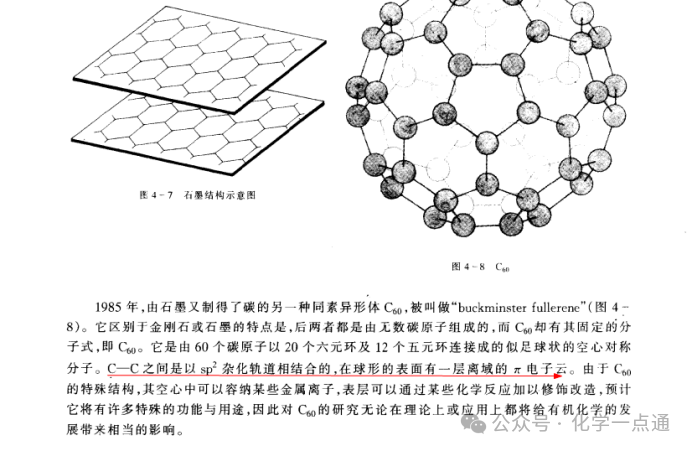
“Higher Education Textbook Organic Chemistry” 3rd Edition, edited by Wang Xiaolan
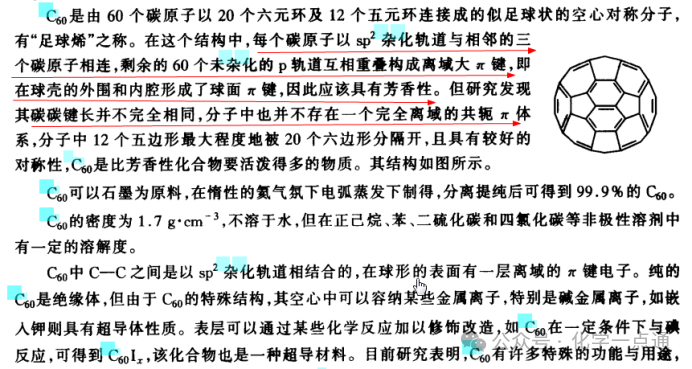
“Organic Chemistry” edited by Zeng Zhaoqiong; Northeast Normal University et al.
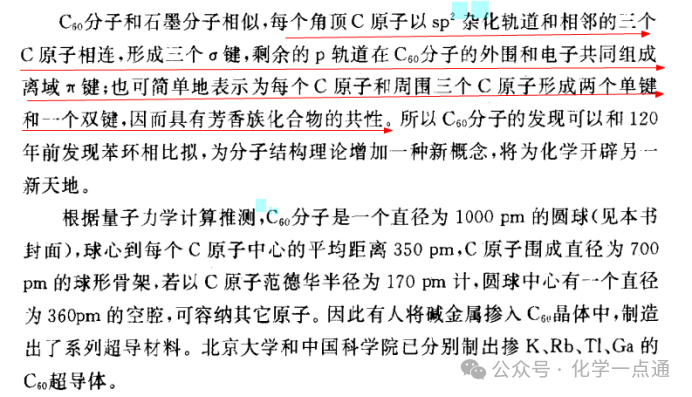
“Concise Course in Inorganic Chemistry: Principles, Structure, Elements, Experiments” edited by Yang Hongxiao
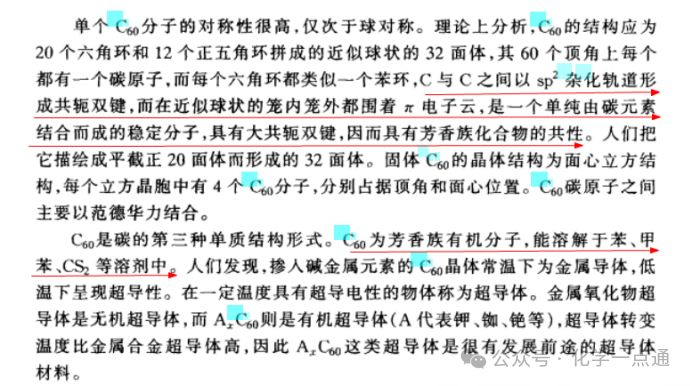
“Modern Chemistry Basics” edited by Hu Zhonggeng
Viewpoint 2: The carbon hybridization in C60 is between sp2 and sp3.
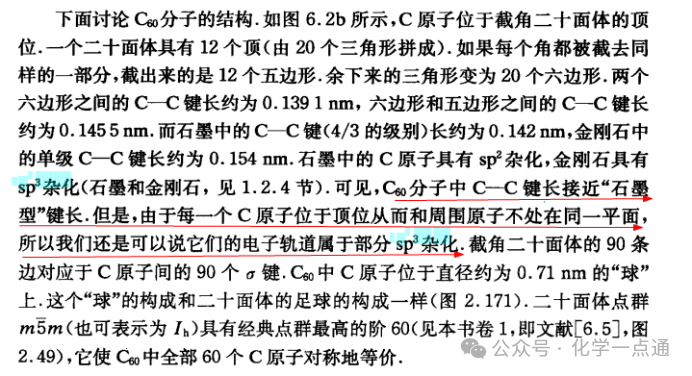
“Modern Crystallography” Volume 2: Structure of Crystals (Russian) by B.K. Vainstein et al.
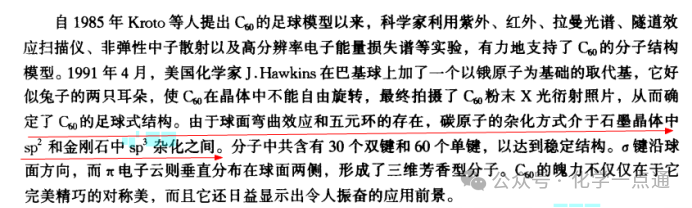
“Organic Chemistry” edited by Ye Fei and Gao Yan
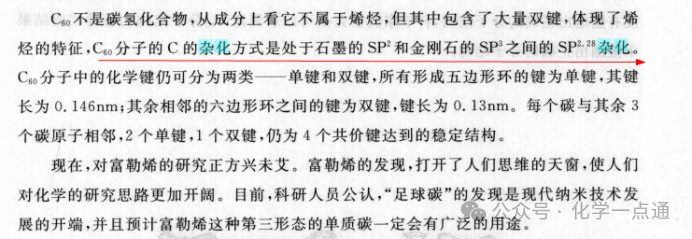
“The Chemistry of Discovery and Creative Thinking” edited by Shen Yuhua and Xie Anjian
So, which viewpoint is more reasonable? Due to the spherical structure of C60, it is certainly different from the typical large π bonds. Let’s analyze it from the perspective of its properties:
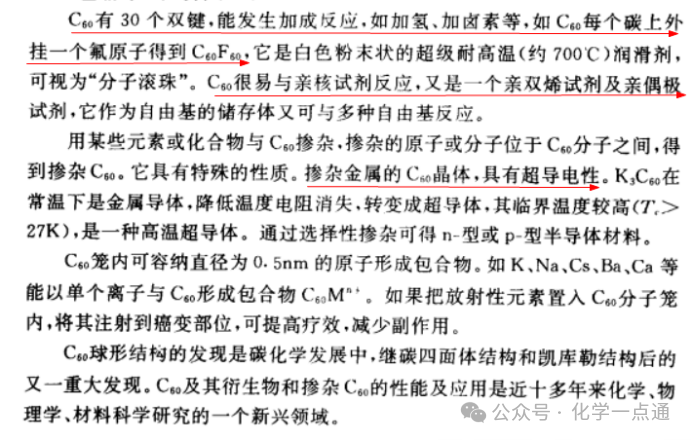
“Organic Chemistry” edited by Zhao Shu et al.
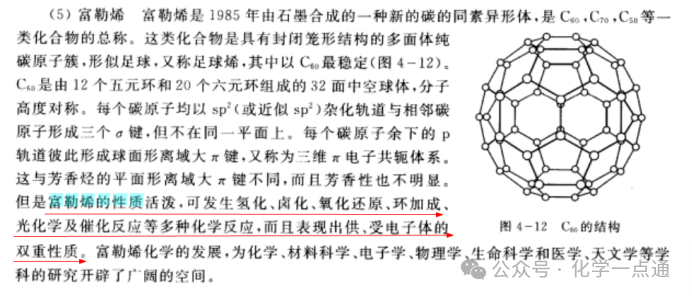
“Organic Chemistry” 2nd Edition edited by Zhao Jianzhang and Zhang Jintong
From the chemical properties of fullerenes, this substance is quite reactive. After forming large π bonds, it becomes relatively harder to add (just like benzene is hard to add but easy to substitute). It seems that the conjugation degree of C60 is not very high. Finally, let’s analyze it from the perspective of ionization energy.
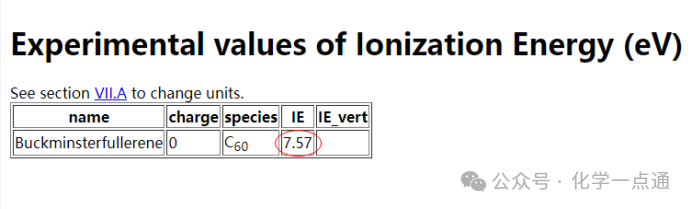
“Ionization Energy Experimental Data of C60” (Data source: National Institute of Standards and Technology, USA)
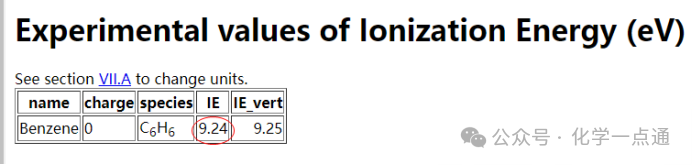
“Ionization Energy Experimental Data of Benzene” (Data source: National Institute of Standards and Technology, USA)
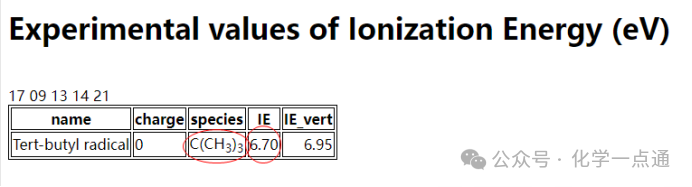
“Ionization Energy Experimental Data of Tert-Butyl” (Data source: National Institute of Standards and Technology, USA)
The tertiary carbon atom in tert-butyl has an unbonded single electron, so its ionization energy is relatively low at only 6.7eV. Benzene, due to the conjugation of its carbon atoms forming large π bonds, is relatively stable with an increased ionization energy of 9.24eV.
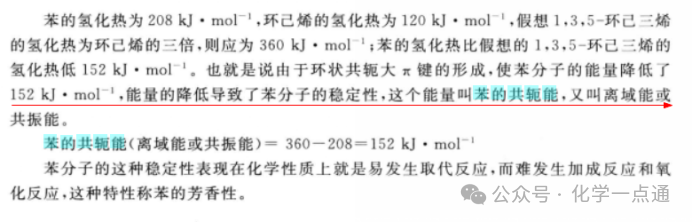
“Textile Organic Chemistry” edited by Huang Xiaodong and Li Chengqin
If we take the large π bond of benzene as the standard, it belongs to standard sp2 hybridization, while the tertiary carbon atom of tert-butyl is standard sp3 hybridization. The difference in ionization energy is 2.54eV. The ionization energy of C60 differs from tert-butyl by 0.87eV, thus 0.87/2.54=34.3%. Based on this, we estimate that the proportion of sp2 hybridization in C60 is about 1/3, meaning its hybridization should be approximately sp2.7 hybridization. (The above estimation of hybridization based on ionization energy is a personal opinion for reference only).
Summary: Through the analysis of the above materials, I believe that the carbon in C60 adopts a partial sp2 hybridization method (approximately 1/3 of the sp2 hybrid component). Due to the low degree of conjugation, its electrons are not very stable, which leads to the high reactivity of fullerenes.
Feel free to add me on WeChat to join the group for discussion. WeChat ID: hms18769652853
Previous article links