
1. Introduction to FPC
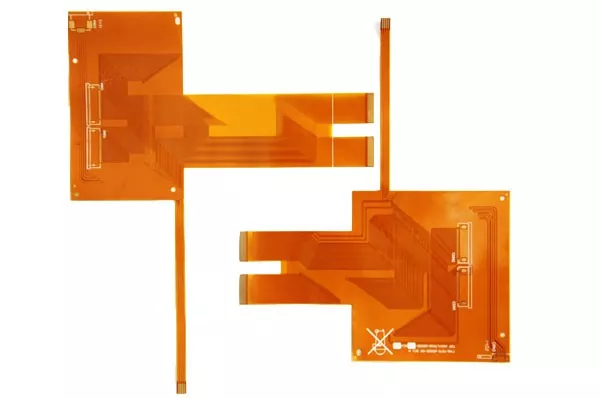
FPC stands for Flexible Printed Circuit, which translates to 柔性印制线路板 in Chinese, commonly referred to as soft boards. It is made by transferring and etching conductor circuit patterns onto a flexible substrate using photolithography techniques. The outer and inner layers of double-sided and multilayer circuit boards are electrically connected through metallized holes, and the circuit pattern surface is protected and insulated with PI and adhesive layers.
It is mainly categorized into single-sided boards, hollow boards, double-sided boards, multilayer boards, and rigid-flex boards.
PCB stands for Printed Circuit Board, which translates to 钢性印制线路板 in Chinese, commonly referred to as hard boards.
2. Characteristics of Flexible Circuit Boards
1. Short: Reduced assembly time
All circuits are pre-configured, eliminating the need for additional wiring connections;
2. Small: Smaller volume compared to PCBs (hard boards)
This effectively reduces the product size, enhancing portability;
3. Light: Lighter weight compared to PCBs (hard boards)
This can reduce the weight of the final product;
4. Thin: Thinner than PCBs (hard boards)
This improves flexibility and enhances three-dimensional assembly in limited spaces.
Advantages of Flexible Circuit Boards
Flexible printed circuit boards are made from flexible insulating substrates and have many advantages that rigid printed circuit boards do not possess:
1. They can be freely bent, rolled, and folded, allowing for arbitrary arrangement according to spatial layout requirements, and can move and stretch in three-dimensional space, achieving integration of component assembly and wire connections;
2. FPC can significantly reduce the volume and weight of electronic products, meeting the needs for high density, miniaturization, and high reliability in electronic products. Therefore, FPC is widely used in aerospace, military, mobile communications, laptops, computer peripherals, PDAs, digital cameras, and other fields or products;
3. FPC also has good heat dissipation, solderability, ease of assembly, and relatively low overall costs. The rigid-flex design compensates for the slight shortcomings of flexible substrates in terms of component load capacity.
Disadvantages of Flexible Circuit Boards
1. High initial cost: Since flexible PCBs are designed and manufactured for specific applications, the initial costs for circuit design, wiring, and photomask are relatively high. Unless there is a special need for flexible PCBs, it is generally not advisable to use them for small applications;
2. Difficulties in modification and repair: Once a flexible PCB is made, changes must start from the base diagram or the compiled photoplot program, making modifications difficult. The surface is covered with a protective film that must be removed before repairs and restored afterward, which is a challenging task;
3. Size limitations: Flexible PCBs are usually manufactured using intermittent processes, which are limited by the size of production equipment, making it difficult to produce very long or wide boards;
4. Prone to damage from improper handling: Improper handling by assembly personnel can easily damage flexible circuits, and soldering and rework require trained personnel.
3. Main Raw Materials for FPC
The main raw materials include: 1. Substrate, 2. Cover film, 3. Reinforcement, 4. Other auxiliary materials.
1. Substrate
1.1 Adhesive Substrate
The adhesive substrate mainly consists of three parts: copper foil, adhesive, and PI, with two categories: single-sided substrate and double-sided substrate. Materials with copper foil on one side are single-sided substrates, while those with copper foil on both sides are double-sided substrates.
1.2 Non-Adhesive Substrate
The non-adhesive substrate is one without an adhesive layer, which lacks the intermediate adhesive layer compared to ordinary adhesive substrates, consisting only of copper foil and PI. It is thinner, has better dimensional stability, higher heat resistance, better bendability, and superior chemical resistance, and is now widely used.
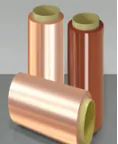
Copper foil: The commonly used copper foil thicknesses include 1OZ, 1/2OZ, and 1/3OZ. A thinner 1/4OZ copper foil has been introduced, which is currently used domestically for ultra-fine line products (with line widths and spacings of 0.05MM or less). As customer demands increase, this specification of material will be widely used in the future.
2. Cover Film
It mainly consists of three parts: release paper, adhesive, and PI. The final product retains only the adhesive and PI, while the release paper is discarded during production (its role is to protect the adhesive from foreign substances).

3. Reinforcement
This is a material specifically used for FPC, applied to certain areas of the product to increase support strength and compensate for the relatively “soft” characteristics of FPC.
Common reinforcement materials include:
1) FR4 reinforcement: Mainly composed of fiberglass cloth and epoxy resin, the same material used for PCBs;
2) Steel reinforcement: Composed of steel, providing strong hardness and support strength;
3) PI reinforcement: Similar to the cover film, consisting of PI and adhesive release paper, but with a thicker PI layer, which can be produced in thicknesses ranging from 2MIL to 9MIL.

4. Other Auxiliary Materials
1) Pure adhesive: This adhesive film is a thermosetting acrylic adhesive film consisting of a protective paper/release film and a layer of adhesive, mainly used for layered boards, rigid-flex boards, and FR-4/steel plate reinforcement boards, serving as an adhesive.
2) Electromagnetic shielding film: Applied to the board surface for shielding purposes.
3) Pure copper foil: Composed solely of copper foil, mainly used for hollow board production.
4. Types of FPC
FPC types can be distinguished into the following six categories:
A. Single-sided board: Only one side has circuits.
B. Double-sided board: Both sides have circuits.
C. Hollow board: Also known as window board (with openings on the finger side).
D. Layered board: Two sides with circuits (separated).
E. Multilayer board: More than two layers of circuits.
F. Rigid-flex board: A product combining flexible and rigid boards.
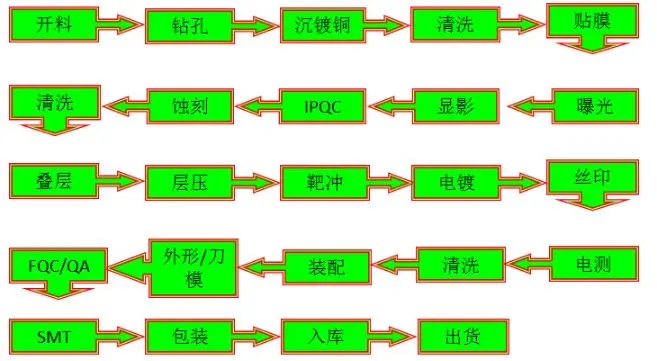
5. FPC Process Flow

Screenshots from some electronic books
【Complete Set of Hardware Learning Materials Collection】