Western Digital, Toshiba, and Intel disclosed their development status of PLC flash technology as early as 2019. Currently, Intel and Kioxia are increasingly confident about the debut of PLC flash. The new flash can further reduce SSD prices, but Western Digital recently stated that SSDs using PLC flash are unlikely to appear before 2025.
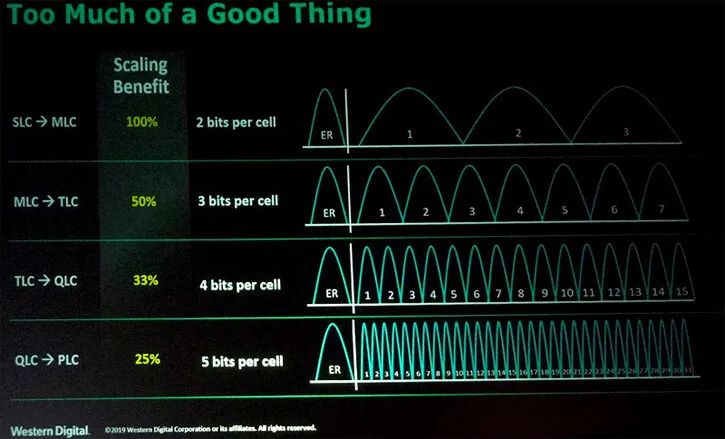
According to Tom’s Hardware, Western Digital believes that using PLC flash will only become feasible in the latter half of this decade when SSD main controls become more advanced, which means after 2025. Of course, this is just their opinion; other flash suppliers believe that 3D PLC SSDs can enter the market in the coming years to compete with HDDs.
Every new flash entering the market will lower SSD prices, but the durability and performance will significantly decline. QLC flash has been on the market for many years, but it has not quickly replaced TLC flash. The transition takes much longer than TLC replacing MLC. For these two reasons, durability issues can be solved by using larger capacities, but performance issues will require waiting for more advanced main controls and improved flash.
Compared to QLC flash, PLC flash can increase the data storage per cell from 4 bits to 5 bits, and the number of levels from 16 to 32, allowing for a 25% capacity boost. However, achieving this requires more resources, including stronger ECC and more robust wear leveling algorithms, which necessitate a more powerful SSD main control.
Currently, the main controls used in 3D TLC SSDs already provide high performance and durability. They utilize 120bit/1KB or even 340bit/2KB LDPC ECC algorithms, which are quite complex. Additionally, they need to provide static and dynamic wear leveling algorithms, EAID ECC, etc., to further enhance SSD durability.
For 3D QLC SSDs, the main control needs to support 2KB or even 4KB LDPC ECC, as well as more complex wear leveling algorithms. Furthermore, it requires excellent SLC Cache algorithms to improve SSD performance.
As for 3D PLC SSDs, the requirements will be even greater. The current SSD main control using the Cortex-R8 core may become overwhelmed and needs to be upgraded to the latest Cortex-R82 core, which can improve performance by 21% to 23%. However, the first SSD main control using the Cortex-R82 core may not appear until 2023 or even 2024, and it will be aimed at high-end products. However, 3D PLC will definitely take a low-cost route when it first enters the market, so 3D PLC flash will not likely enter the market that quickly.

Follow us on WeChat
Scan to follow us for popular hardware reviews
Check the latest rankings anytime