On July 30, 2025, Applied Composite Materials published the latest research from the Materials Engineering Department of California State Polytechnic University titled Water Durability of 3D-Printed PEEK and PEEK Carbon Fiber Composites (3D打印聚醚醚酮(PEEK)及聚醚醚酮碳纤维复合材料的耐水性).
https://doi.org/10.1007/s10443-025-10364-y
**Abstract**
– This paper investigates the water absorption behavior of amorphous PEEK and short carbon fiber reinforced PEEK (PEEK-CF) produced by fused deposition modeling in distilled water and seawater. After approximately 1125 hours of long-term immersion testing, it was found that the PEEK-CF samples exhibited the highest water absorption in seawater (mass increase of about 6%), while both PEEK and PEEK-CF in distilled water and PEEK in seawater reached about 4% water absorption. The higher water absorption rate of PEEK-CF compared to unreinforced PEEK is attributed to osmotic pressure and porosity at the fiber-matrix interface. The diffusion behavior deviated from Fickian diffusion kinetics, aligning more closely with the Vas-power model (an improved Lucas-Washburn equation). Moisture exposure significantly affects mechanical properties: the tensile modulus of PEEK-CF decreased by up to 32%, while the mechanical properties of unreinforced amorphous PEEK remained largely unaffected. The modified mixing rule, combined with the water absorption degradation factor, fiber length, and orientation, accurately predicted the observed mechanical degradation. These findings emphasize the importance of considering moisture effects in the design of 3D-printed PEEK-CF composites.
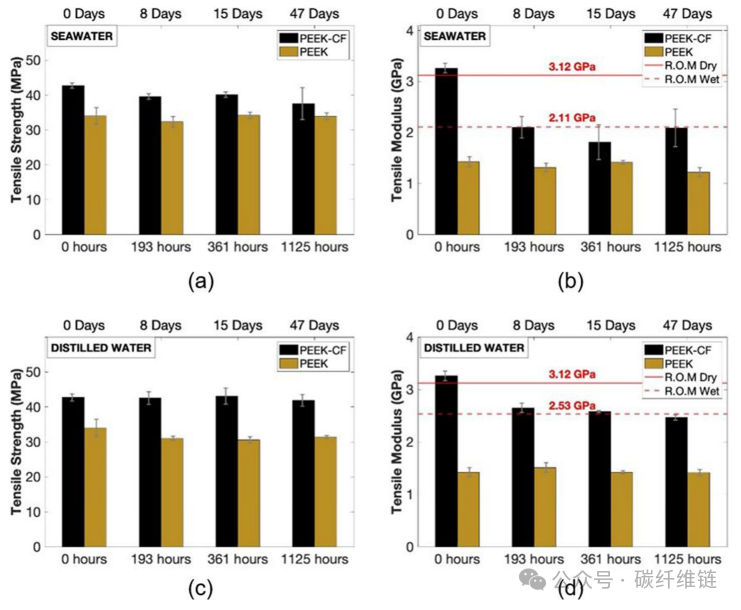
The average tensile performance of PEEK-CF and PEEK over time in seawater and distilled water. (a) Tensile strength before and after immersion in seawater and (b) tensile modulus. (c) Tensile strength before and after immersion in distilled water and (d) tensile modulus.
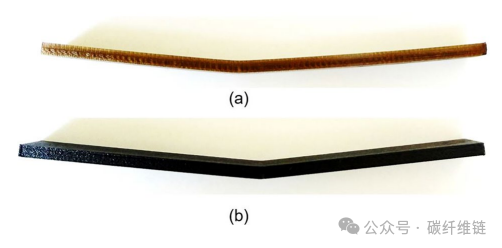
Typical bending failure samples: (a) PEEK and (b) PEEK-CF. The failure modes remained consistent before and after immersion in seawater and distilled water.
**Methods**
– **Material Preparation**: Two types of 3D printing filaments were used, namely PEEK filament produced by 3D4MAKERS and Solvay KetaSpire® CF10 LS1 AM filament (containing 10% discontinuous carbon fiber reinforcement). All materials were dried before use.
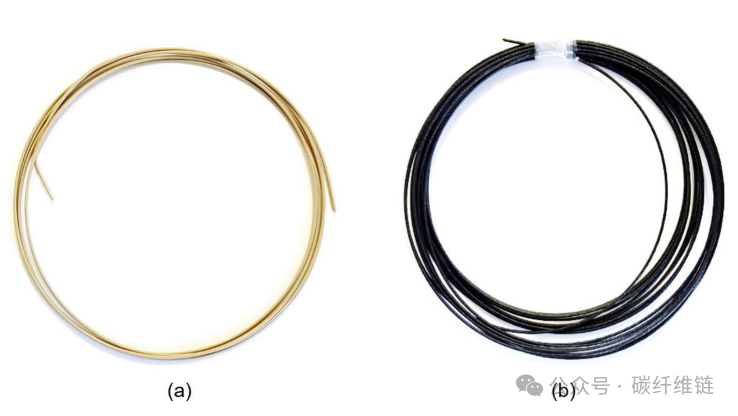
(a) 3D4MAKERS PEEK filament. (b) Solvay KetaSpire® CF10 LS1 AM filament. Both filaments had a diameter of 1.75 mm before printing.
– **3D Printing Parameters**: The 3DGence INDUSTRY F350 3D printer was used, with printing parameters including grid fill pattern, 100% fill density, different bed temperatures, and printing temperatures.
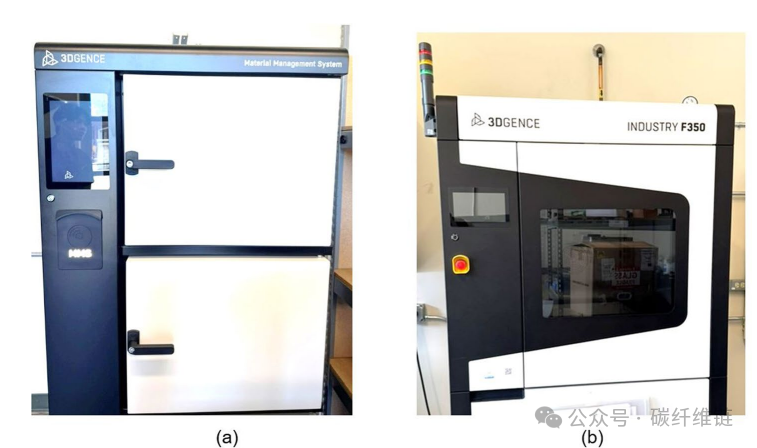
(a) 3DGence material management system. (b) 3DGence INDUSTRY F350 3D printer.
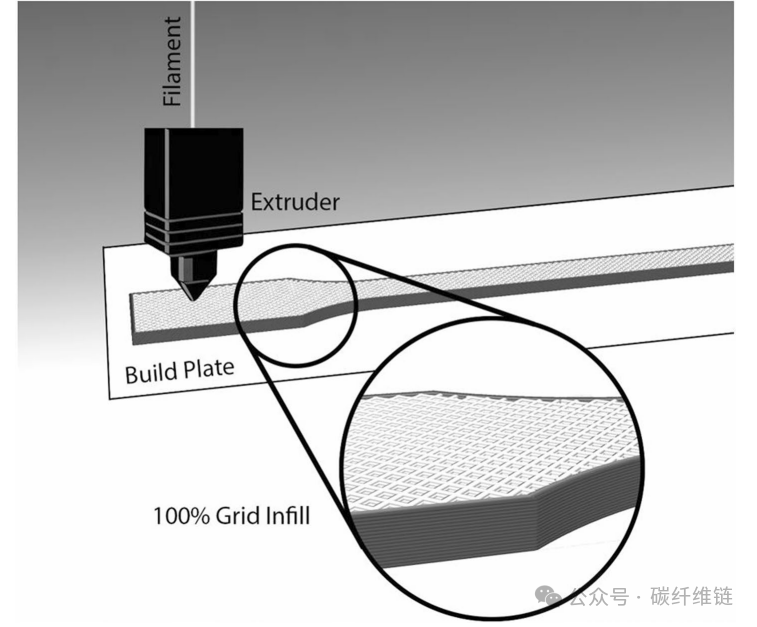
Schematic diagram of the 3D printing process for PEEK tensile samples.
– **Water Absorption Testing**: Samples were fully immersed in simulated seawater and distilled water, with periodic measurements of mass change to determine water absorption rates.
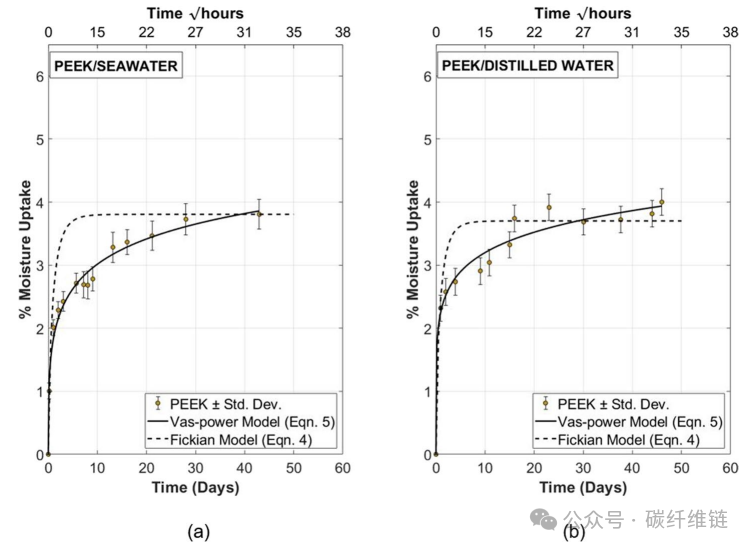
Weight gain-immersion time curves for 3D printed amorphous PEEK in (a) seawater and (b) distilled water.
– **Mechanical Performance Testing**: Tensile and bending tests were conducted under dry and wet conditions to assess the impact of water absorption on mechanical performance.
– **Microstructural Imaging**: Scanning Electron Microscopy (SEM) was used to analyze the microstructure of samples before and after water absorption.
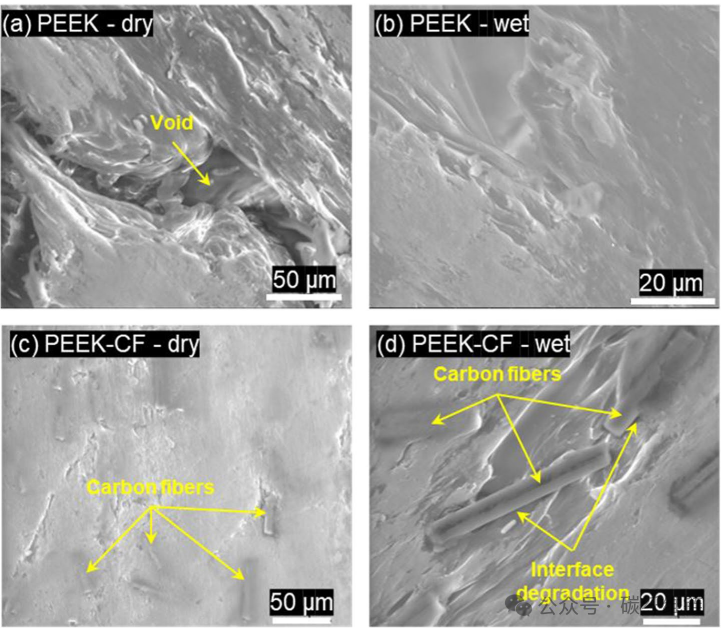
SEM micrographs showing (a) (dry) PEEK before immersion in seawater, (b) PEEK after immersion in seawater well beyond saturation (approximately 1125 hours), (c) (dry) PEEK-CF before immersion in seawater, and (d) PEEK-CF after immersion in seawater well beyond saturation (approximately 1125 hours).
**Conclusion:**
– This study demonstrates that water absorption significantly affects the mechanical behavior of 3D-printed PEEK-CF composites, primarily due to degradation at the fiber-matrix interface. Specifically, the tensile modulus of PEEK-CF decreased by up to 32% after long-term exposure in seawater and distilled water. In contrast, tensile strength, flexural strength, and flexural modulus remained largely unchanged in both PEEK and PEEK-CF, indicating that the primary impact of moisture is limited to interfacial bonding rather than the bulk polymer matrix.
– Innovation: An improved mixing rule model was introduced, successfully predicting the decrease in tensile modulus due to water absorption.
– Performance: The accuracy of the model was experimentally validated, demonstrating the water absorption sensitivity of PEEK-CF.
Disclaimer|Some materials are sourced from publicly available information, copyright belongs to the original authors.This platform publishes solely to convey a different perspective and does not represent endorsement or support of that perspective.If there are any copyright issues, please contact us for resolution.