Automakers will never tell you that even with the sameOrinchip, the computing power can differ bythreetimes. SomeThorchips are only on par withOrin Xin terms of performance. Car reviewers only mention theThor platform in their test drives, withoutdisclosingspecific models andcomputing power. Thus, even with models labeled asL2+, the computing power can differ by four times while still being in the same category. A collective vague promotion regarding automotive chips is spreading in the industry, leaving consumers under the impression that they are getting the high-performance versions ofOrinandThorchips, while in reality, they might be receiving significantly downgraded versions.
Previously, I received a private message from a fan, who said that the “NVIDIAOrinchip+CityNOA” “high-end intelligent driving version” of a new energy vehicle he purchased this year had not yet delivered the urban functions after six months. Eventually, he discovered that the core chip was actuallyOrin-N, with a computing power of only84 TOPS, which could not run the official demonstration’s end-to-end model. The dealership confidently replied, “We did not lie; we are indeed using theOrinseries.”
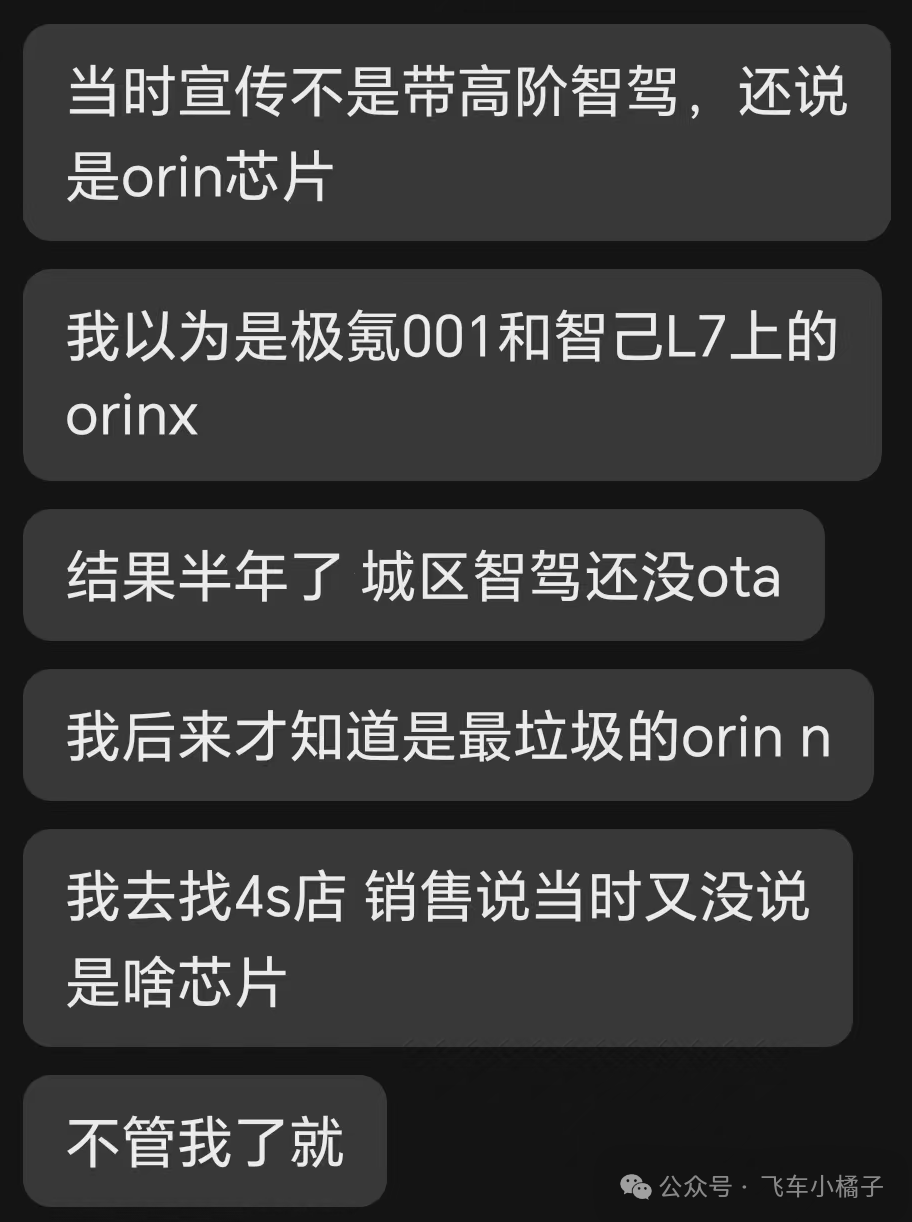
This kind of vague promotion has become an unspoken norm in the industry. Automakers prefer to promote series names rather than specific models, creating an illusion of“high configuration,” while the actual vehicles may be equipped with the lowest-performing versions in that series.
NVIDIA’sOrinseries includes multiple models:Orin-X has a computing power of254 TOPS, whileOrin-N has only84 TOPS, resulting in a performance gap of three times, yet both are generically referred to as “Orinchips.” Even more exaggerated is that the procurement price of a singleOrin N is nearly $150 less than that of Orin X. When converted to the end-user price, it can be a fulldouble, but the computing power drops from254 TOPS to84 TOPS, a reduction of two-thirds.
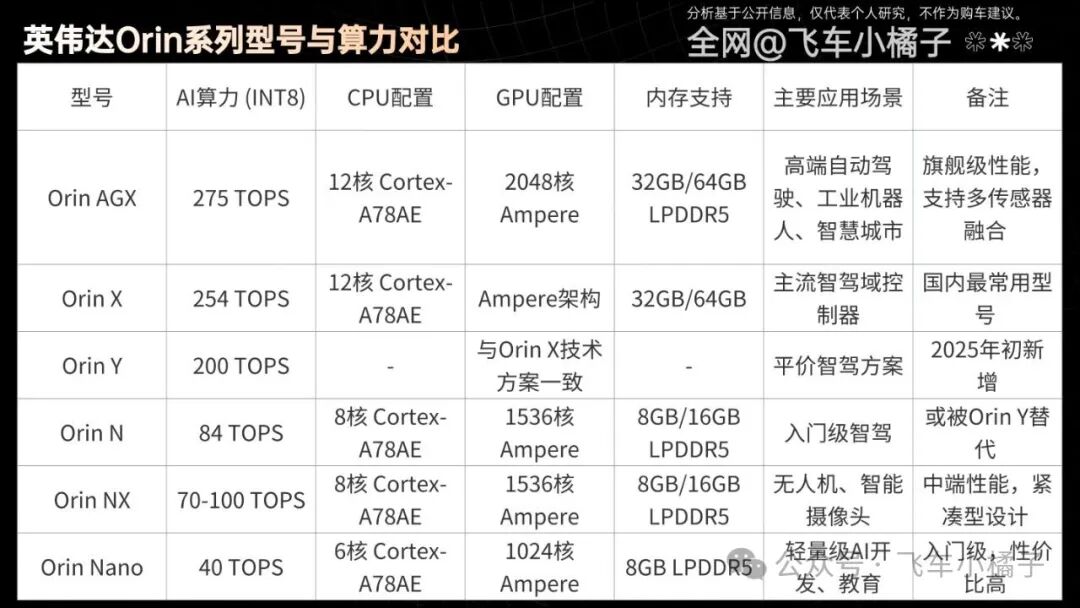
Typically, the urbanNOA needs to run at120 km/h with a10 Hzend-to-end network, with a single frame parameter size of120 M, and a single camera at300 Mbps, requiring at least180 TOPS of redundancy. With only84 TOPS, the frame rate can only be reduced to3 Hz or the model branches cut off, leading to a poor situational experience in rainy nights, while the car owner will only suspect their operation is improper.
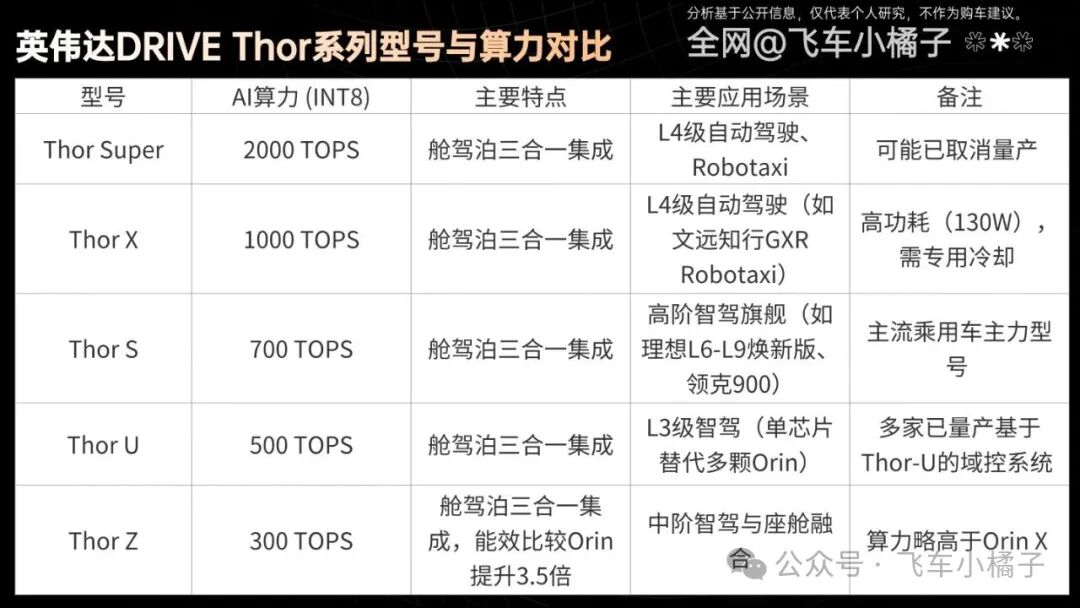
Even more exaggerated scenarios are unfolding with the first generation of the Thor series. NVIDIA’sThor series is actually divided into five versions: from the strongest2000TOPS Thor-Super to just slightly better thanOrin X Thor Z, with a performance difference of seven times sufficient to support completely different intelligent driving functions, yet they are often collectively referred to as “Thor chips” in promotions. The official press releases boast about thousands ofTOPS, and the integrated cockpit is loudly advertised, but the chip that is actually locked in by car manufacturers,Thor-U, can only release500 TOPS of computing power, while1000 TOPS Thor-X is currently only used in the GXR Robotaxi launched by WeRide in the commercial vehicle sector. The typical power consumption of Thor-X can reach130 W, requiring a dedicated cooling module, which may be quite cramped for the power distribution box of ordinary passenger cars. In other words, the “Thor models” available for purchase next year are likely to be the700 TOPS version, and to reach1000 TOPS, a complete re-certification of cooling, power supply, and EMC will be required, pushing the timeline to at least mid-2026. Of course, optimizing the VLA model is also crucial for releasing computing power; the actual released computing power often does not reach the heights advertised by manufacturers, which we will discuss later. If interested, you can follow up. The700 TOPS running BEV+Transformer for urban scenarios has a single frame latency of58 ms, just enough to meet the60 km/h following distance, but once the speed reaches80 km/h, it must prune20% of the weights, and such a downgrade in experience is hardly noticeable to the driver, as the dashboard still shows that intelligent driving is activated.
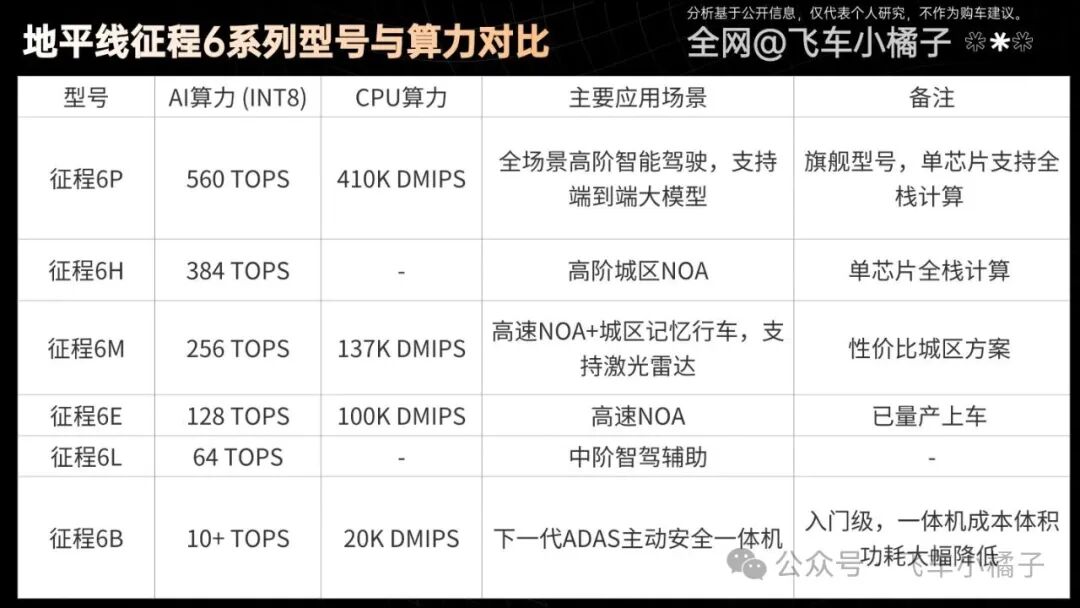
Domestic chip manufacturers also face similar issues. The Horizon Journey6 series is divided into six tiers, with a performance gap of50 times between the highest and lowest configurations, yet they often only say“equipped with HorizonJ6 chip.”
Moreover, the same chip model may perform vastly differently across different automakers. This depends on the automaker’s software optimization capabilities, sensor configurations, and system integration levels. A high-performance chip paired with low-quality sensors and poor algorithms may perform worse than a well-optimized system with a lower-spec chip.
Why do automakers engage in such wordplay? The reasons are complex and rooted in industry realities.
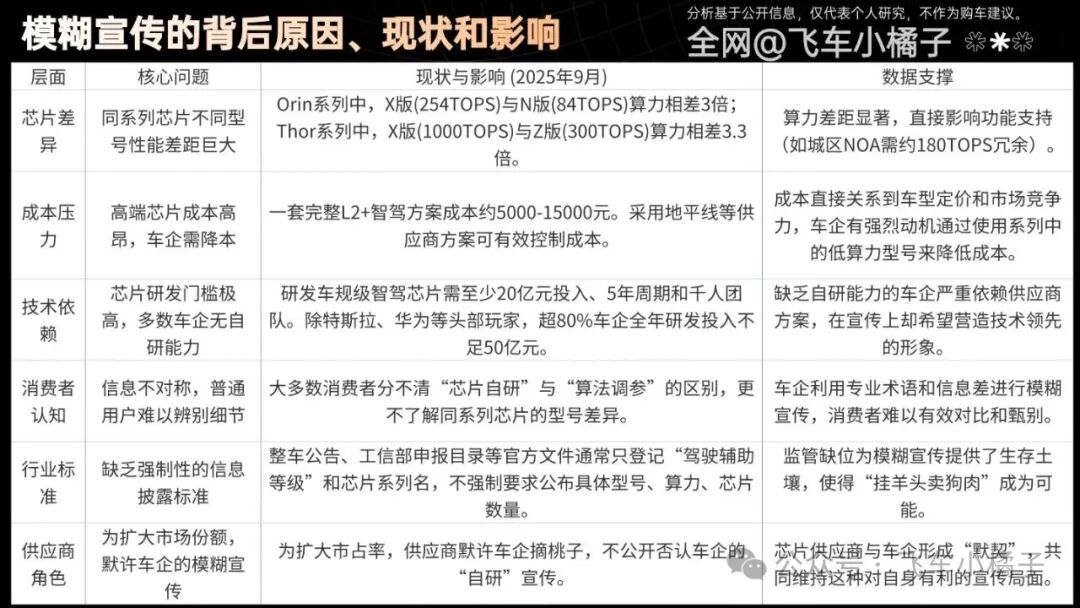
First is the cost pressure. A completeL2+ intelligent driving solution costs about7000 yuan, while using suppliers like Horizon can reduce it to below3000 yuan. In the price war, automakers must seek ways to cut costs to maintain profits—using lower-spec chips is one method, but they continue to use high-end series names in promotions.
Secondly, there is a dependency on technology. Developing a vehicle-grade intelligent driving chip requires at least2 billion yuan in investment, a five-year cycle, and a team of thousands. Except for leading players like NIO, Huawei, and XPeng,80% of automakers invest less than5 billion yuan annually in R&D. Automakers lacking self-research capabilities can only rely on supplier solutions while wanting to appear technologically advanced in their promotions.
Thirdly, there is a gap in consumer awareness. Most consumers cannot distinguish between self-developed chips and algorithm tuning, let alone the differences between different models within the same chip series. This information asymmetry leaves room for automakers to maneuver. Chip suppliers often remain silent on this. To expand market share, suppliers often tacitly allow automakers to take advantage, not publicly denying the automakers’ claims of “self-developed” promotions. This supplier hype allows automakers to maintain their celebratory atmosphere.
This results in configuration lists that only state“equipped with NVIDIAOrin chip,” without disclosing whether it is one or two chips, whether it isN orX; media test drive articles only mention “based onThor platform,” without writing specific models and power consumption. Similarly, models labeled as “L2+” can have computing power differences of four times while still being in the same category.
To expose the chip trap, the only way is to write computing power, power consumption, and core counts on the nameplate like engine displacement, allowing consumers to compare at a glance. However, relevant regulations in our country are still in the works.
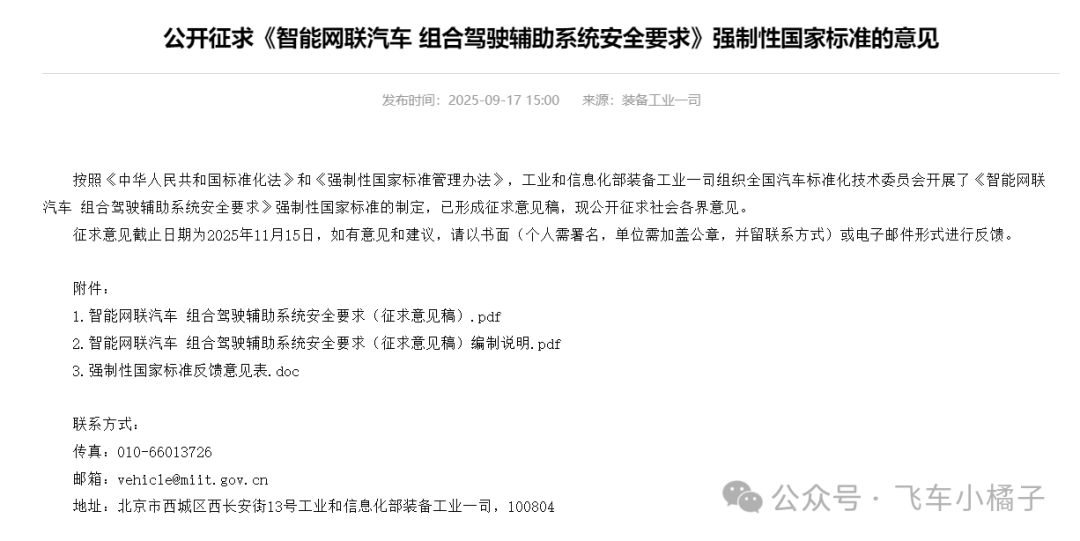
Until then, we can only help ourselves: when choosing a car, do not just listen to the big words “Orin,” “Thor,” “Journey6,” but make sure to check the “small print” on the configuration list—chip model, computing power values, number of chips, power consumption limits, and then compare with the functions in the official demonstration videos to see if they match. If you really cannot find out, you can also message me. If the dealership is evasive, it can generally be determined that it is a low-spec model masquerading as a high-spec one.
Another simple “home remedy” is to ask about the frame rate and speed of urbanNOA; true254 TOPS and above computing power can run at120 km/h with10 Hz; if below this standard, it is highly likely that the model has been cut down.
For the industry, the computing power “arms race” has reached a turning point; the era where simply saying “we useOrin” can command a premium should come to an end. In September 2025, statistics showed that the domesticL2 and above penetration rate had surpassed55%, but the penetration rate of urbanNOA was only11%; the core bottleneck is not the algorithm, but the mixed sale of high and low-spec chips leading to inconsistent experiences, undermining consumer confidence.
Chip manufacturers, automakers, and regulators must face the reality: computing power is not a marketing slogan, but a hard metric that must be as publicly transparent as fuel consumption and crash star ratings. Only when “Orin-N,” “Orin-X,” “Thor-U,” and “Thor-X” are no longer obscured by a single “Orin,” and when “Journey6E,” “6M,” and “6P” are no longer confused with a single “Journey6,” can intelligent driving truly transition fromPPT to reality, rather than being “inflated” on configuration lists. If no one clarifies the truth about computing power, those chips shining with blue light will merely be “futures” that have been overdrawn in advance, while the real “future” still lingers at the red light ahead.