Are CRP and hsCRP testing the same thing? Some say they are the same, while others disagree. Many clinical doctors in hospitals also tend to confuse them. Why do we have two testing ranges for one substance? Today, I will briefly share with you these two familiar yet unfamiliar testing items.
First, CRP and hsCRP test for the same substance, which is the C-reactive protein. “hs” stands for high sensitivity; this is what we refer to as high-sensitivity or hs CRP. However, essentially, both tests measure CRP.
Next, another question is, why are there two different testing items?
The clinical applications of these two testing items are different.
Regular CRP has been widely used as an indicator of infection and inflammation. When we go to the hospital with a cold or fever, in addition to the complete blood count, many doctors like to look at the CRP level, mainly to differentiate between inflammatory infections and bacterial infections.
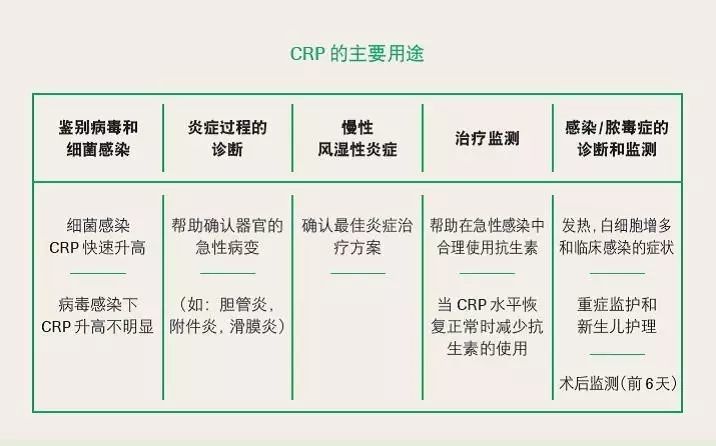
On the other hand, hsCRP is mainly used in clinical settings to assess cardiovascular risk. This explanation may seem inadequate. Let’s consider a hypothetical situation: when a patient has minor cardiovascular changes, but clinically has not yet developed cardiovascular disease, myocardial cells are damaged (this damage is subtle and goes unnoticed), and the CRP level rises slightly.
The traditional CRP testing range can reach up to 350mg/L, and cannot clearly identify slight elevations in CRP levels. Therefore, there is an urgent need for a more sensitive CRP test. This is why we have two different testing items, namely CRP and hsCRP.
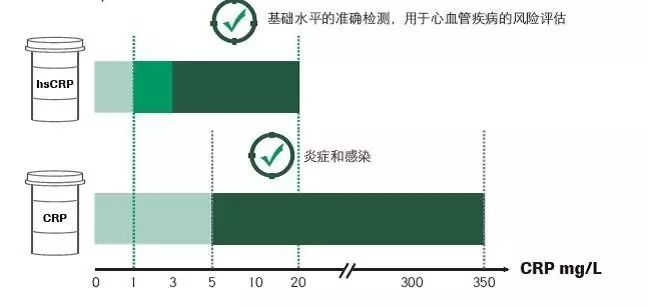
Note: ① hsCRP should only be included in the assessment when other cardiovascular risk indicators are abnormal, serving as an auxiliary diagnostic indicator for doctors to assess the risk of cardiovascular diseases.
② When assessing cardiovascular disease risk, measurements should be taken in a metabolic stable state without inflammation or infection.
High-sensitivity C-reactive protein (hsCRP) testing refers to laboratory techniques that use high sensitivity to accurately detect extremely low concentrations of C-reactive protein, making it a sensitive indicator for distinguishing low-level inflammatory states. The clinical significance is as follows:
HsCRP testing is used for assessing the risk of cardiovascular diseases:
1. HsCRP < 1.0mg/L indicates low risk;
2. HsCRP between 1.0 – 3.0mg/L indicates moderate risk;
3. HsCRP > 3.0 mg/L indicates high risk;
4. HsCRP > 10.0 mg/L suggests the possibility of other infections, and samples should be re-collected for testing after controlling other infections.
HsCRP testing can predict the risk of myocardial infarction, stroke, and other cardiovascular accidents.
HsCRP is an independent indicator for the prognosis of recurrent events in patients with coronary heart disease.
HsCRP testing can be used to diagnose early osteoarthritis, with reference values < 5 mg/L.
HsCRP testing is used to diagnose bacterial infections in newborns, with reference values < 2 mg/L.
Who needs regular testing?
1. Patients with “three highs” (hypertension, hyperglycemia, hyperlipidemia);
2. Patients with coronary heart disease, cerebral infarction, and other cardiovascular diseases;
3. Newborns with suspected bacterial infections;
4. Patients with kidney transplants or bone diseases.
What are the precautions for testing?
1. Fasting is required before testing.
2. Testing in conjunction with blood lipids provides a more accurate assessment of cardiovascular risk.
Pathogenic Mechanism What is the relationship between high-sensitivity CRP and regular CRP?
CRP is divided into regular CRP and high-sensitivity CRP. To clarify the relationship between the two, we must first discuss the pathogenesis of cardiovascular diseases.
For a long time, it has been believed that lipid deposition is the main cause of cardiovascular diseases, which is why lipid-lowering medications are used for prevention and treatment.
However, during this process, a problem was discovered: while lowering lipids can significantly reduce the incidence of cardiovascular diseases, it cannot completely prevent the occurrence of cardiovascular diseases, indicating that the lipid deposition theory cannot fully explain the etiology of cardiovascular diseases, and there must be other pathogenic mechanisms involved.
Through relentless exploration, medical researchers have found a close relationship between inflammatory responses and cardiovascular diseases.
Most of this evidence comes from cohort studies where researchers first selected healthy individuals (with a large sample size), measured their CRP levels, and then followed them up. The results showed that individuals with higher CRP levels were at greater risk of experiencing cardiovascular events in the future.
This indicates that CRP is a risk factor for cardiovascular events.
However, in research involving CRP and cardiovascular events, researchers encountered a frustrating issue: most healthy individuals had CRP levels below the detection limit (10mg/L), yet they still experienced cardiovascular events.
Researchers speculated that variations in CRP levels below the detection limit (10mg/L) were still related to cardiovascular diseases.
For example: if patient A has a CRP level of 1 mg/L and patient B has a CRP level of 8mg/L. If we use conventional CRP testing methods, both would be reported as < 10 mg/L, and their risk of cardiovascular disease would be assessed as the same based on the test results.
The problem is that A and B have different CRP levels, and their risks of developing the disease may also differ. Therefore, we need a more sensitive testing technology to differentiate between A and B and see if their risks of developing the disease are the same.
Thus, the “high-sensitivity CRP” testing technology was born!
To distinguish, we will refer to the previously mentioned CRP testing with a detection limit of 10mg/L as “regular CRP.” Of course, different testing systems have slightly different detection limits, but most are below 0.5mg/L.
After the invention of high-sensitivity CRP, studies confirmed that A and B indeed had different risks of developing the disease. By now, you should understand that the value of high-sensitivity CRP lies in its ability to detect low levels of CRP, thereby identifying individuals at risk of cardiovascular events that conventional CRP cannot differentiate.
In 2008, a study by Paul M Ridker’s team published some exciting findings: they discovered that statin drugs (rosuvastatin) could lower high-sensitivity CRP levels.
This finding further reinforced the relationship between inflammatory responses and the pathogenesis of cardiovascular events, while also prompting reflection on whether the fundamental reason statins reduce cardiovascular events is due to “lowering lipids” or “anti-inflammation.”
Furthermore, they found that if a patient’s high-sensitivity CRP level rises (> 2mg/L), even if LDL-C is normal (< 130mg/L), the patient can still benefit from statin treatment.
In short: high-sensitivity CRP is not only a “risk factor” for cardiovascular diseases but also a “monitoring biomarker” for treatment.
Why Can’t the Two Be Converted?
Regular CRP and high-sensitivity CRP do indeed measure the same substance, but the testing methods are different. Additionally, due to the use of immunoassay methods, there are too many influencing factors to trace back, making it currently impossible to convert between the two. This conversion itself is also not particularly meaningful.
When Should Each Type of CRP Be Tested?
If a patient has a clear infectious disease or autoimmune disease tendency, it is recommended to test regular CRP. If it is just for a health check or to assess the risk of cardiovascular events, it is recommended to test high-sensitivity CRP.
Some may ask, why not just uniformly test high-sensitivity CRP? It’s not that simple.
-
High-sensitivity CRP testing is relatively expensive.
-
Previous research on the value of CRP in diagnosing autoimmune and infectious diseases mostly used regular C-reactive protein, and it is unclear whether the conclusions apply to high-sensitivity C-reactive protein.
-
If a person’s inflammatory response is very strong, high-sensitivity CRP may exceed the linear range, affecting the accuracy of the test results. The upper limits of different high-sensitivity CRP tests vary greatly, with most being within 60mg/L.
In summary, the relationship between high-sensitivity CRP and regular CRP is akin to the relationship between a sniper rifle and a handgun. If the enemy is 100 meters away, it is best to use a sniper rifle, as that is its specialty. If the enemy is within 25 meters, using a handgun is preferable, as close-quarters combat is clearly the handgun’s specialty.
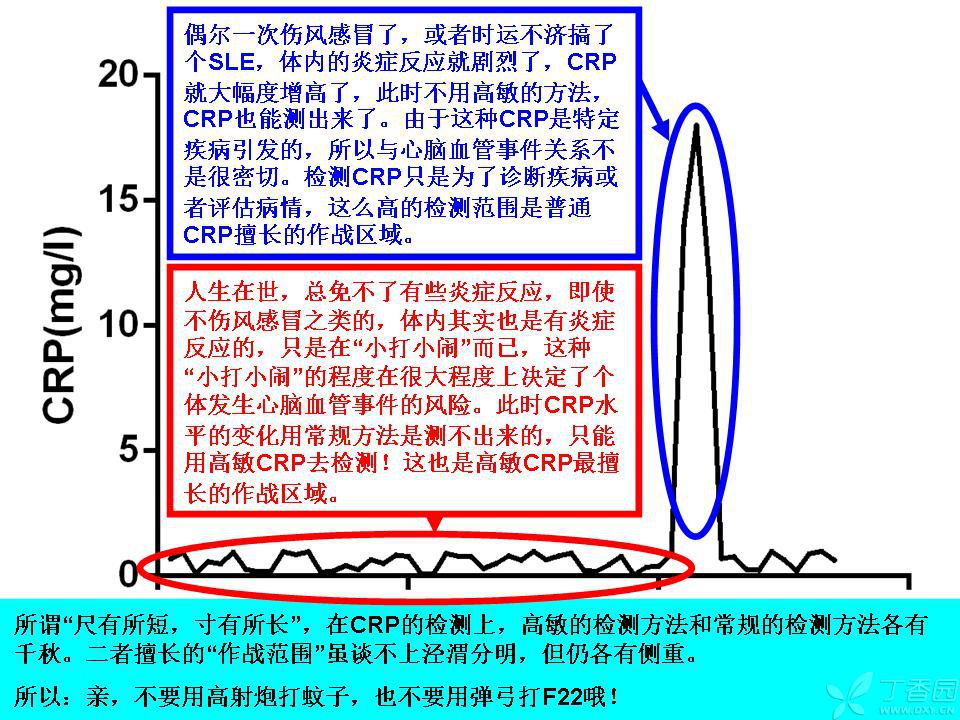
Image source: Dingxiangyuan Forum
Why Are the Reference Ranges Different for the Two?
Since the testing methods are different, the reference ranges are also different.
-
The significance of these types of indicators’ reference ranges is minimal; what is most important is the appropriate range!
The reference ranges for high-sensitivity CRP listed on lab reports are theoretically all appropriate ranges. Please correctly understand the concepts of reference range and appropriate range!
The reference range indicates whether a patient’s indicator is similar to most people; the appropriate range emphasizes that if this indicator exceeds this limit, action should be taken to adjust it.
The text and images in this article are copyrighted by the original author. If there is any infringement, please contact us for deletion. Thank you!!

● Common Causes of Quality Control Failures
● Hepatitis B Five Items with 32 Possible Combinations
● Summary of Clinical Significance for 95 Testing Items
● Impact of Unqualified Samples on Test Results
● Clinical Significance of Complete Tumor Markers and Hormones

If this is useful, just give a “Like“!

 Click the original text, there is valuable content!