1. Medical Robot Applications Are in the Introduction Stage, Automation Is in the Auxiliary Stage
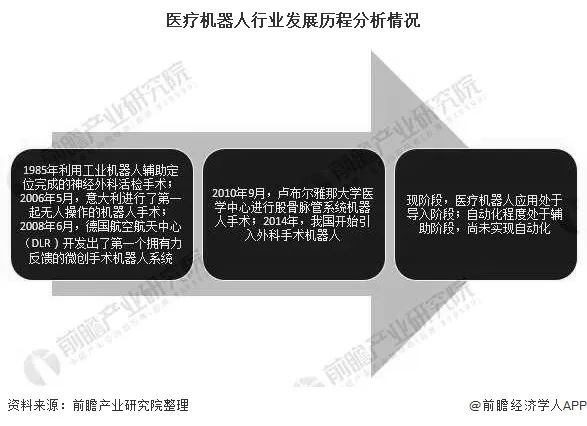
The development of medical robots can be traced back to 1985 when industrial robots were used to assist in positioning for neurosurgical biopsy surgeries, marking the first integration of robotic technology with medicine and opening a new era for medical robots.
Since then, some countries have taken the lead in developing surgical robot technologies to promote the development of medical robots. In September 2010, the University Medical Centre in Ljubljana performed a truly robotic surgery on the femoral vascular system, which did not replicate human hand movements but operated autonomously after pressing a button.
Starting from 2014, China began to introduce surgical robots, which are currently only available in some top-tier hospitals in major cities. Hospitals such as the Second Affiliated Hospital of Kunming Medical University and the Children’s Hospital affiliated with Zhejiang University have introduced the Da Vinci surgical robot.
Overall, the application of medical robots in China’s healthcare sector is still in the introduction stage, with both the technology of the robots and the operational capabilities of medical staff requiring a cultivation process. In terms of automation levels, currently, medical robots are still unable to perform surgeries fully autonomously throughout the entire process, and doctor intervention is still needed during surgeries.
2. The Demand for Medical Robots in China Is Increasing, Yet Market Penetration Is Low
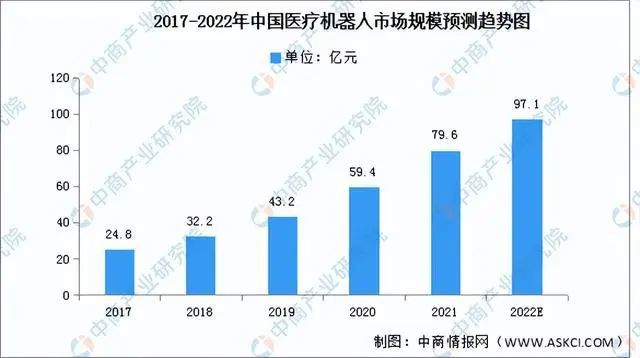
With the accelerating aging population, the demand for medical robots is gradually increasing, and various types of medical robots have been applied. From the perspective of market scale, the current distribution of medical robots in China is mainly concentrated in top-tier comprehensive hospitals and some public hospitals, with market penetration at a low level, accounting for only about 5% of the global medical robot market scale. Data shows that in 2020, the market scale of medical service robots in China reached 5.94 billion yuan, and it is expected to further reach 9.71 billion yuan by 2022.
 3. Rehabilitation Robots Hold the Largest Market Share, Followed by Auxiliary Robots
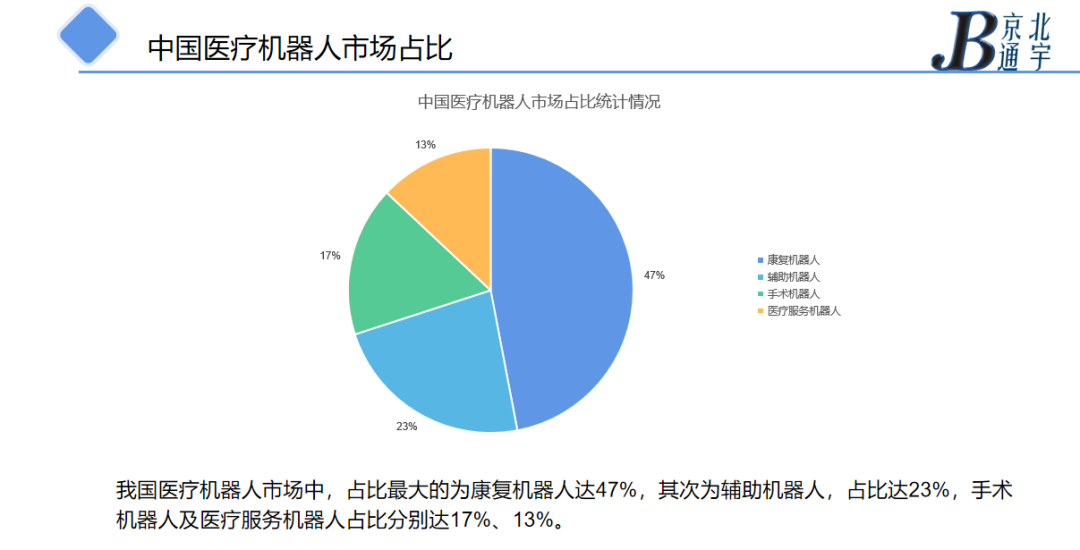
According to the International Federation of Robotics (IFR), medical robots can be classified into four categories: surgical robots, rehabilitation robots, auxiliary robots, and medical service robots. In terms of market structure, rehabilitation robots account for the highest share at 47%; surgical robots account for 17%; auxiliary robots account for 23%; and medical service robots account for 13%.
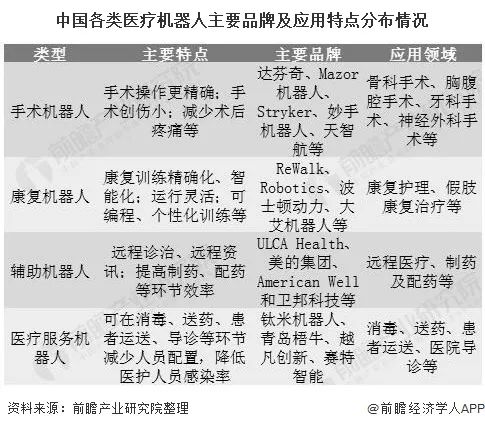
Among the businesses covered by Chinese medical robot companies, those focusing on rehabilitation and auxiliary robots account for a high proportion. More than 10 rehabilitation robot companies in China have completed one or more rounds of financing, and there are approximately 20-30 companies in the entire sector, leading to fierce competition and significant product homogeneity. Companies will compete comprehensively on clinical progress, technological advantages, marketing capabilities, sales abilities, and product pricing. The main brands and application characteristics of various medical robots are as follows:
4. Investment Heat Has Declined, with Over 300 Million Yuan Invested in the Industry in 2019
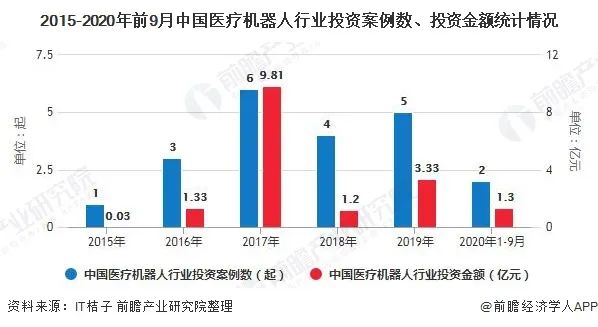
From the perspective of industry investment and financing, between 2015 and 2019, the investment heat in China’s medical robot field showed a trend of increasing first and then decreasing. In 2017, the investment heat was high, with the number of investments and investment amounts reaching 6 and 981 million yuan, respectively. Due to the impact of the capital winter, the investment heat in medical robots declined in 2018-2019, with the number of investment cases dropping to 5 in 2019 and the investment amount being 333 million yuan.
5. Development Prospects of the Medical Robot Industry
1. Favorable Policies Promote the Development of Medical Robots
Since 2016, the state has successively issued a series of important policy documents to promote the transformation and upgrading of Chinese manufacturing, with the medical field being a key focus of support for the research and production of medical robots. With the continuous introduction of favorable policies, China’s medical robot industry is entering a phase of rapid development.In February 2021, the Ministry of Industry and Information Technology released the “Development Plan for the Medical Equipment Industry,” proposing to tackle intelligent surgical robots, enhance smart control functions such as real-time navigation and force sensing during treatment processes, and promote the standardized application of surgical robots in treating major diseases. It aims to develop health rehabilitation equipment that integrates clinical logic, sensing and control technology, and artificial intelligence algorithms, as well as new nursing and rehabilitation equipment based on robots, intelligent vision, voice interaction, brain-machine interfaces, and intelligent control technologies.
2. The Aging Population Accelerates the Development of Medical Robots
China has a large elderly population, and since entering an aging society in 2000, the degree of population aging has continued to deepen. In 2021, the population aged 60 and above reached 267.36 million, an increase of 9.92 million from the previous year, accounting for 18.9% of the national population, an increase of 0.7 percentage points from the previous year. The population aged 65 and above exceeded 200 million, reaching 200.56 million, an increase of 3.34 million from the previous year, accounting for 14.2% of the national population, an increase of 0.2 percentage points from the previous year. In recent years, medical robots have become the preferred elderly care equipment under the smart elderly care model, and apart from companion robots, rehabilitation robots, surgical robots, and exoskeleton robots are expected to see wider applications, accelerating the development of medical robots.
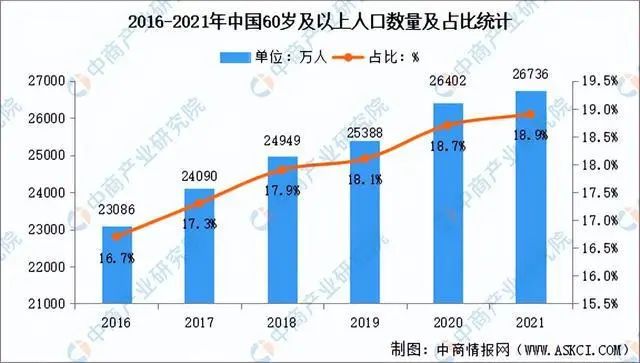 Data Source: Organized by the China Business Industry Research Institute
3. Cutting-edge Technologies Deeply Integrate to Promote the Intelligent Development of Medical Robots
As medical robots deeply integrate with cutting-edge technologies such as artificial intelligence, brain-machine interaction, 5G networks, AR/VR, and big data, it will further enhance the interaction level with doctors and patients, and enable more precise perception of data, objects, and environments, promoting the intelligent development of medical robots and achieving integrated intelligent healthcare.
Source: Electronic Components Supermarket
 END
END

Wuhan Hubei  Previous Review@【Focus on Health Expo】Technology Innovation Safeguards Public Health – Observations from the 2022 World Health Expo

@【Focus on Health Expo】What Is the Future Path of Big Health? Chen Dongsheng, Li Xiting, Liu Qingfeng, and others Discuss “Health” in Wuhan

@Focus on Health Expo | Mindray Medical’s Smart Healthcare Ecosystem Appears at the 2022 Health Expo