In our daily work and life, we often use various electronic or electrical products, such as computers, mobile phones, televisions, refrigerators, washing machines, etc.If we take these products apart, we will see a green board like the one below.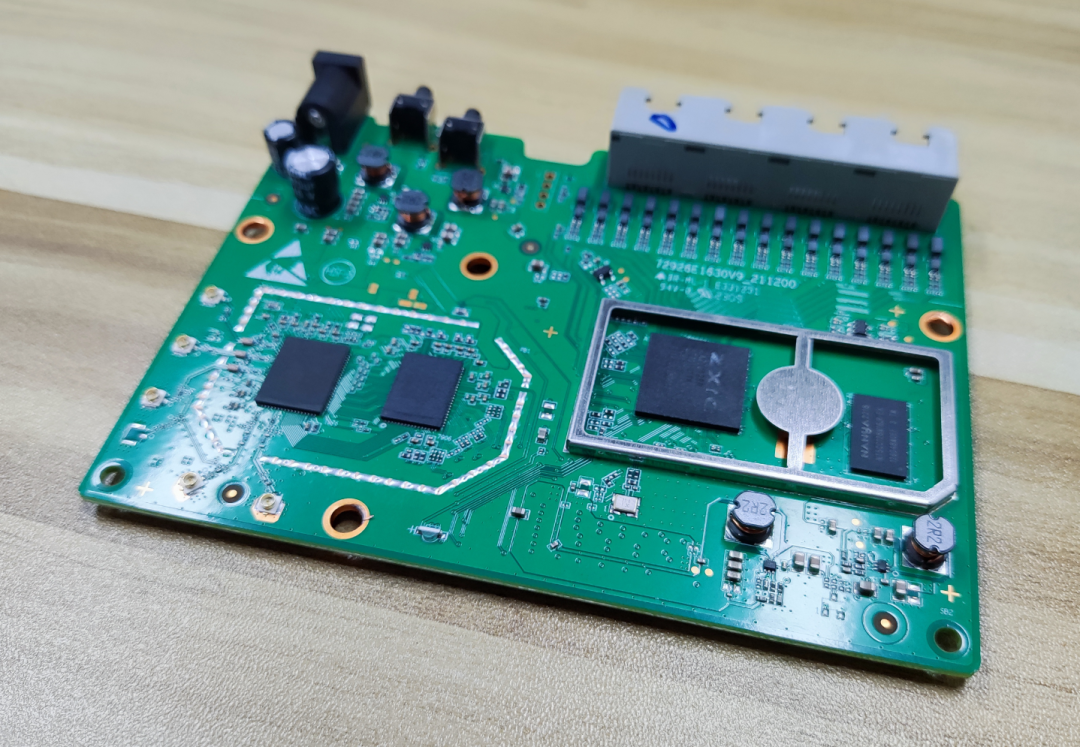 Sometimes it can be blue or black.Everyone knows that this green board is called a circuit board. A more official name is printed circuit board, or PCB (Printed Circuit Board; sometimes referred to as PWB, Printed Wire Board, abroad).On the PCB, many electronic components are soldered, such as capacitors, resistors, inductors, etc.We can also see some black square components.That’s right, this component is likely a chip (called a chip in English).
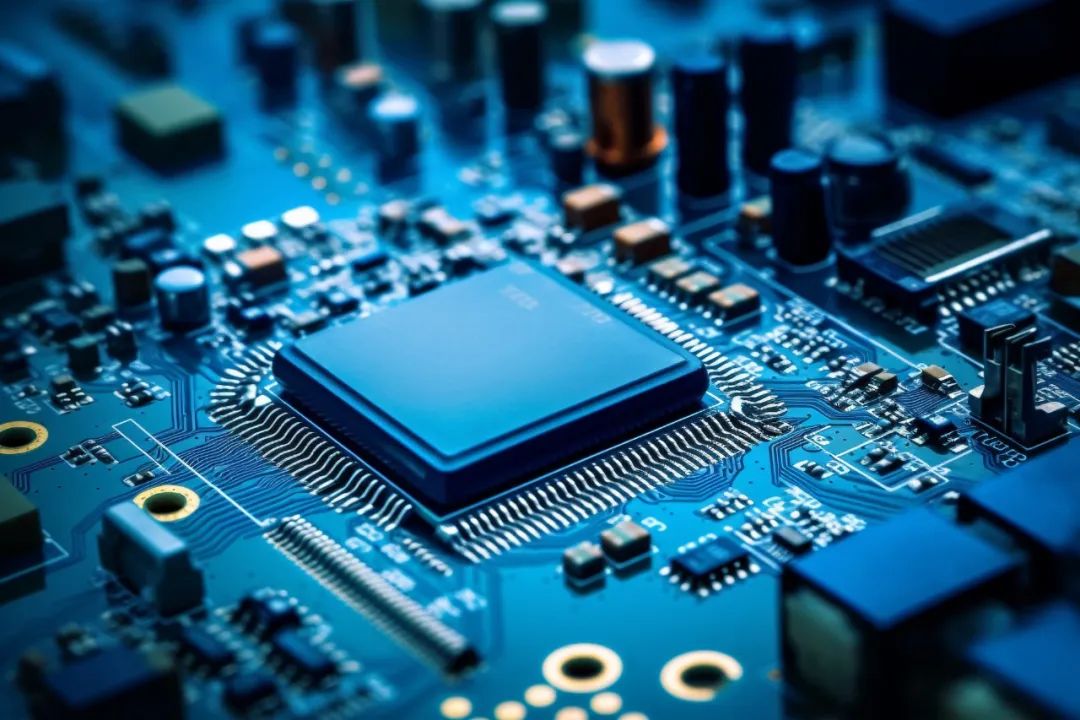 █ Definition of ChipA chip is actually a rather vague term.For electronic devices, it is hidden inside and very important, equivalent to the engine of a car or the heart of a person, hence the term “core”. In terms of shape, it is in pieces, hence the term “chip”. Together, it is called “chip”.Generally speaking, a chip is an integrated circuit (integrated circuit). The two can be equated and used interchangeably.An integrated circuit is relatively easy to define. It is formed by integrating electronic components such as transistors, resistors, capacitors, and diodes onto a single substrate using specific technologies, creating a miniature circuit, known as an integrated circuit.If this substrate is made of semiconductor materials (such as silicon), or if the integrated circuit is made from semiconductor material wafers, it belongs to semiconductor integrated circuits.In the traditional sense, when we refer to integrated circuits, we are basically talking about semiconductor integrated circuits. Therefore, sometimes the terms semiconductor, chip, and integrated circuit are used interchangeably.If we delve deeper, there are still some differences between chips and integrated circuits.Some industry opinions suggest:Integrated circuits are circuits, the basic units, primarily emphasizing the realization of a specific function, such as a logical operation. This terminology is used more in circuit design and other scenarios.In contrast, a chip is a more macro and product-oriented concept. After design, manufacturing, packaging, and testing, it forms a directly usable product form, considered a chip. When emphasizing usage, people are more likely to use the term “chip”, such as CPU chips, AI chips, baseband chips, etc.Some also define a chip as: “a general semiconductor component product that contains one or more integrated circuits and can realize a specific function”. Or, a chip is a general term for semiconductor component products.In contrast, the differences between semiconductors and integrated circuits are clearer:Semiconductors include: integrated circuits + discrete devices + optoelectronic devices + sensors.The main difference between integrated circuits and the other three lies in the level of integration. The number of transistors in integrated circuits is far greater than in discrete devices, optoelectronic devices, and sensors. Additionally, the substrate materials are generally different.Currently, the combined market size of optoelectronic devices, discrete devices, and sensors accounts for only about 10% of the total semiconductor market size.Therefore, we can say that integrated circuits are the most important component of semiconductors.█ Classification of ChipsA chip is a set of circuits that achieve specific functions. It has modular characteristics, allowing manufacturers to quickly design and develop products, reducing development difficulty and shortening development cycles.For decades, semiconductor processes have rapidly developed under the guidance of Moore’s Law, making chips smaller and accommodating more circuits, significantly reducing the size, cost, and power consumption of electronic products.It has not only improved our quality of life but also led the information technology revolution, promoting the progress of human civilization.
 With chips, we have mobile phones.Today, chips have a wide range of applications and have given rise to many categories.The classification method of the World Semiconductor Trade Statistics (WSTS) is relatively authoritative and official. They categorize all integrated circuits into: analog (Analog), micro (Micro), logic (Logic), and memory (Memory).On an unofficial level, the classification is more casual.By function, we often classify chips as: computing chips, memory chips, communication chips, sensing chips, energy chips, interface chips.Some familiar types of chips include:
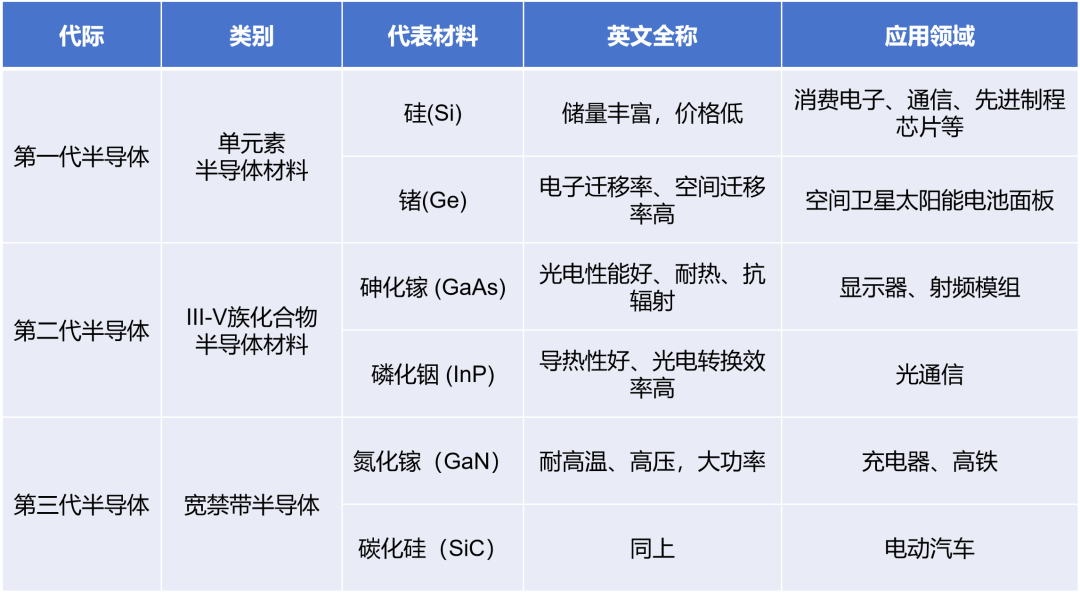
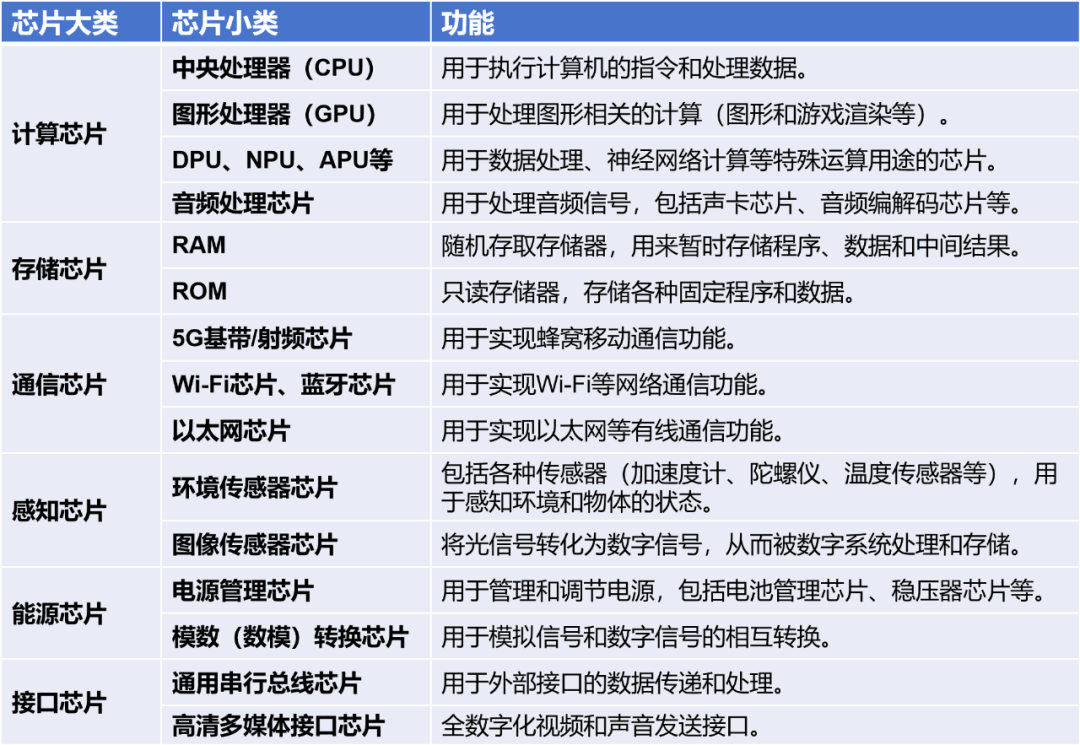 By grade, chips can also be divided into consumer grade, industrial grade, automotive grade, military grade, and aerospace grade. By design philosophy, they can also be divided into general-purpose chips (CPU, GPU, etc.) and dedicated chips (AISC).We can also categorize them by process technology, such as the commonly heard 28nm, 14nm, 7nm, 5nm. Or, by semiconductor materials, such as silicon (Si), germanium (Ge), gallium arsenide (GaAs), and gallium nitride (GaN). We will introduce these further when discussing the chip manufacturing process.
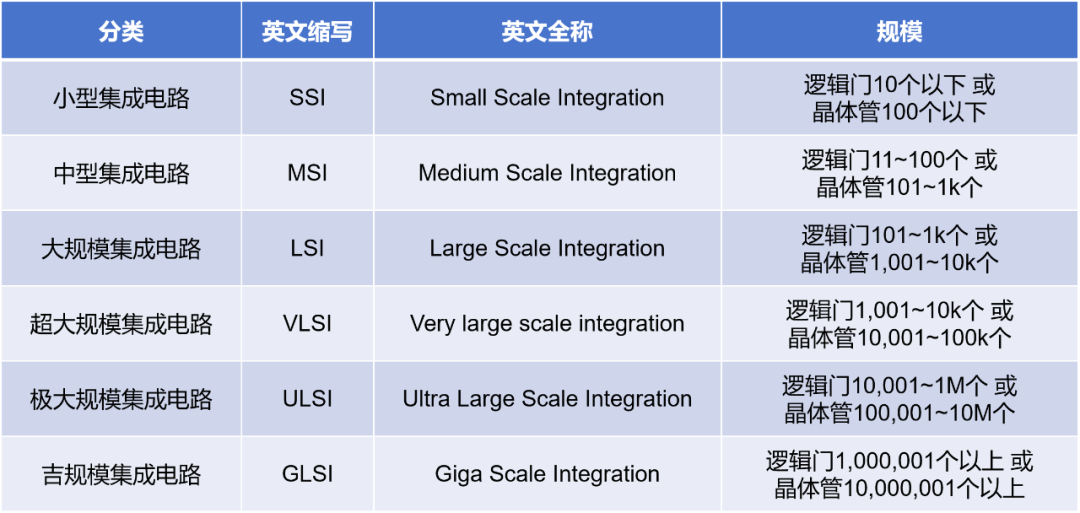
In fact, apart from electronic chips, we have also developed optical chips (such as silicon photonics technology), which use light instead of current to transmit signals.From the perspective of integrated circuits, there are many classifications.By manufacturing process, integrated circuits can be divided into semiconductor integrated circuits and film integrated circuits (film integrated circuits use metals and ceramics, etc.). Film integrated circuits can be further divided into thick-film (thick-film) integrated circuits and thin-film (thin-film) integrated circuits.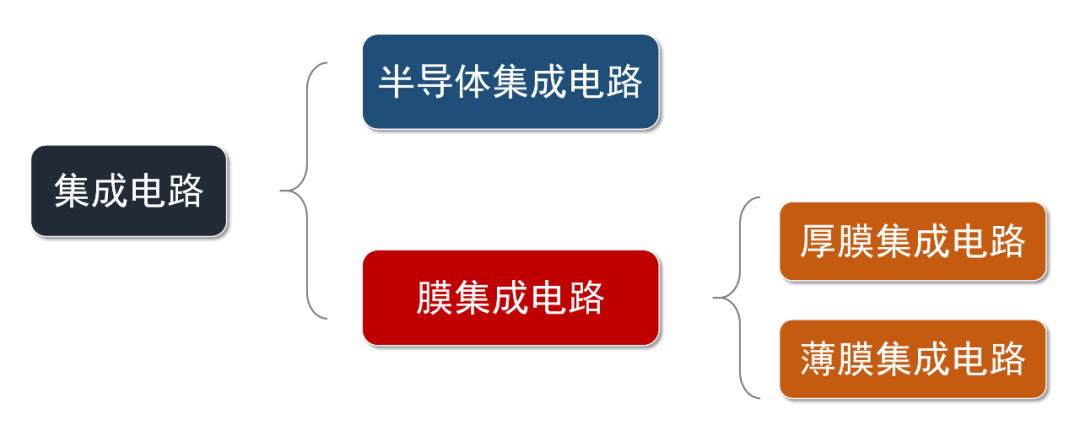 By circuit attributes, we can also classify into digital integrated circuits, analog integrated circuits, and mixed-signal integrated circuits.Digital integrated circuits, as the name suggests, process digital signals. They are found most frequently around us, such as microprocessors (CPU, GPU, etc.), digital signal processors (DSP), and microcontrollers (MCU), all of which are digital integrated circuits.Analog integrated circuits are used more in sensors, power supply chips, operational amplifiers, etc., mainly for amplifying, filtering, demodulating, and mixing analog signals.Mixed-signal integrated circuits integrate both analog and digital circuits on a single chip. As you can guess, analog-to-digital (ADC) and digital-to-analog (DAC) conversion chips belong to this category.By the number (scale) of microelectronic devices integrated on the chip, integrated circuits can be classified into the following categories:
 More professionally, by conductivity type, integrated circuits can also be divided into bipolar integrated circuits and unipolar integrated circuits.Bipolar integrated circuits have complex manufacturing processes and higher power consumption; representative integrated circuits include TTL, ECL, HTL, LST-TL, STTL, etc.Unipolar integrated circuits have simpler manufacturing processes, lower power consumption, and are easier to make into large-scale integrated circuits; representative integrated circuits include CMOS, NMOS, PMOS, etc.The above terms will be explained in detail when the author discusses the working principles of chips later.█ Internal Structure of ChipsEarlier we mentioned that chips appear as black square pieces.Sometimes, they also have a silver metal cover (for added protection and heat dissipation). For example, our CPU:
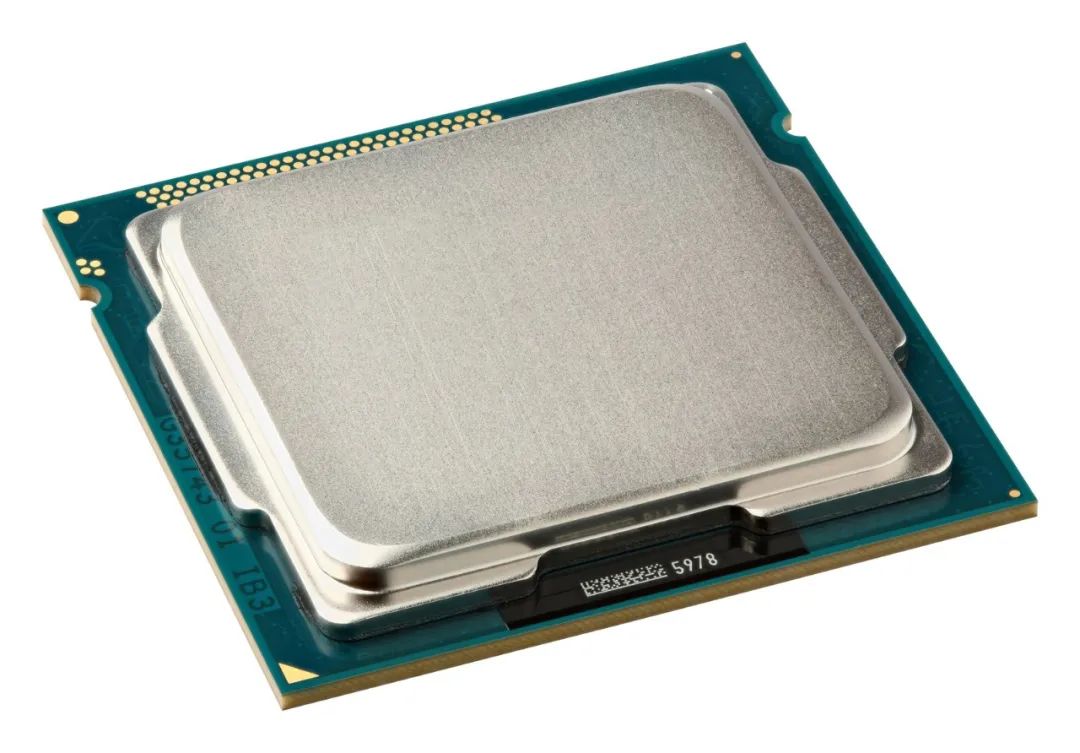 CPU cover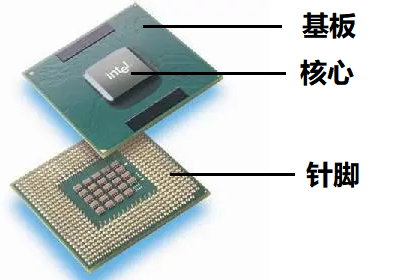
CPU appearance
Chips are only transformed into this after packaging (a process in chip manufacturing).We need to remove the “shell” to see the core of the chip. Under a microscope, it looks like this: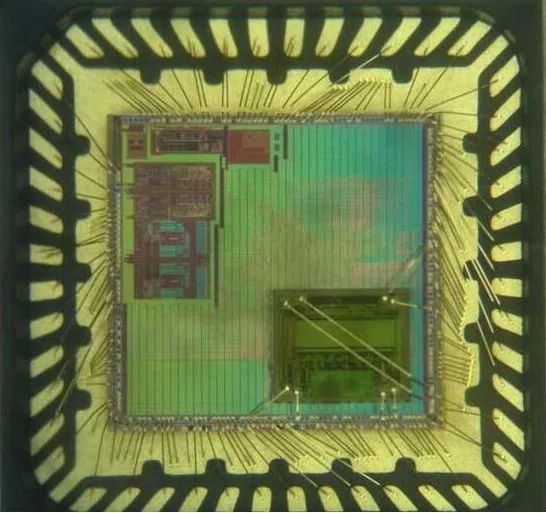 The outer circle consists of pins (pins). The thin lines are wire bonds. The square part in the center is the actual circuit of the chip.If we continue to zoom in, it looks like this:
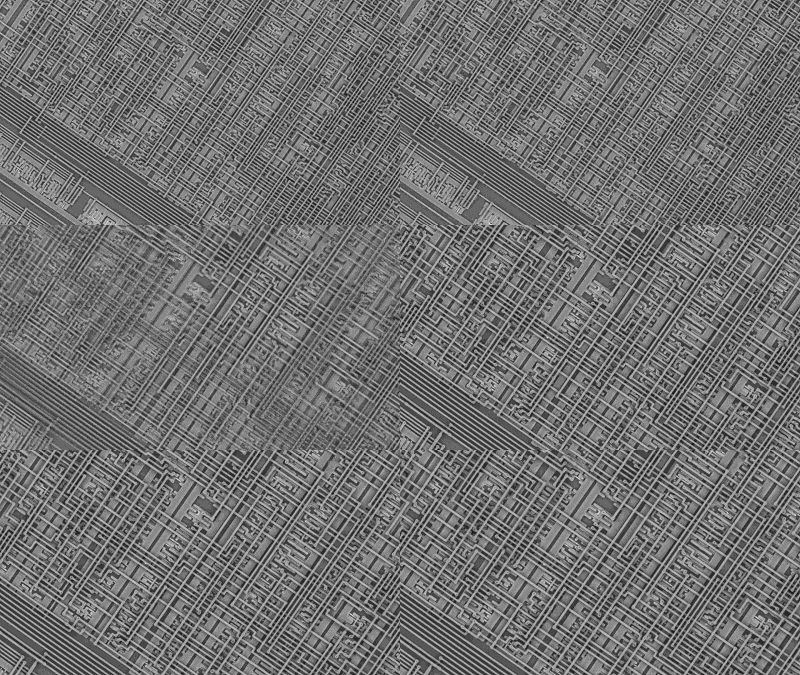 In 3D, it looks like this:
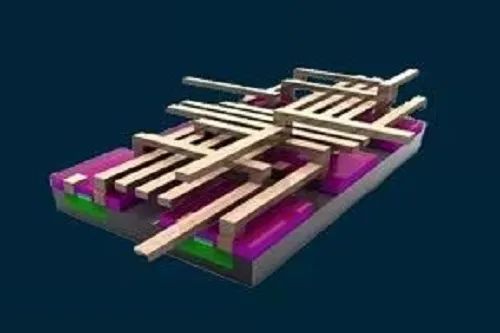 Indeed, they are all three-dimensional, with many layers, densely packed, resembling a super maze, like a futuristic city.In the image, each line connects to a transistor.The number of transistors in a chip usually represents its capability. The more transistors there are, the more circuits there are, and the stronger the functions and computing power. Nowadays, many manufacturers emphasize how many transistors their chips contain, which is the meaning behind it.
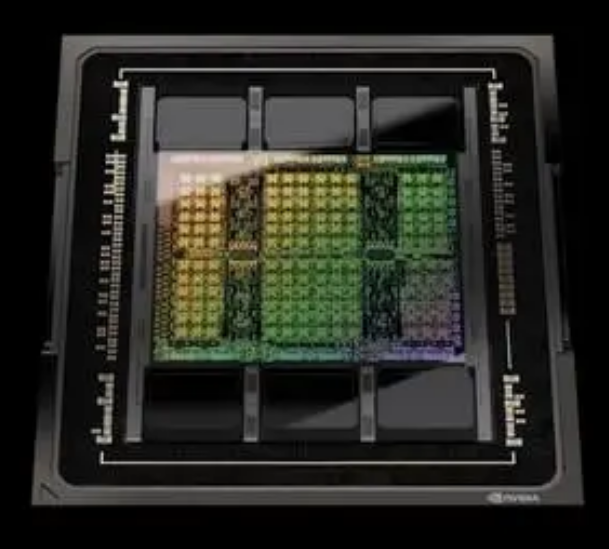 NVIDIA’s H100 GPU has 80 billion transistors.There are simple chips (relatively speaking) and complex chips. Some complex chips are further divided into different functional modules. These modules together form a system, becoming an SoC (System on Chip, system-on-chip, system-level chip).Our mobile phone’s main chips, such as Qualcomm Snapdragon, MediaTek Dimensity, Huawei Kirin, are typical SoC chips. The chip includes CPU, GPU, APU, ISP, baseband, RF, etc.
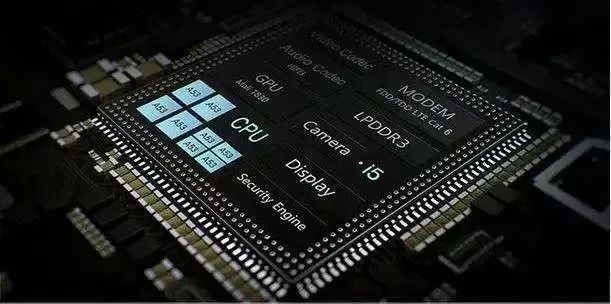 Now, the question arises: why can the transistors in the chip perform various tasks such as computing and storage?What do we mean by logic gates, MOSFETs, FinFETs, and PN junctions?To be continued… This article is reproduced from the WeChat public account “Fresh Date Classroom” // Selected articles from 50 years of “Physics”
What is a neutron bomb? | Selected articles from 50 years of “Physics”
A historical review of research on crystal defects | Selected articles from 50 years of “Physics”
Phase transitions and critical phenomena (I) | Selected articles from 50 years of “Physics”
Phase transitions and critical phenomena (II) | Selected articles from 50 years of “Physics”
Phase transitions and critical phenomena (III) | Selected articles from 50 years of “Physics”
A review and outlook on condensed matter physics | Selected articles from 50 years of “Physics”
Acoustics and ocean development | Selected articles from 50 years of “Physics”
The role of models in the development of physics | Selected articles from 50 years of “Physics”
My memories of Wu Youxun, Ye Qisun, and Sa Bendong | Selected articles from 50 years of “Physics”
The National Southwest Associated University Physics Department – A unique flower in the Chinese physics community during the Anti-Japanese War (I) | Selected articles from 50 years of “Physics”
The National Southwest Associated University Physics Department – A unique flower in the Chinese physics community during the Anti-Japanese War (II) | Selected articles from 50 years of “Physics”
The discovery of nuclear fission: history and lessons – Commemorating the 60th anniversary of the discovery of nuclear fission phenomena | Selected articles from 50 years of “Physics”
A review and outlook – Commemorating the 100th anniversary of the birth of quantum theory | Selected articles from 50 years of “Physics”
My research career – Huang Kun | Selected articles from 50 years of “Physics”
A model of the combination of theoretical physicists and biologists in China – A historical contribution of Tang Peisong and Wang Zhuxi to the study of the relationship between water and plant cells (Part 1) | Selected articles from 50 years of “Physics”
A model of the combination of theoretical physicists and biologists in China – A historical contribution of Tang Peisong and Wang Zhuxi to the study of the relationship between water and plant cells (Part 2) | Selected articles from 50 years of “Physics”
In memory of the forgotten – Recollections of Ye Qisun in his later years | Selected articles from 50 years of “Physics”
From the perspective of molecular biology – A cross-disciplinary view – Commemorating the 50th anniversary of the publication of the golden spiral paper | Selected articles from 50 years of “Physics”
Beauty can be expressed – Mathematical equations describing flower morphology | Selected articles from 50 years of “Physics”
Einstein: A portrait on a stamp | Selected articles from 50 years of “Physics”
Fun facts about the physics of ball sports | Selected articles from 50 years of “Physics”
In an instant, ninety years | Selected articles from 50 years of “Physics”
A classic work that has trained generations of physicists – Review of “Theory of Lattice Dynamics” | Selected articles from 50 years of “Physics”
Landau’s centenary | Selected articles from 50 years of “Physics”
In the language of heaven, explain the way of physics | Selected articles from 50 years of “Physics”
Soft matter physics – A new discipline in physics | Selected articles from 50 years of “Physics”
Cosmology in the past 80 years | Selected articles from 50 years of “Physics”
Entropy is not a commodity – the Myth of Entropy | Selected articles from 50 years of “Physics”
Evolutionary phenomena in physics | Selected articles from 50 years of “Physics”
Purdue notes – Starting from the 2010 Nobel Prize in Chemistry | Selected articles from 50 years of “Physics”
My learning and research experience | Selected articles from 50 years of “Physics”
Weather forecasting – From experience to physical mathematics theory and supercomputing | Selected articles from 50 years of “Physics”
Commemorating the 100th anniversary of Bohr’s “Great Trilogy” and the 100th anniversary of the establishment of the physics department at Peking University | Selected articles from 50 years of “Physics”
History and status of synchrotron radiation | Selected articles from 50 years of “Physics”
The origin of concepts in Maxwell’s equations and gauge theory | Selected articles from 50 years of “Physics”
Space science – The source of exploration and discovery | Selected articles from 50 years of “Physics”
The establishment and role of Maxwell’s equations | Selected articles from 50 years of “Physics”
Topological phases and topological phase transitions in condensed matter materials – Interpretation of the 2016 Nobel Prize in Physics | Selected articles from 50 years of “Physics”
Several Chinese physics masters I am familiar with | Selected articles from 50 years of “Physics”
The interpretation problem of quantum mechanics | Selected articles from 50 years of “Physics”
Challenges in high-temperature superconductivity research | Selected articles from 50 years of “Physics”
Unconventional superconductors and their properties | Selected articles from 50 years of “Physics”
Vacuum is not empty | Selected articles from 50 years of “Physics”
General quantum computers and fault-tolerant quantum computing – Concepts, status, and prospects | Selected articles from 50 years of “Physics”
Talking about books and people: How was “Tutorial on Theoretical Physics” written? | Selected articles from 50 years of “Physics”
Struggle, opportunity, physics | Selected articles from 50 years of “Physics”
Basic principles of quantum mechanics | Selected articles from 50 years of “Physics”
Space-time singularities and black holes – Interpretation of the 2020 Nobel Prize in Physics | Selected articles from 50 years of “Physics”
A new chapter in condensed matter physics – Topological quantum states beyond the Landau paradigm | Selected articles from 50 years of “Physics”
The art of thinking in physics | Selected articles from 50 years of “Physics”
Is the low-speed limit of Lorentz transformation in Maxwell’s equations Galileo transformation? | Selected articles from 50 years of “Physics”
The research taste and style of Mr. Yang Zhenning and their implications for cultivating outstanding talents | Selected articles from 50 years of “Physics”
Poincaré’s special relativity – Part 1: The discovery of the Lorentz group | Selected articles from 50 years of “Physics”