 Source: Content from Ruichuang Electronics, thank you!
With the continuous fluctuations in domestic and international oil prices, the new energy vehicle market is booming. However, the upstream automotive-grade MCU chips are in short supply. So what are automotive-grade MCU chips, and how are they different from ordinary chips? Today, we will reveal the secrets and explore their magical aspects.
Types of MCU Chips
Before understanding what automotive-grade chips are, let’s first look at the types of MCU chips:
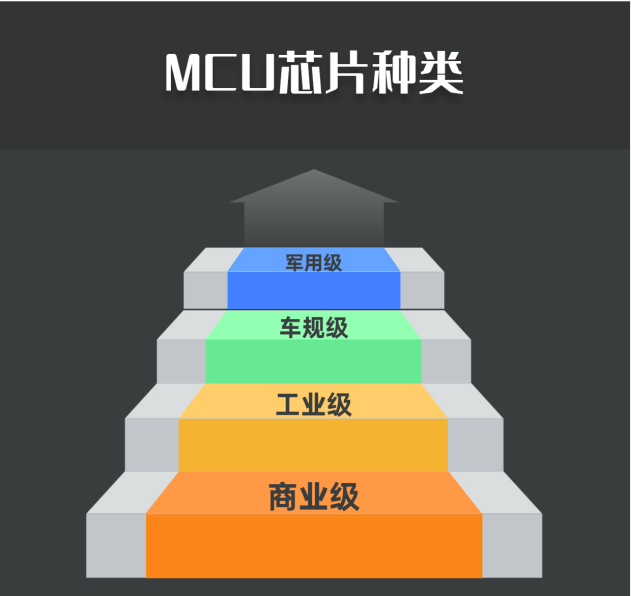
The classification of MCU chips mainly includes the following four types: commercial grade (also known as consumer grade), industrial grade, automotive grade, and military grade. Their classification standards mainly have the following differences:
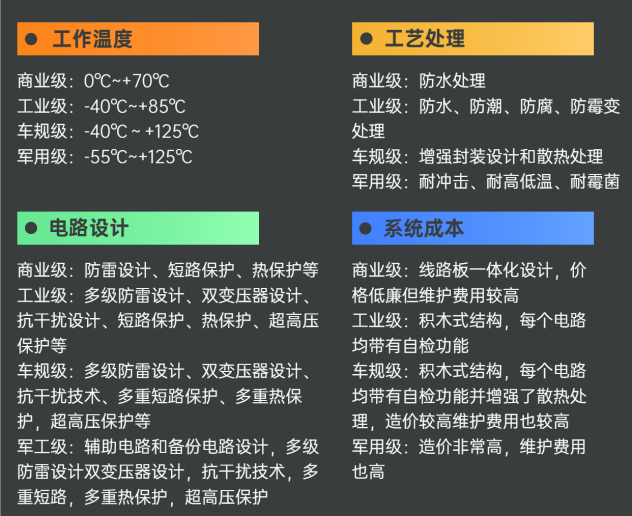
In terms of operating temperature: Commercial-grade chips operate between 0℃~+70℃. Industrial-grade chips can reach -40℃~+85℃. Automotive-grade chips can withstand high temperatures up to 125℃, with an operating temperature range of -40℃ to +125℃. Military-grade chips excel in low temperatures compared to automotive-grade chips, with an operating temperature range of -55℃~+125℃.
In terms of processing: Commercial-grade chips are only waterproofed. Industrial-grade chips add moisture-proof, corrosion-proof, and anti-mold treatments on top of waterproofing. Automotive-grade chips enhance packaging design and heat dissipation based on industrial-grade chips. Military-grade chips, compared to automotive-grade chips, are more resistant to shock, extreme temperatures, and mold.
In terms of circuit design: Commercial-grade chips have lightning protection, short-circuit protection, and thermal protection circuit designs. Industrial-grade chips implement multi-level lightning protection, dual transformer design, anti-interference design, short-circuit protection, thermal protection, and ultra-high voltage protection based on commercial-grade chips. Automotive-grade chips add multiple short-circuit protections, multiple thermal protections, and ultra-high voltage protection circuit designs on top of industrial-grade chips. Military-grade chips also add auxiliary circuits and backup circuit designs, along with multi-level lightning protection and dual transformer designs.
In terms of system cost: Commercial-grade chips use integrated circuit board designs, which are cheap but have high maintenance costs. Industrial-grade chips use a modular structure, with each circuit having a self-checking function. Automotive-grade chips also use a modular structure but enhance heat dissipation on top of industrial-grade chips, resulting in higher costs and maintenance expenses. Military-grade chips are very expensive, with the highest maintenance costs among these types of chips.
Automotive-grade Chips
In the automotive manufacturing industry, the reliability requirements for automotive-grade chips are undoubtedly higher than for commercial-grade and industrial-grade chips.
Automotive-grade chips, as the name suggests, are chips used in vehicles. They differ from consumer and industrial products in that they have higher reliability requirements, such as operating temperature range, operational stability, and defect rates. Meanwhile, automotive-grade chips that meet these reliability requirements are also considered the highest entry threshold in this industry.
So, what verifications must automotive-grade chips undergo to obtain this qualification?

Automotive Market Entrance Ticket—Automotive-grade Certification
1、 IATF 16949
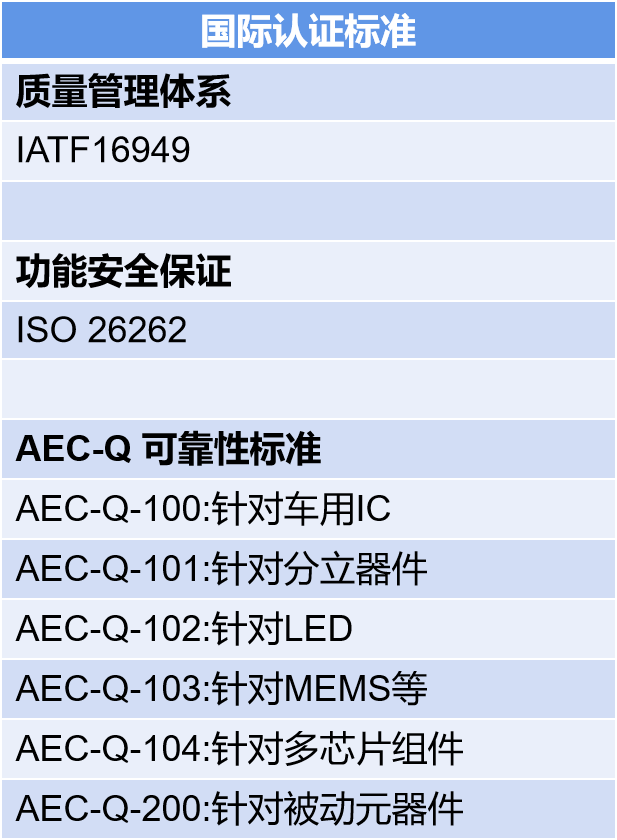
In October 2016, the International Automotive Task Force (IATF) officially released IATF 16949:2016, replacing ISO/TS 16949:2009 as the standard for quality management in the automotive industry. The goal of the new standard is to standardize the quality management system requirements for organizations in the automotive industry to achieve continuous improvement, emphasize defect prevention, and reduce variation and waste in the supply chain.
IATF 16949:2016 is a globally recognized quality management standard for the automotive industry, covering the relevant requirements for effectively operating a Quality Management System (QMS). This standard is closely related to critical business operations, making it a mandatory requirement for many automotive manufacturers (OEMs) and suppliers.
The IATF members consist of OEMs and national automotive industry associations representing suppliers. The group has established five supervisory offices, commonly known as IATF Global Oversight Offices, to implement and manage the IATF 16949 certification scheme. The IATF is the only recognized body for IATF 16949 certification, and only certification bodies recognized by the IATF are allowed to conduct IATF 16949 certification audits and issue certificates bearing the IATF recognition mark.
The IATF 16949 standard is based on the internationally accepted ISO 9001 standard, supplemented by the specific requirements of the automotive industry. It is a technical specification for the international automotive industry, with clear targeting and applicability: this specification only applies to vehicle manufacturers and their direct parts manufacturers. These manufacturers must be directly involved in automotive production, able to carry out manufacturing activities that add value to the products. There are strict limitations on the qualifications of certified enterprises. Units that only have supporting functions, such as design centers, company headquarters, and distribution centers, cannot independently obtain IATF 16949:2016 certification.
Manufacturers that produce equipment and tools for vehicle manufacturers or automotive parts manufacturers also cannot obtain IATF 16949:2016 certification.
2、ISO 26262
ISO 26262 is derived from the basic standard IEC 61508 for electronic, electrical, and programmable device functional safety, primarily targeting specific electrical components, electronic devices, and programmable electronic devices used in the automotive industry, aiming to improve the functional safety of automotive electronic and electrical products. It classifies automotive electronic functional safety standards from low to high levels: ASIL-A, ASIL-B, ASIL-C, ASIL-D.
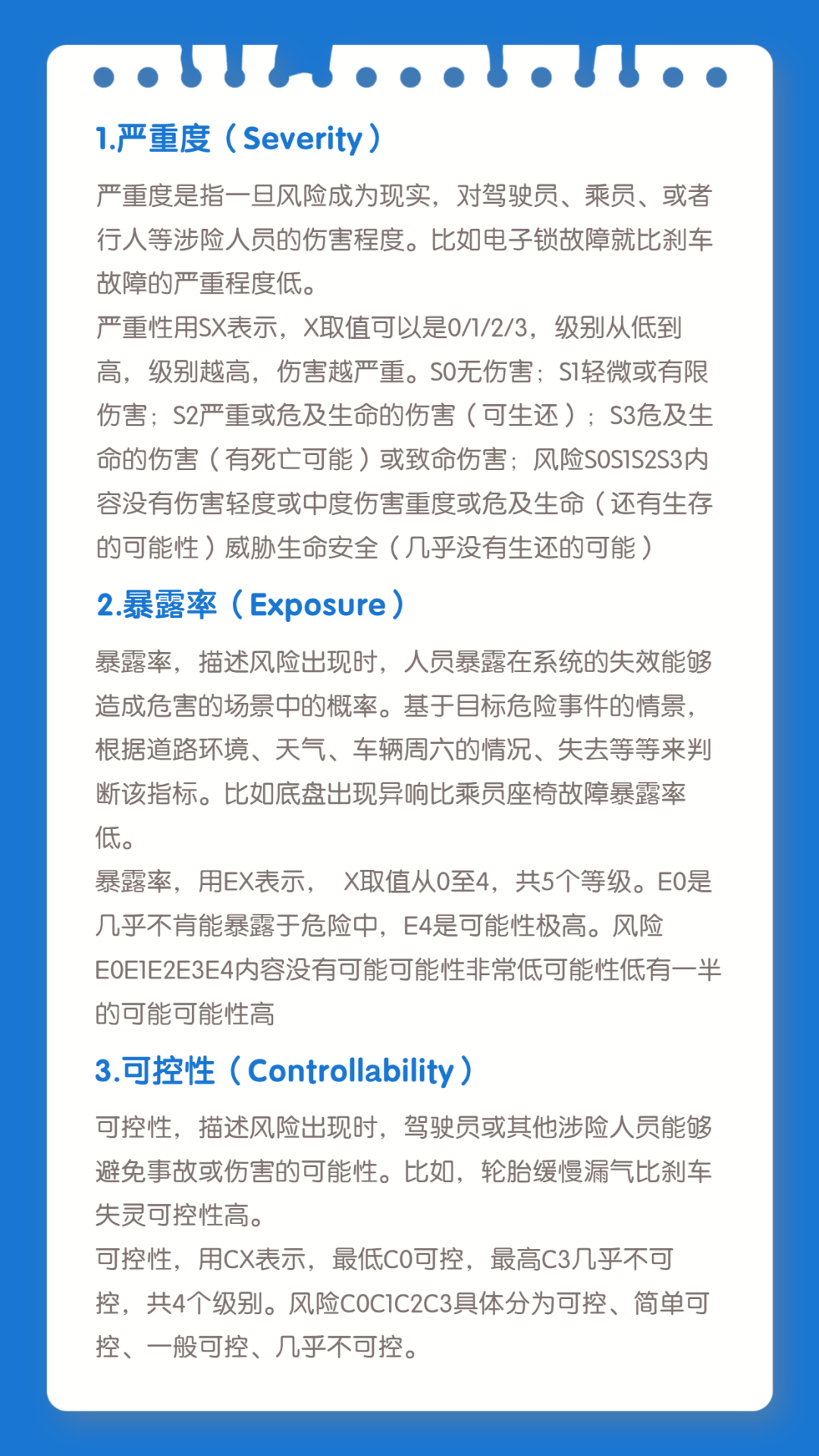
Currently, ISO 26262 is one of the indicators for determining whether chip products qualify for automotive use.
3、AEC-Q
AEC-Q series certification is a recognized general testing standard for automotive-grade components. IC design companies looking to enter the automotive electronics field and the automotive electronic components supply chain must obtain AEC-Q series certification.
Automotive electronics mainly rely on the Automotive Electronics Council (AEC) as the verification standard for automotive-grade components, including AEC-Q100 (integrated circuits IC), AEC-Q101 (discrete components), AEC-Q102 (discrete optoelectronic LEDs), AEC-Q103 (sensors), AEC-Q104 (multi-chip components), and AEC-Q200 (passive components), with testing conditions that are stricter than those for consumer-grade chips.
AEC-Q100 is one of the indicators for determining whether chip products qualify for automotive use, focusing on quality reliability. Its key testing categories include:
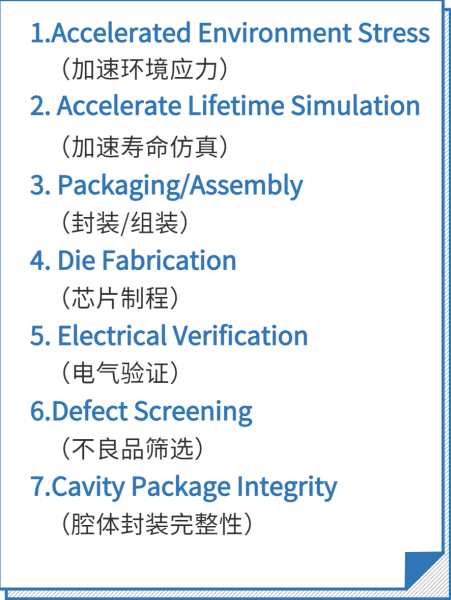
Only after fully passing 41 tests across 7 major categories can one obtain AEC-Q100 certification. Completing all AEC-Q series certification tests typically requires an average of about 6 months.
Automotive-grade Chips Available in the Market
1、Power Chips
The new energy vehicle sector is the main source of demand for power devices. Among them, the major incremental devices are IGBT modules, SiC modules, MOSFETs, and GaN products. The newly added power devices are mainly used in main drive inverters, on-board chargers (OBC), and DC-DC converters in power system components.
2、Computing and Control Chips
Computing and control chips are the “eyes” of intelligent vehicles, mainly consisting of microcontrollers and logic ICs, including main control chips and auxiliary chips. From the application scenario perspective, computing chips can be divided into smart cockpit chips and autonomous driving chips, as well as body control chips.
3、Storage Chips
Primarily used for data storage functions, including DRAM (dynamic memory), SRAM (static memory), FLASH (flash memory chips), etc.
4、Sensor Chips
Mainly used to detect and sense external signals and convert the detected information into electrical signals or other required forms to transmit to other devices. This includes CMOS image sensors (CIS), image signal processors (ISP), laser radar chips, etc.
5、Communication Chips
Primarily used for sending, receiving, and transmitting communication signals, including baseband chips, RF chips, channel chips, and power line carrier communication chips.
6、Analog Chips
Analog chips are used in various parts of the vehicle, including the body, dashboard, chassis, powertrain, and ADAS, mainly divided into signal chain chips and power management chips.
7、Power Management Chips
Automotive power management chips (PMIC) are widely used in intelligent cockpits, autonomous driving, body electronics, dashboards and entertainment systems, lighting systems, and BMS.
8、Driver Chips
The performance of driver chips determines key performance indicators of the vehicle, such as climbing ability, acceleration ability, and maximum speed.
9、Safety Chips
Automotive safety chips are a type of automotive-grade chip that mainly includes standards such as AEC and ISO 26262, with functions to control the safety, efficiency, and comfort of the vehicle.
Scan the code for a free trial and consultation on IC courses!


E课网 (www.eecourse.com) is a professional integrated circuit education platform under Moore Elite, dedicated to cultivating high-quality professional talents in the semiconductor industry. The platform is oriented towards the job needs of integrated circuit companies, providing training platforms that fit the corporate environment and quickly training students to meet corporate demands through online and offline training methods.
E课网 has a mature training platform, a complete course system, and a strong faculty, planning 168 premium courses for the semiconductor industry, covering the entire integrated circuit industry chain, and has four offline training bases. To date, it has deeply trained a total of 15,367 people, directly supplying 4,476 professional talents to the industry. It has established deep cooperative relationships with 143 universities and has held 240 corporate-specific IC training sessions.