Theoretical Research on the Self-assembly
System of Molecularly Imprinted Polymers
Formed via Phenobarbital and Acrylamide
WANG Guang-Yu (王光宇) LIU Jun-Bo (刘俊渤) TANG Shan-Shan (唐珊珊)
CHANG Hai-Bo (常海波) JIN Rui-Fa (靳瑞发)
Chinese J. Struct. Chem., 38, 1069 (2019)
To prepare phenobarbital (PHN) molecularly imprinted polymers (MIPs) with higher adsorption and selectivity, this paper employed quantum chemical density functional theory M062X method and 6-31G (d,p) basis set, using PHN as the imprinted molecule and acrylamide (AM) as the functional monomer. The cross-linking agents used were ethylene glycol dimethacrylate (EGDMA), trimethylolpropane trimethacrylate (TRIM), divinyl benzene (DVB), and pentaerythritol trimethacrylate (PETA), while acetonitrile (ACN), chloroform (CHF), toluene (TL), and tetrahydrofuran (THF) were used as solvents. The configurations of the molecular imprinting self-assembly system for PHN and AM were simulated to study the bonding sites, binding energy, number of hydrogen bonds, and interaction mechanisms. The essence of the imprinting interaction between PHN and AM was revealed through atomic in molecules theory (AIM). Additionally, structural analogues such as dihydroxymethylbutyric acid (DMBA), pentobarbital (PNT), and barbital (BAR) were used to discuss the selectivity of the stable PHN-AM complex. The results indicated that the PHN imprinted molecule interacts with AM monomer through hydrogen bonding. When the imprinting molar ratio of PHN-AM is 1:6, using THF as the solvent, the number of hydrogen bonds formed is the highest, the binding energy is the lowest, and the configuration is the most stable; compared to EGDMA, TRIM, and DVB cross-linking agents, PETA has the strongest interaction with AM and is more suitable as a cross-linking agent for PHN-MIPs. By simulating the elution of PHN after the stable PHN-AM complex, the rebinding energies for DMBA, PNT, and BAR were predicted, indicating that PHN-MIPs show the best selectivity for PHN in the presence of DMBA.
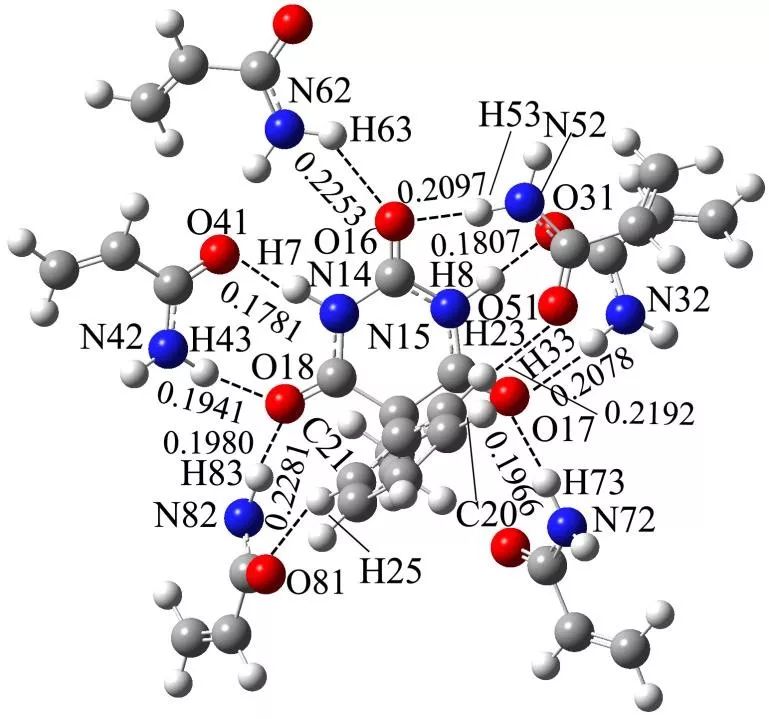
For preparing the phenobarbital (PHN) molecularly imprinted polymers (MIPs) with higher adsorption and selectivity properties, we used the M062X/6-31g(d,p) method of density functional theory to predict the various properties of PHN-MIPs. Here PHN is as the imprinted molecule and acrylamide (AM) as the functional monomer. The ethylene glycol dimethacrylate, trimethylolpropane trimethacrylate, divinyl benzene, and pentaerythritol trimethacrylate are as the cross-linking agents, respectively. The acetonitrile, chloroform, toluene, and tetrahydrofuran are used as the solvents, respectively. The configurations of the molecular imprinting self-assembly system for PHN and AM have been simulated to study their bonding sites, binding energy, amount of hydrogen bond, and interaction mechanism. The essence of imprinting interaction for PHN and AM has been revealed by the atomic in the molecule theory. Meanwhile, the analogues of PHN were used to discuss the selectivity property of the stable PHN-AM complex. The results show that the PHN interacts with AM through hydrogen bonds. When the imprinting molar ratio of PHN-AM is 1:6 and the THF is as the solvent, the amount of their hydrogen bonds is the most, the binding energy is the lowest, and their configuration is the most stable. In comparison with the other cross-linking agents (EGDMA, TRIM, and DVB), the PETA is more suitable for PHN-MIPs. The selective property of PHN-MIP to PHN is excellent when PHN and DMBA exist at the same time.
.


Journal of Structural Chemistry
Long press the QR code to follow us