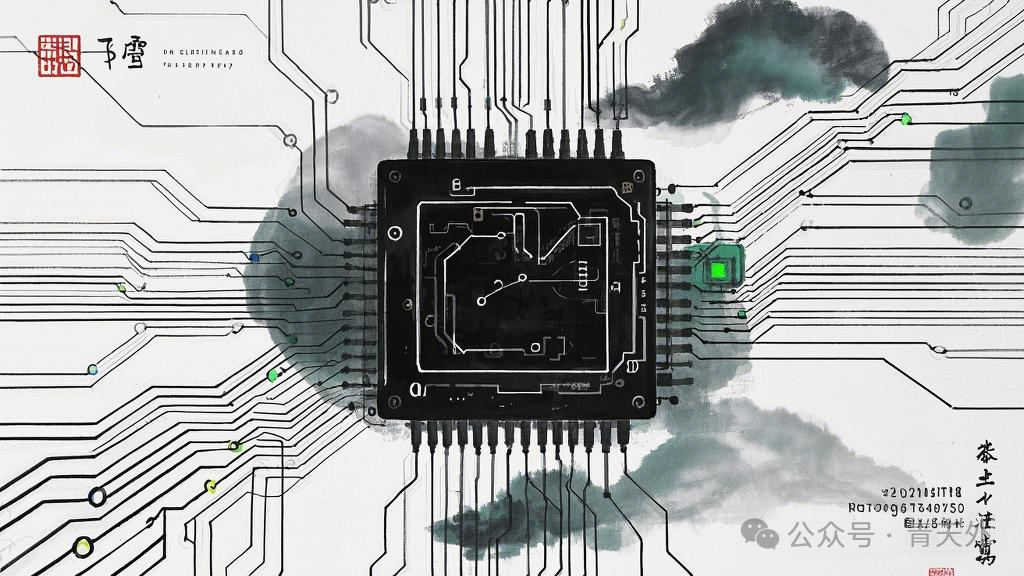
On the nanoscale copper foil circuits, current travels at the speed of light between transistors. This precise creation of modern technology resonates wonderfully with the “Way” described by Laozi two thousand years ago, creating a remarkable harmony in the folds of time and space.When we examine circuit boards from a Taoist perspective, we find that this crystallization of human wisdom surprisingly aligns with natural laws. The microscopic world within the chips exhibits an astonishing isomorphism with the macroscopic laws governing the universe.
1. The Simplest Way and Circuit Topology
Laozi said, “The Great Way is extremely simple, the beginning of all things.” Modern circuit design precisely confirms this truth. The lines on a mobile phone motherboard undergo millions of topological optimizations, ultimately forming structures that often resemble the neural networks and leaf vein distributions found in nature. The “shortest path” pursued by engineers follows the natural law of energy minimization, just like the path networks formed by ant colonies during foraging. In the design of Huawei’s 5G baseband chip, engineers used bionic algorithms to simulate honeycomb structures, improving signal transmission efficiency by 37%. This is a modern interpretation of “Man follows the Earth, the Earth follows Heaven, Heaven follows the Way.”
2. Yin-Yang Transformation and Electronic Transition
The movement of current on circuit boards perfectly illustrates the Taoist philosophy of Yin and Yang. The opening and closing of each logic gate adhere to the basic laws of binary, with the alternation of 0 and 1 resembling the flow of Yin and Yang energies. In the quantum bits of quantum computers, electrons exist in a mysterious superposition state, akin to what is described in the “I Ching”: “The changes have the Great Ultimate, which produces the two forms.” Samsung Semiconductor Labs discovered that when the chip temperature reaches a critical value, the electron mobility exhibits a nonlinear change resembling the Tai Chi diagram. This order on the edge of chaos is a microscopic manifestation of the Taoist principle of “the reverse is the movement of the Way.”
3. Non-Action and Self-Healing Circuits
Modern circuit systems are moving closer to the Taoist ideal of “non-action.” The self-healing circuit materials developed by MIT can automatically reconstruct broken lines within milliseconds. This self-organizing ability is akin to the self-regulating mechanisms of the human meridian system. IBM’s neuromorphic chip mimics the plasticity of human brain synapses, dynamically adjusting computing paths during operation, achieving a composure akin to “governing a large country is like cooking a small fish.” These technological breakthroughs reveal that the most brilliant design is not about strong control, but about creating an environment that aligns with the nature of matter.
Standing at the intersection of silicon-based civilization and Taoist wisdom, we suddenly realize: humanity’s ultimate pursuit of technology ultimately points to a return to natural laws. When chip designers outline circuits in EDA software, the lines in their hands are both the trajectory of technology and the manifestation of the Way in the microscopic world. This resonance that transcends time and space reminds us that true innovation should not be about conquering nature, but rather, like water, “benefiting all things without contention,” achieving a realm of technology that harmonizes heaven and humanity in the process of conforming to the nature of matter.