 Click the blue text above to follow me
In November 2005, at the World Summit on the Information Society (WSIS) held in Tunisia, the International Telecommunication Union (ITU) released a report titled “ITU Internet Report 2005: The Internet of Things”, officially introducing the concept of the “Internet of Things (IoT)” to the world. Although the industry generally agrees that the term “Internet of Things” was first proposed by Kevin Ashton of MIT in 1999, it was merely an idea without a systematic explanation or consensus. As one of the most influential international organizations, the ITU provided a systematic exposition of the IoT in this 130-page report, covering its forms, technical systems, industrial structures, application scenarios, and future prospects. This report can be considered the starting point of the global IoT industry.
Today, it has been 20 years since the release of the “ITU Internet Report 2005: The Internet of Things”. The IoT is no longer just a technical term; the industry has experienced multiple ups and downs, and many aspects of people’s production and daily life are now inseparable from the support of the IoT. Over the past 20 years of industrial turbulence, many of the concepts proposed back then have undergone significant changes, and many previously unanticipated technologies and scenarios have emerged. Today, let us review the changes and constants of the IoT over these 20 years.
1. The IoT Action Plan from 20 Years Ago
(1) What is the IoT in the Eyes of the ITU?
In the “ITU Internet Report 2005: The Internet of Things”, the ITU describes the IoT as a new form of communication between people and objects, and between objects themselves, achieved by embedding short-range mobile transceivers into various tools and everyday items. Previously, information and communication technology (ICT) provided a vision of connectivity for anyone, anywhere, at any time. Now, a new dimension has been added: connectivity for all objects. The three-dimensional characteristics of ICT will exponentially increase the number of connections, creating a new dynamic network known as the IoT. The IoT is neither science fiction nor industry hype; it is based on solid technological advancements and the actively realized vision of ubiquitous networks.
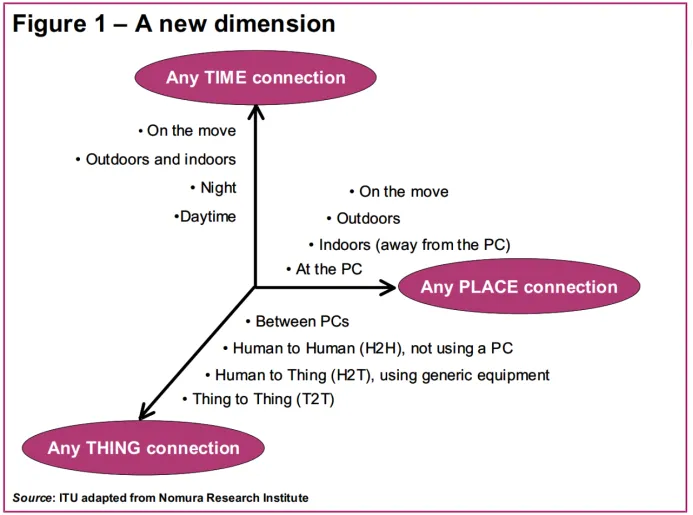
The ITU proposes to view the IoT from three dimensions.
(2) What Does the IoT Technical System Include?
The ITU believes that the IoT represents a technological revolution that signifies the future of computing and communication, and its development depends on dynamic technological innovations across several important fields, from wireless sensors to nanotechnology.
First, to connect everyday items and devices to large databases and networks, including the internet, a simple, unobtrusive, and cost-effective item identification system is needed to collect and process data about devices. Radio Frequency Identification (RFID) is a technology that provides this functionality. Second, advancements in sensor-related technologies facilitate the collection of data on the status changes of various physical devices. The ITU also emphasizes decentralizing information processing capabilities to the network edge, where the embedded intelligence of objects can further enhance network capabilities. Third, advancements in miniaturization and nanotechnology mean that increasingly smaller objects will have the ability to interact and connect. The combination of all these developments will create an IoT that connects objects in a sensory and intelligent manner. Even particles as small as dust could potentially be tagged and connected to the network.
The ITU specifically emphasizes that RFID is one of the key driving forces of the IoT. The wireless communication capabilities of RFID, along with its ability to provide more functions beyond next-generation barcode technology, can track important information in real-time throughout the lifecycle of items. At that time, RFID was widely used in areas such as toll collection, retail, pharmaceuticals, and healthcare. The then-prominent mobile phone manufacturer Nokia announced the release of a mobile phone with an RFID reader and planned to launch consumer phones supporting RFID by 2006.
From the ITU’s description, a series of technologies such as sensing technology, communication technology, computing technology, and device miniaturization technology are the driving factors for the development of the IoT. Over the next 20 years, these technologies underwent profound changes, transforming previously static objects into new dynamic entities and embedding intelligence into everyday environments, leading to the birth of new products and services.
(3) Shaping the IoT Market
The ITU believes that IoT technology offers tremendous potential for consumers, manufacturers, and companies. However, to transform these groundbreaking innovations from ideas into specific products or applications for the mass market, a challenging commercialization process is required, involving the efforts of a wide range of participants, including standard development organizations, research centers, service providers, network operators, and major users.
The ITU listed several typical application cases in the report, including McDonald’s Paypass, RFID wristbands for patients at Chang Gung Memorial Hospital in Taiwan, item tracking in supply chain management in the UK, mobile payments in Japan using specific chips, and environmental monitoring in the US at Duck Island.
(4) Challenges in IoT Development
According to the ITU, the standardization of technology in most areas of the IoT is still in its infancy or fragmented. Standardization is crucial for the large-scale deployment and dissemination of any technology; almost all commercially successful technologies have undergone some standardization process to achieve penetration into the mass market. For example, the development of the internet and mobile communications up to 2005 greatly benefited from standards such as TCP/IP and IMT-2000 (3G). Therefore, in 2005, standardization was the primary challenge for the nascent IoT.
Moreover, one of the most significant challenges in persuading users to adopt emerging technologies is protecting data and privacy, especially since sensors and smart tags can track users’ movements, habits, and ongoing preferences. Everyday items equipped with some or all of the functions of sensory organs, as well as computing and communication capabilities, can lead to invisible and continuous data exchanges between people, between people and objects, and between objects, often without the knowledge of the data owners and initiators. Around 2004, two well-known retailers planned to conduct commercial trials of RFID but abandoned them due to public concerns and consumer resistance. Therefore, the ITU advocates that to promote the broader adoption of foundational IoT technologies, principles of informed consent, data confidentiality, and security must be adhered to. Additionally, protecting security and privacy should not be limited to technical solutions but should also include regulatory, market, and social ethical considerations.
(5) The Impact of the IoT on Developing Countries
To achieve the global commitment to the United Nations Millennium Development Goals, the WSIS focuses on the development of ICT technologies under the principles of universality, ubiquity, fairness, and affordability. The ITU believes that the foundational technologies of the IoT offer many potential benefits in this regard, such as using sensor technology to track the origin of Brazilian coffee and Namibian beef, monitoring drinking water safety in Bangladesh, and disease prevention in multiple countries.
The ITU anticipates that the next generation of communication technologies is likely to originate from larger growth markets in developing countries, particularly China and India, where IoT applications will adapt to local conditions and situations. For example, in terms of RFID, China is rapidly preparing to become a leader in RFID deployment. Therefore, developing countries are far from being passive followers of the IoT; they will significantly influence the implementation and widespread adoption of these emerging technologies.
2. The Evolution of the IoT Industry Over 20 Years
The release of the “ITU Internet Report 2005: The Internet of Things” quickly led to the global acceptance of the IoT vision, prompting various countries to introduce policies to vigorously promote the development of the industry, gradually shaping the IoT industry. Over 20 years of turbulent changes, many of the visions depicted by the ITU have been realized. Although the IoT is not the hottest topic pursued by society, it has become a core industry of the digital economy, quietly providing strong support for the digital development of various sectors as a foundational technology. There are many stories from the past 20 years of change, and I will summarize the IoT’s journey from several aspects.
(1) Continuous Deepening of Policy Support, Evolution of IoT Industry Structure Along Main Lines
1. From Perception to Core Industry of the Digital Economy, Continuity of IoT Policies
Taking China as an example, we will review the policy system for the IoT. Since 2006, the country has successively introduced a series of policies to continuously increase support for the development of the sensor industry.
2009 was a key year for the development of the IoT. At that time, Premier Wen Jiabao proposed the establishment of a “Perception China” center during a visit to Wuxi. In November, during a speech at the Capital Science and Technology Conference, Premier Wen reiterated that “the global internet is upgrading to the next generation, and sensor networks and the IoT are on the rise. Smart Earth, simply put, is the combination of the IoT and the internet, which is the widespread application of sensor networks in infrastructure and services. We must focus on breaking through the key technologies of sensor networks and the IoT.” This marked the beginning of China’s IoT development. The European Union also formulated an IoT action plan and launched an IoT standard strategy in the same year.
In March 2010, the government work report explicitly proposed to “accelerate the research and application of the IoT” for the first time. In October 2010, the “Decision of the State Council on Accelerating the Cultivation and Development of Strategic Emerging Industries” was released, which clearly stated the promotion of “demonstration applications of the IoT”. In July 2012, the State Council issued the “12th Five-Year Plan for the Development of National Strategic Emerging Industries”, which identified the IoT as an important component of the “new generation of information technology industry”. Strategic emerging industries are advanced industries based on significant technological breakthroughs and major development needs, which play a leading role in the overall and long-term development of the economy and society. The inclusion of the IoT in strategic emerging industries reflects the country’s high regard for this field.
To implement the relevant spirit of the Party Central Committee and the State Council and further accelerate the development of the IoT in China, the Ministry of Finance decided to establish a special fund for the development of the IoT from 2011 onwards, fully supporting the development of the IoT in China, and jointly issued the “Interim Measures for the Management of Special Funds for IoT Development” with the Ministry of Industry and Information Technology.
In February 2013, the “Guiding Opinions of the State Council on Promoting the Orderly and Healthy Development of the IoT” were released as a programmatic document for China’s IoT development, proposing goals such as “achieving widespread application of the IoT in various fields of the economy and society, mastering key core technologies of the IoT, and basically forming a safe, controllable, and internationally competitive IoT industry system, becoming an important force in promoting the intelligent and sustainable development of the economy and society.”
Since then, the industrialization of the IoT has accelerated, and policy support for the IoT has continued. The role of the IoT in supporting the digital and intelligent development of the economy and society has become increasingly evident. In 2018, the Central Economic Work Conference listed the IoT as a new type of infrastructure. In 2021, the “14th Five-Year Plan” was released, designating the IoT as a key industry of the digital economy. In 2023, the “Overall Layout Plan for Digital China Construction” proposed to promote the comprehensive development of mobile IoT. With the accelerated integration of information and communication technologies such as artificial intelligence and big data with the IoT, “intelligent interconnection of all things” has become a major trend in IoT development, and policies related to intelligent IoT (AIoT) have been continuously introduced to align with the construction of an intelligent economy and society.
There are many policies related to the IoT, and it is impossible to list them all. In my view, the continuity of support policies for the IoT is very evident. Over the past 20 years, most policies related to information and communication technology and digital development have mentioned deepening the application of the IoT. Although the IoT is not a hot field pursued by society, its 20-year journey has proven that the IoT has lasting vitality compared to some fleeting technical buzzwords.
2. The Three-Layer Industry Structure Becomes the Main Line of Evolution
The “ITU Internet Report 2005: The Internet of Things” did not provide a detailed concept and structure of the IoT. Many early applications were based on RFID technology and devices to form networks for intelligent identification and management of items. As the industry continued to explore the IoT, its connotation expanded. Various organizations have provided definitions of the IoT. The China Academy of Information and Communications Technology (then the Telecommunications Research Institute of the Ministry of Industry and Information Technology) provided a widely adopted definition in 2011: the IoT is an extension and application of communication networks and the internet, utilizing sensing technologies and intelligent devices to achieve sensory recognition of the physical world, interconnection through network transmission, computation, processing, and knowledge mining, enabling information exchange and seamless links between people and people, people and objects, and objects and objects, achieving real-time control, precise management, and scientific decision-making of the physical world. Of course, as technology has developed, the concept of the IoT has also evolved continuously.
The “IoT White Paper (2011)” released by the China Academy of Information and Communications Technology first provided a systematic architecture for the IoT. In the context of that time, this architecture served as an important guide for industrial development. Over the following decade, although the overall architecture of the IoT has undergone adjustments, it has primarily evolved and improved based on this architecture.
The network architecture of the IoT is the core of the IoT architecture. The “IoT White Paper (2011)” proposed that the IoT typically consists of a perception layer, a network layer, and an application layer. The perception layer realizes intelligent sensory recognition, information collection, processing, and automatic control of the physical world, connecting physical entities to the network layer and application layer through communication modules. The network layer mainly facilitates information transmission, routing, and control. The application layer includes application infrastructure/middleware and various IoT applications.
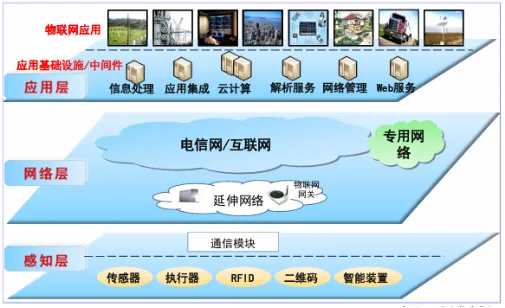
The China Academy of Information and Communications Technology was the first to propose the three-layer architecture of the IoT in the industry.
To this day, this three-layer architecture of the IoT remains the starting point for studying the IoT. With technological advancements and the expansion of industrial scenarios, edge layers, platform layers, and others have gradually been added, especially with the deep integration of artificial intelligence and the IoT, where AIoT has become dominant, leading to continuous refinement of the IoT architecture. Guided by the network architecture, IoT technology standards and industrial systems have gradually formed based on this framework. Today, our analysis and research of the IoT industry still habitually assign different enterprises and scenarios to the corresponding levels of this architecture.
(2) RFID Demonstrates Strong Vitality, Sensing Technology Develops as Expected by the ITU
The ITU’s IoT report seems to favor RFID, closely related to the technological and industrial environment of that time. RFID, by storing item information, possesses certain sensing capabilities and communicates relevant data through radio frequency technology. At the beginning of this century, the connection technologies for physical devices were very limited; WiFi, Bluetooth, and cellular networks were not yet suitable for large-scale deployment on non-electronic devices, making RFID one of the few suitable technologies.
RFID has indeed lived up to expectations. This technology, which originated in the 1950s, has achieved continuous development over the past 20 years. The ITU report indicated that the RFID market size was approximately $1.5-1.8 billion in 2004. According to market research firm Global Market Insights, the global RFID market size is projected to reach $16.8 billion by 2024, with a compound annual growth rate of 12.7% from 2025 to 2034. The annual shipment of RFID tags has exceeded 50 billion units, and the cost of tags has significantly decreased, deeply penetrating logistics, transportation, retail, manufacturing, healthcare, asset management, and other fields. Although there are still some challenges, RFID has fulfilled the expectations set by the ITU in 2005.
While the ITU envisioned equipping all items with sensors resembling “facial features”, although not exclusive to the IoT, the development of the IoT has created a large-scale demand for sensors, which have also experienced rapid development opportunities over the past 20 years.
Sensors are not a new industry; they emerged in the 1960s and 1970s, initially as structural sensors that used changes in structural parameters to sense and convert signals. They later evolved into solid-state sensors composed of solid components such as semiconductors, dielectrics, and magnetic materials, utilizing certain properties of materials. After 2000, intelligent sensors became mainstream. Intelligent sensors equipped with microprocessors have the ability to collect, process, and exchange information. By fully utilizing various software functions, microprocessors can accomplish tasks that hardware finds difficult, significantly reducing the difficulty of sensor manufacturing, improving sensor performance, and lowering costs.
The ITU report identified nanotechnology as an important component of the IoT technical system. However, over the past 20 years, nanotechnology has not become a focal point for the development of the IoT. Of course, nanotechnology has still made significant contributions, particularly in the field of sensors. Nanoscale sensors have made certain IoT scenarios possible. Some scientists have attempted to compress sensors to the nanoscale, allowing these tiny sensors to circulate within living organisms or directly integrate with building materials, forming a nan IoT (IoNT). The IoNT has broad applications in medicine, energy conservation, and other fields. The IoNT was recognized as one of the top 10 innovative technologies proposed by the World Economic Forum in 2016.
(3) Leapfrog Development of Communication Technologies Achieves the Vision of “Interconnection of All Things”
In my view, communication technology has been the most direct supporting technology for the rapid development of the IoT over the past 20 years. The “ITU Internet Report 2005: The Internet of Things” did not specifically mention specific communication technologies, as the integration of communication technologies and the IoT was not yet clear at that time. Looking back at 2005, 3G was the most advanced cellular communication technology, primarily used by mobile phone users, and it was uncertain whether it could be applied on a large scale to the IoT. WiFi and Bluetooth were not yet widely known and had not become standard features in mobile phones, let alone being used for the IoT. Other communication technologies specifically for the IoT had not yet emerged. However, in the following years, these new communication technologies achieved leapfrog development, rapidly lowering the barriers to connecting physical devices and promoting the realization of the vision of “interconnection of all things”.
1. The Rise of the 3GPP Camp Promotes Cellular Technology as the Main Force for IoT Connectivity
When it comes to IoT communication technologies, the 3GPP is undoubtedly the most powerful IoT communication technology camp that has emerged over the past 20 years. As an international organization, the 3GPP was initially established to develop international standards for 3G, and later took on the task of formulating international standards for the subsequent evolution of mobile communications, becoming a barometer for global mobile communication development. The global standardization of IoT communication cannot be separated from the work of the 3GPP. The 3GPP’s work on IoT standards over the past 20 years has, to some extent, become a main line of IoT development.
Embracing the IoT for the First Time in 2005
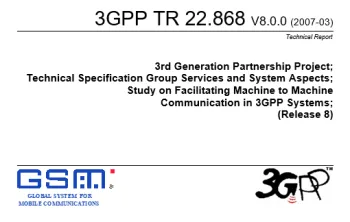
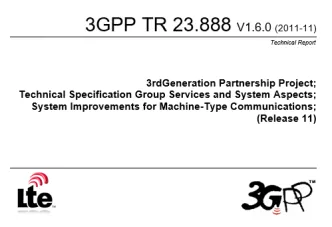
This version studied the needs of M2M communication in logistics, healthcare, remote management, wireless payment, wireless metering, and other areas, supporting the access of a large number of IoT terminals through cellular networks.
Standardization Work for IoT Terminals
In addition to the network-side specifications for access network architecture and core network support, terminals also need dedicated standard specifications to enable effective communication. With the formulation of the 4G LTE standard, the 3GPP has continued to advance the specifications for terminals. A typical example is the classification of terminals based on uplink and downlink rates, which adapted to the access characteristics of various types of IoT terminals, significantly impacting the subsequent development of the IoT.
The 3GPP R8 version included standardization work on user terminal access capabilities, defining levels Cat 1-Cat 5, as reflected in the TS 36.306 specification. The 3GPP has continued to research and update in subsequent versions, defining Cat 6-Cat 8 in R10 and Cat 9-10 in R11.
From Cat 4 and above, the terminals are primarily aimed at mobile phone terminals, which require higher speeds, while levels below Cat 4 are more suitable for the IoT, especially the definition of Cat 1, which has had a significant impact on the subsequent development of the IoT. Currently, the main speed in domestic mobile IoT is Cat 1 terminals. The 3GPP further lowered the terminal level in R12, defining the Cat 0 terminal level for the first time, with a working bandwidth of 20 MHz and an uplink and downlink rate of only 1 Mbps.
The Emergence of LPWAN Standards
Starting in 2013, Low Power Wide Area Network (LPWAN) entered the public eye, with increasing demand for low-speed, low-power IoT scenarios. The existing IoT technologies in the 3GPP camp could not meet the needs of LPWAN scenarios, prompting experts in the 3GPP camp to quickly respond and begin formulating new standards. In the 2016 R13 version, standards for LPWAN based on cellular networks were frozen, including eMTC, EC-GSM, and NB-IoT, where eMTC is an evolution based on 4G LTE networks, EC-GSM is an evolution based on 2G GSM networks, and NB-IoT is a relatively independent IoT standard.
The emergence of these three LPWAN standards has generated a huge response in the industry, becoming a highlight of the mobile communication industry and seemingly carrying the future of cellular operators in the IoT field. Of course, the fates of these three technologies have diverged significantly; especially shortly after the emergence of EC-GSM, it was abandoned, while NB-IoT and eMTC have been favored by different countries and operators worldwide, forming a distinct market pattern to this day.
IoT Technologies in the 5G and Post-5G Era
With the commercialization of 5G, the industry has focused on IoT technologies supported by 5G, where uRLLC and mMTC provide technical support for communication between objects. In terms of the evolution of 5G technology, achieving the goal of hundreds of billions of connections is a key direction for the IoT, particularly in three aspects:
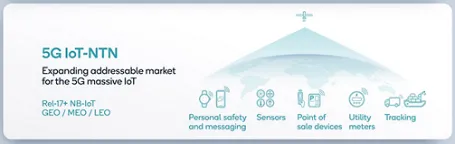
First is the standardization work for RedCap. As a lightweight version of 5G specifically for IoT scenarios, the R17 has completed freezing, and the first RedCap standard has been released, with the industry beginning to promote its commercialization process based on the standard. Second is the standardization work for passive IoT. The 3GPP R18 version has included passive IoT in its research projects, and R19 is further developing standardization work. Third is the standardization of satellite IoT, namely IoT-NTN. With the first IoT-NTN standard released, the strength of the 3GPP camp in satellite IoT has been continuously strengthened over the past few years, forming an integrated IoT across air and space.
2. Diversified Development Paths of Unlicensed Spectrum Camps Promote the Prosperity of Diverse IoT Scenarios
The 3GPP camp relies on licensed spectrum, with operators uniformly deploying cellular networks to provide services for the IoT. In the process of IoT development, short-range communication technologies such as WiFi and Bluetooth, as well as wide-area technologies like LoRa, also rely on unlicensed spectrum to support a large number of scenarios. Data shows that IoT connections supported by unlicensed spectrum communication technologies account for over 70%, while cellular IoT connections using licensed spectrum account for less than 30%. Therefore, the widespread application of unlicensed spectrum technologies is also a crucial condition for realizing the vision of “interconnection of all things”.
Standing on the Shoulders of Giants, WiFi and Bluetooth Achieve Penetration from Mobile Phones to IoT
In my view, the development of the IoT has also been achieved by standing on the shoulders of giants, with this “giant” being the smartphone. Currently, consumer IoT, especially smart home and wearable devices, predominantly use communication technologies like WiFi and Bluetooth, initially interacting with these consumer IoT devices through smartphone apps, and later evolving into diverse interaction methods such as voice and gesture with the development of artificial intelligence.
WiFi and Bluetooth can be widely applied in the IoT field due to their rapid adoption and standardization in smartphones. Once these technologies matured in mobile applications, they could be quickly adapted for use in IoT devices.
For example, WiFi’s first standard, IEEE 802.11, was officially released in 1997, and the WiFi Alliance was established in 1999, bringing together tech giants like Apple, Microsoft, and Intel to promote the widespread adoption of wireless networking technology. In the same year, Apple launched the world’s first WiFi laptop, the iBook. However, at that time, the adoption rate of WiFi was still very low, and scenarios for its use in the IoT had not yet emerged.
With the proliferation of smartphones, due to the inadequacy of 3G networks and high costs, WiFi began to be integrated into smartphones, allowing people to connect to low-cost internet in hotspot areas. According to ABI Research, the shipment of WiFi-enabled phones reached 141 million units in 2009. By 2014, the proportion of smartphones supporting WiFi reached about 90%, essentially becoming a standard feature.
It was during the rapid adoption of WiFi in smartphones that many companies sensed the opportunity in the IoT and began launching WiFi-based IoT products. A typical case is the American startup Nest, founded in 2010, whose main product is a smart thermostat that connects via WiFi and can be set and operated through a smartphone. In January 2014, the company was acquired by Google for $3.2 billion.
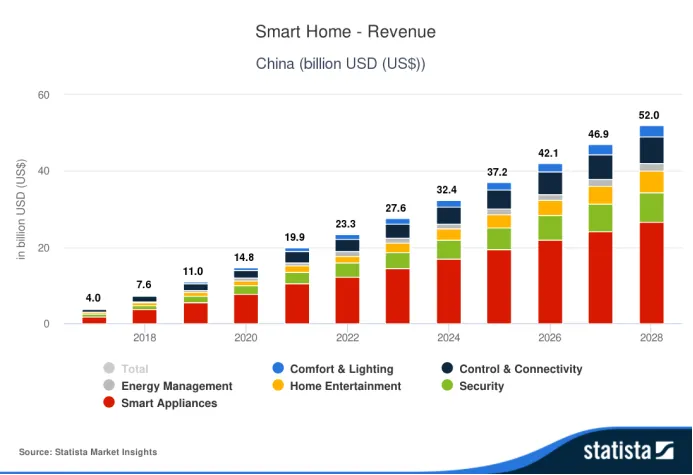
Since then, WiFi-based smart home products have emerged in droves. In addition to some startups, internet companies, appliance manufacturers, and telecom operators have also entered the market, driving exponential growth in consumer IoT connections and encouraging companies like Xiaomi, Tuya Smart, Haier, and Midea to widely develop services both domestically and internationally. Market research firm Statista reported that the smart home market in China reached $23.3 billion in 2022, and it is expected to reach $52 billion by 2028. In terms of household applications, the penetration rate of smart homes in Chinese households reached 16.6% in 2022, with over 80 million households adopting smart home products.
Unlicensed Spectrum LPWAN Still Holds a Place
LPWAN technology, represented by LoRa, originated from a small town in Toulouse, France, and has undergone acquisition by Semtech, the establishment of the LoRa Alliance, and iterations of the LoRaWan specification, becoming a de facto standard in the global IoT field. The ITU’s 2005 IoT report did not anticipate that such startups could create a global IoT de facto standard.
According to tracking data from IoT Analytics, in 2023, among the connections using various LPWAN technologies globally, NB-IoT accounted for 54%, while LoRa held a 29% share, ranking second. If we exclude the Chinese market, the LPWAN market landscape in other countries and regions presents a different picture, with LoRa accounting for 41% of the total LPWAN connections.
In early 2018, with the issuance of a document by the Ministry of Industry and Information Technology’s Radio Administration, LoRa could not be used for metropolitan-level networking in the Chinese market, shifting its focus to park, home, and some vertical industries, leading to a slowdown in shipments in the Chinese market. However, due to its flexible business and commercial cooperation models, LoRa has maintained a stable market share and influence in the IoT market. Various vertical industry enterprises, internet companies, and OEM manufacturers have increased their applications of LoRa, such as Amazon AWS launching multiple products based on LoRaWAN, and AWS’s self-developed communication technology Sidewalk incorporating LoRa modulation technology, becoming an important player in the LoRa ecosystem.
(4) Deep Integration of Artificial Intelligence, AIoT Becomes a Means of Realizing IoT Value
Driven by the development of communication technologies, the IoT has achieved significant results in connectivity. However, how to realize value after connectivity has become a key focus in the industry. With the development of artificial intelligence, the rapid penetration of AI+ has made the deep integration of artificial intelligence and the IoT, known as AIoT, the core business model of the new stage of the IoT, promoting the realization of IoT value, which was also a key focus in the 2005 ITU IoT report.
Seeking Value Beyond Connectivity
Innovative applications based on the massive data generated by extensive connectivity, fully utilizing the latest achievements in artificial intelligence, empowering various industries and enterprise users in their digital and intelligent transformation, and further amplifying the value beyond connectivity has become a consensus across various sectors.
Currently, AIoT technology solutions have become a core component of industrial digitalization solutions. Previously, various industries primarily accumulated data based on human activities and internet data, and the digital transformation promoted on this basis could not penetrate core production and operational processes, making it challenging to advance digital transformation in core production and operations. Now, driven by various IoT technologies, core assets and equipment in various industries can achieve interconnection at low costs, mapping the entire scene and process from the physical world to the digital world, laying the foundation for substantial digital transformation. For example, in industrial scenarios, after connecting various machines and assets, it is not just about helping managers monitor status or replacing manual inventory; further, through the support of artificial intelligence, modeling and analyzing the long-term operational data of these connected devices can provide early warnings of equipment failures, forming predictive maintenance applications. In smart homes, after connecting various appliances, lighting, and security devices, the application of artificial intelligence technology can provide users with an intelligent living scenario.
Latest Achievements of Generative Artificial Intelligence, IoT Becomes an Important Scene
The explosion of generative artificial intelligence has made large models a focus of exploration across various industries, and IoT practitioners are continuously exploring how to integrate and apply this latest technology.
From the perspective of IoT development trends, the scale of IoT data is large enough to surpass internet data. Market research firm IDC predicts that by 2025, the data generated by IoT devices will account for 44% of the global total data. Among them, data generated by high-computing, high-bandwidth terminals such as smart cameras and smart cars is particularly astonishing. The massive connections of IoT are expected to generate data volumes that may exceed those of the internet, providing continuous “nourishment” for training artificial intelligence models.
At the same time, the distinctive characteristics of IoT data provide fresh nourishment for large models. Compared to the internet, IoT data is generated by physical entities, characterized by objectivity, and most scenarios primarily aim for production and operations, making it more practical. The data generated by the IoT includes both static data sensed by sensors and dynamic time-series data generated during device operation. In terms of data types, IoT technology can collect state data, location data, behavioral data, etc., from the physical world, obtaining energy, asset attributes, diagnostic data, and signal data across various industries, which are of great significance for the core production and operational processes and intelligent upgrades of various industries.
With the “feeding” of these special data, large models may be able to learn more deeply about specific scene knowledge across various industries, output more precise information, and further drive application innovation. Last July, a Japanese IoT virtual operator, Soracom, announced the launch of products that deeply embed generative artificial intelligence capabilities into IoT connectivity and service platforms, including a low-code application builder that allows even non-technical users to build integrated AI IoT applications in real-time by defining data flows between sensors, cameras, actuators, GenAI engines, and the cloud, and another product that simplifies the management of large IoT deployments through natural language network data analysis.
In my view, if the development of cellular networks, WiFi, and other communication technologies has made connectivity ubiquitous, then the rapid development of artificial intelligence and its deep integration with the IoT has made the value of the IoT ubiquitous. Of course, the rapid development of artificial intelligence is, to some extent, benefiting from the progress of the IoT, as currently popular embodied intelligence and edge AI can realize the vision of intelligence being everywhere, requiring the development of the IoT to penetrate all scenarios of home, automotive, work, and daily consumption.
(5) Other Fields Are Also Continuously Evolving
Many key areas of the IoT have undergone significant changes over the past 20 years and are worth attention.
IoT Platformshave become a focus for various manufacturers over a decade ago, bearing the task of these large enterprises’ global strategic layout for the IoT and digitalization. However, in recent years, many have experienced setbacks, with several leading global companies in various fields, such as Google, Ericsson, SAP, IBM, and Bosch, exiting the IoT platform space.
IoT Operating Systemshave also gone through a rollercoaster-like process. Previously, many manufacturers laid out IoT operating systems, hoping to seize the entry point of the IoT era. Well-known operating systems like Ali OS Things, Lite OS, and ARM Mbed OS are now rarely mentioned.
I believe that while the exposure of IoT platforms and operating systems is decreasing, it does not mean they lack value. The overall development of the IoT industry still requires platforms and operating systems as essential elements; their business models and service methods have changed, supporting the deployment of various IoT scenarios behind the scenes.
Another area worth noting isIoT Security, which was also specifically mentioned in the ITU IoT report. Over the past 20 years, the IoT has faced several major security threats, and users’ awareness of security has increased. Security protection technologies and business models have continuously advanced. As the ITU stated, IoT security should not be limited to technical solutions but should also include regulatory, market, and social ethical considerations. In recent years, major economies worldwide have vigorously promoted IoT security labeling programs, providing solutions for IoT security from this perspective.
3. What Factors Have Driven China’s IoT Over 20 Years?
The appendix of the “ITU Internet Report 2005: The Internet of Things” disclosed data on mobile and broadband markets in several countries. By the end of 2004, China had 334 million mobile users, with a penetration rate of only 25.5%, and a broadband penetration rate of only 6.5%. Against this backdrop,the ITU predicted that China would become a leader in the IoT, a prediction that has since become a reality.
Today, China has over 1.4 billion mobile users, with a penetration rate exceeding 100%, and 670 million broadband users, over 30% of whom have achieved gigabit broadband access. Against this backdrop, China leads the world in IoT connections, with cellular IoT connections alone surpassing the human population, and non-cellular IoT connections being even larger. In terms of connection numbers, supplier ecosystems, and application scales, China’s advantages in the IoT industry are very evident.
Over the past 20 years, the development of China’s IoT has been driven by the rapid overall development of the Chinese economy, with a clear trend of social informatization and digitalization, leading to a continuous rise in digital demand for production, life, and social governance. The demand-driven aspect is very evident; there is also the continuous innovation spirit of a large number of enterprises in China, especially private enterprises, seizing various market opportunities with great enthusiasm to meet challenges and expanding from domestic to overseas, increasing the supply of IoT products and solutions.
The ITU mentioned in the report that regardless of how the IoT develops, people should be at the core of the overall vision, as human needs are key to future innovations in this field. Moreover, technology and markets cannot exist independently of the overall principles of social and ethical systems. On the road to the IoT, a human-centered strategy must be adopted, establishing closer connections between those who create technology and those who use it. Only in this way can we better address the challenges modern life presents. I believe that the core concept of “people-centered” is also a key factor driving the transformation of China’s IoT over the past 20 years.
Conclusion
The “ITU Internet Report 2005: The Internet of Things” opens with a quote from Mark Weiser, the father of ubiquitous computing: “The best technologies are those that seem to ‘disappear’, integrating themselves into the structure of everyday life until they become indistinguishable from it.” In my view, the IoT is developing towards this state. From the first introduction of the IoT 20 years ago to its rise as a hot topic a decade ago, and now to its current status of no longer being pursued, the IoT has gradually integrated into all aspects of production and life. Smart locks and remotely controlled appliances in homes, shared bicycles on the streets, disappearing water and gas meter readers, assisted driving cars, real-time tracking of key items, smart factories, and many other scenarios exist, even though many people are unaware of the IoT technology behind them, they use it every day. This may be the most significant achievement of the IoT industry over the past twenty years.
Source: IoT Think Tank
END
Disclaimer
Unless otherwise specified, the content of this public account comes from the internet, public WeChat accounts, and other open channels, and does not represent the views of this public account, but is for reference and exchange purposes only. The copyright of the reprinted articles belongs to the original author or organization.