 Author:Peng Zhao (Founder of Zhici Fang and Co-founder of Yunhe Capital)IoT Think Tank Original
This is my 377th column article.
On June 18, during the keynote speech at the Lujiazui Forum, the Governor of the People’s Bank of China, Pan Gongsheng, systematically elaborated on his observations and judgments regarding stablecoins.
He pointed out that the current global financial system still has structural shortcomings such as regulatory fragmentation, insufficient cross-border coordination, and regulatory gaps for non-bank institutions. Emerging technologies represented by blockchain and distributed ledgers are pushing central bank digital currencies and stablecoins into the mainstream, achieving “payment as settlement,” fundamentally disrupting the traditional payment and settlement systems.
This transformation is the prelude to the digital and intelligent reconstruction of financial infrastructure. At the same time, he also clearly stated that the technological leap of stablecoins will bring unprecedented regulatory challenges, especially in new scenarios such as decentralization, smart contracts, and cross-border circulation, which urgently require institutional collaboration and innovative mechanisms to keep pace.
Shortly thereafter, on June 26, the Hong Kong SAR government issued the “Hong Kong Digital Asset Development Policy Declaration 2.0”, reiterating the government’s commitment to making Hong Kong a global innovation center in the field of digital assets. The declaration clearly states that the tokenization of government bonds will be normalized and that the tokenization of real-world assets such as precious metals, non-ferrous metals, and renewable energy will be promoted, marking a new stage in the development of digital assets in Hong Kong.
This declaration not only reshapes the boundaries of financial regulation but also clarifies the legitimate positioning of stablecoins in “serving the real economy,” sending a clear signal: stablecoins are transitioning from “marginal innovations in crypto finance” to “underlying capabilities of the digital economy.”
In the past, we were accustomed to understanding stablecoins from a financial perspective: they are “cost-reducing tools” for cross-border payments, “value anchors” for DeFi, and “transaction mediums” for on-chain assets. However, today, with the rapid popularization of AIoT and the rise of machine collaboration networks, the role of stablecoins is quietly changing—they are no longer just “digital currencies” serving humans, but rather the foundational accounts, settlement protocols, and value engines in the future device economic system.
In other words: If the Internet of Things allows devices to communicate, stablecoins enable them to transact.
This article will attempt to step out of the financial mindset and re-examine the significance of stablecoins from the perspective of AIoT. We will see that when every device has its own wallet, can autonomously complete micro-payments, and can schedule resources on-chain, stablecoins will no longer just be “digital cash,” but rather the “economic language of the machine world.”
Stablecoins as the “Economic Language” in the IoT World

In traditional IoT systems, the connection between devices is already very common. They can collect data, transmit information, respond to commands, and even achieve intelligent control to a certain extent. However, they have always lacked one capability—the ability to exchange value.
In a highly automated system, sensors can inform you of temperature changes, cameras can capture images, and electric vehicles can sense their battery levels, but these devices cannot perform the action of “you provide me a service, I pay you” like humans do. They can communicate, but they cannot settle.
This is precisely the important significance of stablecoins in the AIoT era.Stablecoins, as a type of machine-readable, verifiable, and programmable digital currency, are naturally suitable for payment scenarios between automated devices. Compared to traditional payment methods, stablecoins do not rely on manual authorization or centralized account systems; devices can complete micro-payments and on-demand settlements without trust. Their technical characteristics make them very suitable for handling transactions that are small in amount, high in frequency, and triggered automatically.
For example, in a smart mobility scenario, an unmanned electric vehicle can automatically complete energy billing at a charging station and make real-time payments using stablecoins, without the need for users to scan codes or reconcile accounts in the background. In an industrial environment, if different brands of robots need to work together, they can settle behaviors such as equipment occupancy and resource invocation through stablecoins, thereby reducing the complexity of platform-level scheduling. In data trading scenarios, if data collected by a sensor is called by another system, both parties can complete “data as a service” instant payments through stablecoins, ensuring that the data provider receives reasonable compensation while also improving data circulation efficiency.
In these scenarios, the role of stablecoins is not to replace traditional payment tools, but to expand the boundaries of “autonomous collaboration” between machines. Once devices can “communicate with money,” their behavior is no longer just passive execution of commands, but possesses a higher level of interactivity and economic participation capability.
From this perspective, another significance of stablecoins is that they are not just a currency, but also an account system. We have always understood stablecoins as a cross-border payment tool, akin to a digital era “Alipay” or “Visa card.” However, in the context of AIoT, stablecoins are actually the bank accounts of future devices.
Every smart device, whether it is an unmanned vehicle, a smart streetlight, or a micro-sensor, may have its own wallet address. They can receive money, make payments, purchase services or resources, becoming economic nodes in the network.
This change means that devices are no longer just controlled objects, but possess a certain form of “economic personality.” They can own resources, allocate budgets, and participate in collaboration. Stablecoins provide these devices with the capability of the smallest financial unit, allowing them to have clear value boundaries and settlement mechanisms within the entire system.
Specifically, traditional account systems often rely on manual registration, bank approval, and centralized management, making it difficult to adapt to the automatic deployment and real-time operation of massive devices. In contrast, stablecoin accounts can be quickly generated on-chain, automatically tracked, and bound to device identities. This method naturally supports micro-transactions, which we often refer to as “pay-per-second” or “pay-per-use.” This transaction model is the foundational condition for the IoT to evolve from connection to collaboration.
From connection to collaboration, from data to value, from hardware to economic entities, stablecoins open a new door for AIoT. Behind this door, the role of devices is quietly changing. They are no longer just the endpoints executing commands, but participants in the system that can make proactive decisions, trade freely, have budgets, and have boundaries. Stablecoins are the economic language they use.
Stablecoins as the Financial Layer of the “Trusted Physical World” in the AIoT Era
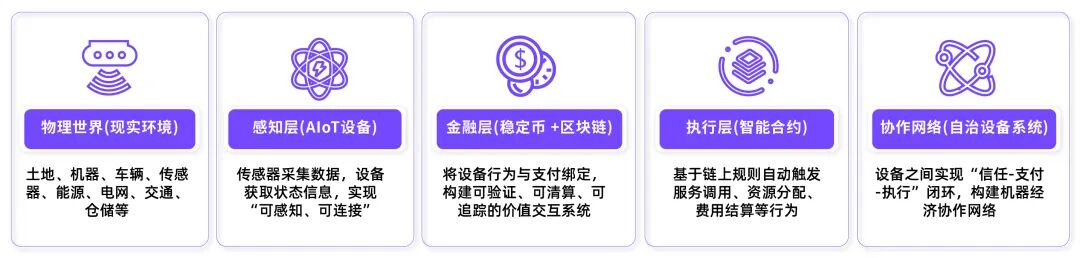 Stablecoins are the financial layer of the trusted physical world in the AIoT era
After long-term development, the Internet of Things has achieved a leap in making objects “perceptible” and “connectable.” Various sensors, cameras, and positioning modules are deployed in the real world, collecting real-time data on temperature, humidity, light, location, status, etc., transforming the originally silent physical environment into a digital mapping that machines can understand. Over the past decade, this capability has driven transformations in various fields such as industrial automation, urban management, and smart mobility.
But merely being “perceptible” and “connectable” is not enough. In many practical scenarios, although IoT systems can determine what has happened, they find it difficult to assess whether it is worth doing or whether payment should be made.
Devices lack a trusted value exchange mechanism, leading many automated actions to remain at the level of local optimization and internal loops, making it difficult to achieve true ecological collaboration.
For example, suppose you are an electric vehicle owner searching for a charging station in the city. Your navigation system can tell you where there are available stations, what the electricity price is, and how far away they are. However, you still need to make a manual judgment: Is this station reliable? Is the price transparent? Is it occupied? You cannot even let the car automatically decide which station to go to, prepay how much, and automatically settle after charging.
The underlying issue is that while this data is real, it lacks a mechanism for binding value. The information provided by the navigation system is free, the electricity price is a reference value, and the availability status may change before you arrive. The entire process relies on humans to bear trust, rather than the system itself having the capability to trust.
However, if stablecoins are introduced, this process will undergo a fundamental change. The vehicle can sign an on-chain agreement with the charging station system before departure, stipulating the electricity price, time, service level, and freezing a portion of stablecoins as a prepayment. After charging is completed, the system automatically deducts the fee based on the actual electricity consumed and returns the remaining amount to the owner’s wallet. The entire process requires no manual operation and no central platform intervention; trust is written into the agreement, and payment and execution are completed simultaneously.
Similarly, in a smart agriculture scenario, if a temperature and humidity sensor in an orchard collects real-time data and provides it to a nearby irrigation control system, the traditional model would transmit this data for free—but the problem is, who guarantees the authenticity of the data? Who incentivizes the data source to continue providing it? If a sensor malfunctions or cheats, how does the system identify it?
If each data upload from the sensor can earn a stablecoin as a “data fee,” and this fee comes from the budget account of the irrigation system, the situation would be completely different. The sensor would only receive payment if the data is compliant, the location is correct, and the timing is consistent. The system can also set thresholds for data quality, automatically stopping payments in case of anomalies to filter out false devices or failed nodes.
This is another value of stablecoins in the IoT: binding actions with incentives, using economic means to regulate technical collaboration.
Structurally, such a design builds a complete closed loop:
1. Trust comes from on-chain verifiable data and identities;2. Payments are completed instantly and incentivized through stablecoins;3. Execution is automatically triggered by smart contracts, requiring no manual intervention.
This is not a simple upgrade of payment methods; it is a replacement of the foundational trust mechanism. Traditional IoT relies on platforms, enterprises, or governments to establish trust, while in the AIoT era, devices can achieve self-organizing collaboration between devices through on-chain logic, economic incentives, and stablecoin accounts.
In these scenarios, stablecoins are no longer just “coins in a wallet,” but a settlement protocol that can be embedded into the behavioral logic of devices. They give every action economic significance, allowing every invocation to be quantified, recorded, and evaluated. This is the foundation for AIoT to truly move towards inclusivity, standardization, and scalability.
It is foreseeable that as stablecoins gradually enter the compliance system, more and more IoT nodes will no longer be just information terminals, but value nodes. Their connections will not only be data channels but also payment paths. From this perspective, stablecoins are becoming the financial layer connecting the physical world and the digital economy in the AIoT era, endowing devices with both trust and value capabilities.
Stablecoins Will Accelerate the Restructuring of IoT Business Models
Traditional IoT business models essentially still follow a “selling devices + selling services” logic. Manufacturers sell hardware such as sensors, cameras, and measuring instruments, while packaging software platforms, cloud services, and operation subscriptions as revenue sources. This model has driven the deployment of numerous smart devices over the past decade, but it has also encountered significant growth bottlenecks: once devices are sold, subsequent revenue is limited, customer usage rates are low, and maintenance costs are high; for customers, the initial investment is large, usage flexibility is poor, and the return cycle is long.
In the context of AIoT, if each device can measure its operational status and settle in real-time using stablecoins, a new business logic emerges—devices are no longer one-time purchased assets but can be rented on demand and paid for by the hour.
This is the core idea of the device-as-a-service model. The introduction of stablecoins makes the realization of this model feasible.
For example, in industrial manufacturing, a small or medium-sized enterprise may not be able to purchase a laser cutting machine worth millions at once. However, if the equipment manufacturer allows customers to use it by the hour and collects fees in real-time through an on-chain wallet, customers only need to wake up the device when needed, and the system automatically deducts stablecoins from their wallet based on usage time. This not only lowers the usage threshold for enterprises but also provides continuous income for equipment providers.
The same logic is emerging in urban governance. Some city lighting systems have begun to experiment with billing based on “lighting time,” with hardware providers responsible for equipment construction and maintenance, while the government settles based on operational duration and energy consumption data. Payments made through stablecoins not only avoid complex billing processes but also enable automatic reconciliation and transparent regulation.
In more relatable household scenarios, stablecoins can also be used to promote new models of the sharing economy.
For instance, a smart air conditioner can be pre-installed with an on-chain wallet, allowing users to scan a code for authorization and be billed by the minute; washing machines, water purifiers, printers, and other devices can also achieve pay-per-use, with fees settled automatically through stablecoins. This method is particularly suitable for apartments, shared spaces, campuses, construction sites, etc., eliminating the need for centralized management, manual charging, or deposit systems.
These examples reflect a common characteristic:devices possess their own value perception and transaction capabilities. They no longer rely on manual intervention but autonomously complete pricing, collection, and service confirmation through stablecoin accounts. The role of devices shifts from static assets to dynamic service nodes.
Furthermore, stablecoins also provide the possibility for the autonomy of AIoT systems. Most traditional IoT systems rely on centralized platforms to schedule resources, manage devices, and handle accounts. Various devices can operate automatically, but they are still limited by platform rules and lack the ability for autonomous collaboration.
Once each device has its own payment capability, they can exchange value and negotiate resources with other devices without relying on a central platform. For example, a wind turbine can sell excess electricity to nearby energy storage devices; a camera can sell image data to an autonomous driving system; a field sensor can send rainfall information to an irrigation system and charge a small fee as a data service fee.
These actions require no human intervention and no platform approval, but are automatically executed based on on-chain contracts, with fees settled instantly through stablecoins. This mechanism gives AIoT systems a “weak autonomy capability”: devices can autonomously participate in collaboration based on rules, needs, and budgets, forming a truly meaningful machine economic network.
It can be said that without stablecoins, AIoT would at most be a highly automated factory; after the introduction of stablecoins, it could become an intelligent economy with self-regulating capabilities. From platform scheduling to edge collaboration, from one-way commands to two-way transactions, stablecoins enable devices to no longer be just “obedient terminals,” but rather participants with “budgets, behaviors, and incentives.”
Stablecoins not only reshape the business models of IoT but also quietly drive changes in their system structure. This change is not instantaneous, but it has already begun to occur in some niche areas. As devices begin to be priced, services begin to be timed, and value begins to be transmitted on-chain, the boundaries of IoT will also expand accordingly.
Conclusion
The story of stablecoins goes beyond digital currency, financial innovation, or improved payment efficiency. For large-scale systems like AIoT that are oriented towards the physical world, the value of stablecoins lies in providing a universal, trustworthy, and automated value exchange mechanism.
They allow collaboration between devices to no longer rely on platform scheduling but to trade autonomously based on rules; they enable sensor data to no longer be a “cost center” but to become a “revenue unit”; they allow originally static hardware to possess service capabilities, thus driving the entire IoT business model shift.
We are entering an era where devices can “speak with money.” Stablecoins are not just for humans; they are also for devices; they are not just for cheap cross-border payments but for building a digital physical system where machines can participate, value can flow, and behaviors can be settled.
Of course, there are still many challenges ahead. The regulatory framework is still under construction, device wallets are not yet mature, and standard protocols are still evolving. But the trend is clear: stablecoins will not only be a matter of Web3 but will also become one of the foundational capabilities in the process of AIoT implementation.
In this sense, understanding stablecoins is not just about understanding a financial tool, but about rethinking the operational methods of future systems. They may not appear in a stunning way, but they will quietly change the operational logic of the entire IoT as an infrastructure.
References:
The Next Stop for Stablecoins: International Payments, US Stock Tokenization, and AI Agents, Source: Wall Street JournalStablecoins: A Bridge Connecting Digital Currency and Real Assets, Source: Zhong Lun Law Firm