
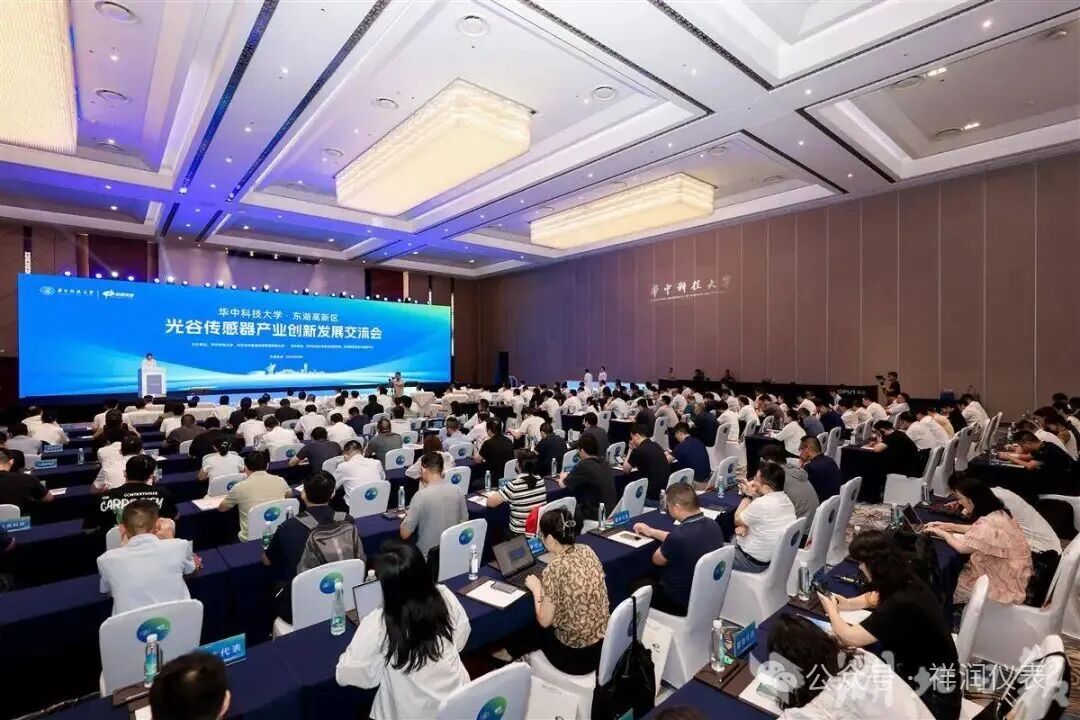
On September 13, at the Optics Valley Sensor Industry Innovation Development Exchange Conference, the Optics Valley Intelligent Sensor Technology Innovation Research Institute was officially signed, and the Optics Valley Sensor Industry Innovation Alliance was simultaneously inaugurated. Currently, Optics Valley has gathered over 100 sensor industry chain enterprises, forming an industry cluster worth nearly 10 billion.
Sensors are known as the “neurons” of artificial intelligence and are core components in industries such as the Internet of Things, industrial internet, smart vehicles, and artificial intelligence. According to industry data, the global sensor market is expected to reach approximately $245.97 billion in 2024, with a year-on-year growth of about 5.3%.
In Optics Valley, a number of leading enterprises are at the forefront of various segments such as temperature, infrared, gas, and pressure sensors, leading both nationally and globally. HUST’s temperature sensors are sold in over 30 countries and regions, with a global market share of up to 70%; GDH Infrared is the only domestic company capable of producing both cooled and uncooled infrared detectors; Sifang Optoelectronics holds the largest global market share for particulate matter sensors; and Fei En Microelectronics leads the national market share for automotive pressure sensors… Optics Valley is not only an industrial hub but also a source of innovation, with national-level platforms and research teams led by several academicians, having established a comprehensive ecological support system for “sensing, storage, transmission, and computation”.

The Optics Valley Sensor Industry Innovation Alliance, established on the same day, was jointly initiated by 10 universities including Huazhong University of Science and Technology, 3 research institutions including the Optics Valley Laboratory, and 45 enterprises including Sifang Optoelectronics. The president of Huazhong University of Science and Technology and an academician of the Chinese Academy of Engineering, You Zheng, stated that they will deeply integrate the “innovation chain, industry chain, capital chain, and talent chain” to promote sensor technology from the laboratory to the production line, solving the dilemma of “having samples but no products, having products but no industry”.
“Although our industry scale still lags behind the Yangtze River Delta and Pearl River Delta, the sensors in Optics Valley focus on high-end fields, with high added value and strong competitiveness, and there is still great potential for building a local innovative industrial ecosystem,” said Xiong Youhui, vice chairman of the alliance and chairman of Sifang Optoelectronics.
Founded in 2003 in Optics Valley, Sifang Optoelectronics primarily focuses on the research and production of smart gas sensors and high-end gas analyzers, possessing multiple self-developed core technologies on sensor technology platforms. In the first half of this year, the company’s net profit increased by 103.41% year-on-year. At the end of August, its high-end sensor industrial base project was just signed in Optics Valley.
Currently, with a strategic layout centered around “one alliance for strength, one plan for guidance, one conference for empowerment, one research institute for driving, and one industrial park for gathering,” Optics Valley is targeting fields such as smart equipment, humanoid robots, intelligent connected vehicles, and health care, accelerating the industrial application of sensor technology. By 2030, Optics Valley plans to establish a nationally influential sensor industry hub.
★ Source: Wuhan Economic and Information Commission ↑ ★ Please cite the above source when reprinting↑Disclaimer: This article is for informational purposes only and is for reference only. If there are issues related to the content, copyright, and other matters, please contact us, and we will handle it immediately. If this article is reprinted on any platform, the platform will be responsible for the article, and Xiangrun Instrument will not be responsible for secondary dissemination caused by reprinting.