 Detailed Explanation of the GESP Examination Syllabus | C++ Level 1Grade Examination of Software ProgrammingC++ Certification Knowledge System (Level 1)1. Assessment Objectives
Students will learn the basics of computer knowledge, understand the composition and operation of computers, and the history of computer development. Through mastering basic programming knowledge and statements, they will be able to independently complete simple programs using sequential structures, branching structures, and loop structures.
2. Knowledge Content
-
Computer Basics and Programming Environment
-
History of Computers
-
Definition and Use of Variables
-
Basic Data Types (Integer, Floating Point, Character, Boolean)
-
Control Statement Structures (Sequential, Loop, Selection)
-
Basic Operations (Arithmetic Operations, Relational Operations, Logical Operations)
-
Input and Output Statements
3. Knowledge Blocks and Descriptions
Knowledge Points
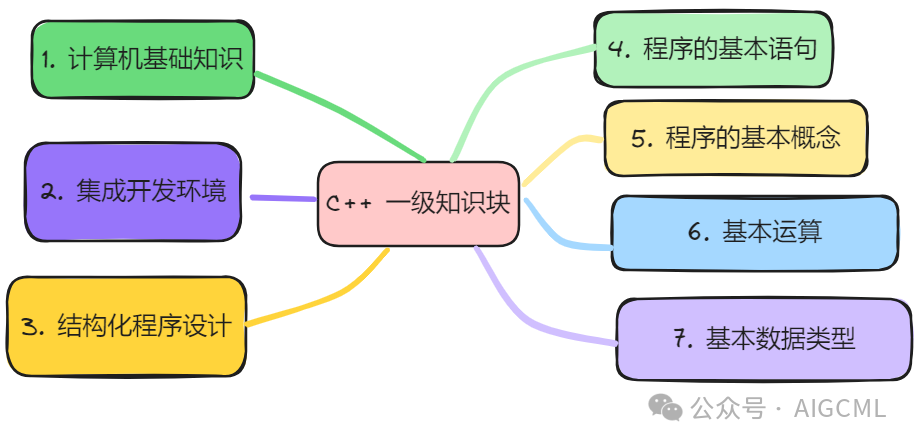
| Knowledge Block Number | Knowledge Point Description |
| 1 |
Composition of computer hardware and software, common operations, and development history. |
| 2 | Creating files, editing files, saving files, compiling, interpreting, debugging. |
| 3 | Sequential structure, branching structure, loop structure. |
| 4 |
cin statement, scanf statement, cout statement, printf statement, assignment statement, compound statement, if statement, switch statement, for statement, while statement, do while statement. |
| 5 |
Concepts of identifiers, keywords, constants, variables, and expressions. Naming, defining, and the role of constants and variables. Program comments. |
| 6 |
Arithmetic operations, logical operations, relational operations, variable increment and decrement operations, ternary operations, bit operations. |
| 7 |
Integer types: int, long long Real types: float, double Character type: char Boolean type: bool |
4. Detailed Knowledge Points
Knowledge Details
01
Understand the basic components of a computer (CPU, memory, I/O devices, etc.), understand the basic concepts and common operations of operating systems like Windows and Linux, and understand the history of computers and their common applications in modern society.
02
Familiar with the use of integrated development environments (e.g., Dev C++): creating files, editing files, saving files, compiling, interpreting, debugging.
03
Master basic cin statements, scanf statements, cout statements, printf statements, assignment statements, etc.
04
Master the concepts of identifiers, keywords, constants, variables, and expressions.
05
Master the naming, defining, roles, initialization, and assignment of constants and variables, as well as variable increment and decrement operations.
06
Master basic arithmetic expressions: addition (+), subtraction (-), multiplication (*), division (/), integer division (/), modulus (%).
07
Master logical operations: AND (&&), OR (||), NOT (!).
08
Master relational operations: greater than (>), greater than or equal to (>=), less than (<), less than or equal to (<=), equal to (==), not equal to (!=).
09
Master the definition and use of basic data types (integer, real, character, boolean).
10
Master the writing of sequential structure programs.
11
Master the writing of branching structure programs, including if statements, if-else statements, switch statements, and understand ternary operations.
12
Master the writing of loop structure programs, including the use of for, while, and do-while loop statements, as well as the application of continue and break statements in loops.
13
Understand the concepts of program comments and debugging.
5. Question Distribution
Examinations
| Multiple Choice Questions | True/False Questions | Programming Questions |
| 15 questions (2 points each) | 10 questions (2 points each) | 2 questions (25 points each) |
Exam Duration:120 minutesOnline Judge ProblemsOnline Real Questions
Past programming questions can be directly practiced online on the Luogu website.
The list of questions is organized as follows, and the question list URL is:
https://www.luogu.com.cn/training/551#problems
In addition, you can also find past real questions on the GESP official website, the URL is:
https://gesp.ccf.org.cn/101/1010/index.html
As of now (September 2025), GESP C++ Level 1 has a total of 10 sets of real questions, and the corresponding solutions can be found directly in the CCF GESP official public account, with the relevant article links organized as follows:
-
March 2023, Solution Analysis / GESP C++ Level 1 March Real Question Review
-
June 2023, Solution Analysis / C++ Level 1 June Real Question Review
-
September 2023, Solution Analysis / GESP September Certification C++ Level 1 Real Question Review
-
December 2023, GESP C++ Level 1 Real Questions | Fourth Time (December 2023) [Unofficial Analysis]
-
March 2024, GESP Fifth Certification Real Question Analysis | C++ Level 1 Real Question Review
-
June 2024, GESP Sixth Certification Real Question Analysis | C++ Level 1 Real Question Review
-
September 2024, GESP Seventh Certification Real Question Analysis | C++ Level 1 Real Question Review
-
December 2024, GESP Eighth Certification Real Question Analysis | C++ Level 1 Real Question Review
-
March 2025, GESP Ninth Certification Real Question Analysis | C++ Level 1 Real Question Review
-
June 2025, [Check the latest real question analysis on the GESP official public account]
Note:The registration for the 11th certification will close on the 16th of this month, so students should prepare in time. Those who are not sufficiently prepared can first practice some real questions. Since the past real questions provided by the GESP official website come with answers, they are not convenient for printing for self-testing training, so I have organized a set of answer-free printable real questions, and the acquisition method is as follows:
Click on the above Follow us
After following, send a message in the public account:“GESP C++“, to obtain GESP C++ past real question materials, including both answered and unanswered real questions.
After completing the real questions, we can also go to some online evaluation systems (OJ) to do programming questions for further training.
More ProblemsProgramming Practice
#include <bits/stdc++.h>
using namespace std;
int main() {
  cout << "AK GESP C++";
  return 0;
}

// Follow us for more information and materials

/*
 * Information Technology Exchange
 * Code Knowledge Sharing
 * Programming Problem Solving
 * Promoting Science and Technology Education
 */
For most primary and secondary school students across the country, they can practice programming questions on the Luogu platform. They can also practice on the Shanghai Computer Society competition platform according to star levels. Of course, Zhejiang also has many excellent OJ platforms from informatics institutions that provide free programming practice and algorithm competitions/monthly contests, so everyone can participate more to promote learning through competition.Any questions or ideas can be discussed together~ Scan to add friends for discussionAdd friends | Note “C++”