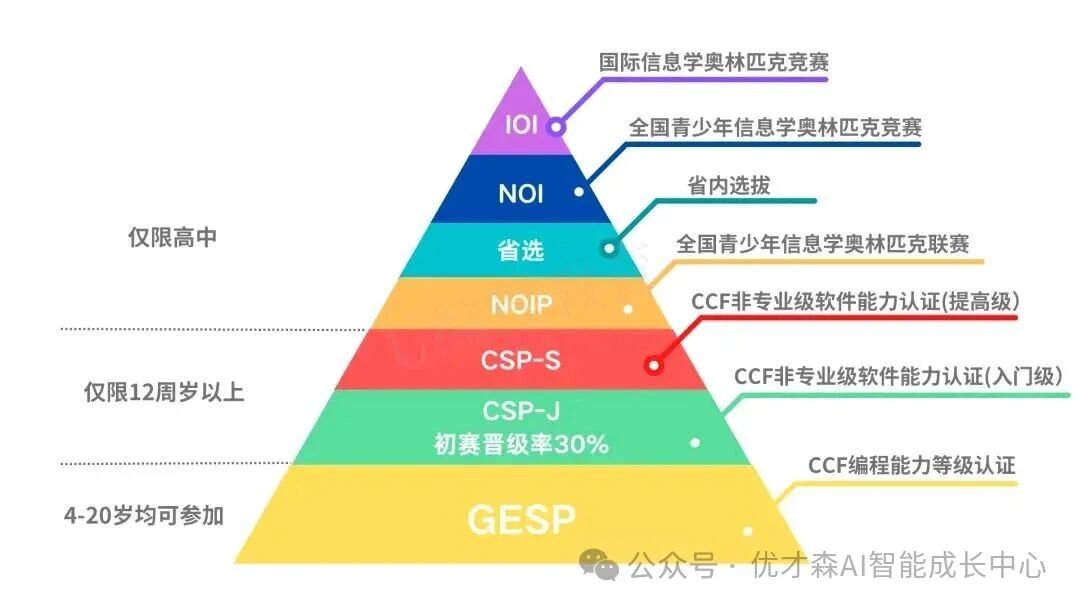
There exists a very clear and inevitable progressive connection between learning Scratch, Python, and C++. These three are not isolated from each other, but rather form a classic learning path from “programming thinking enlightenment” to “practical application development” and finally to “system-level deep control”.
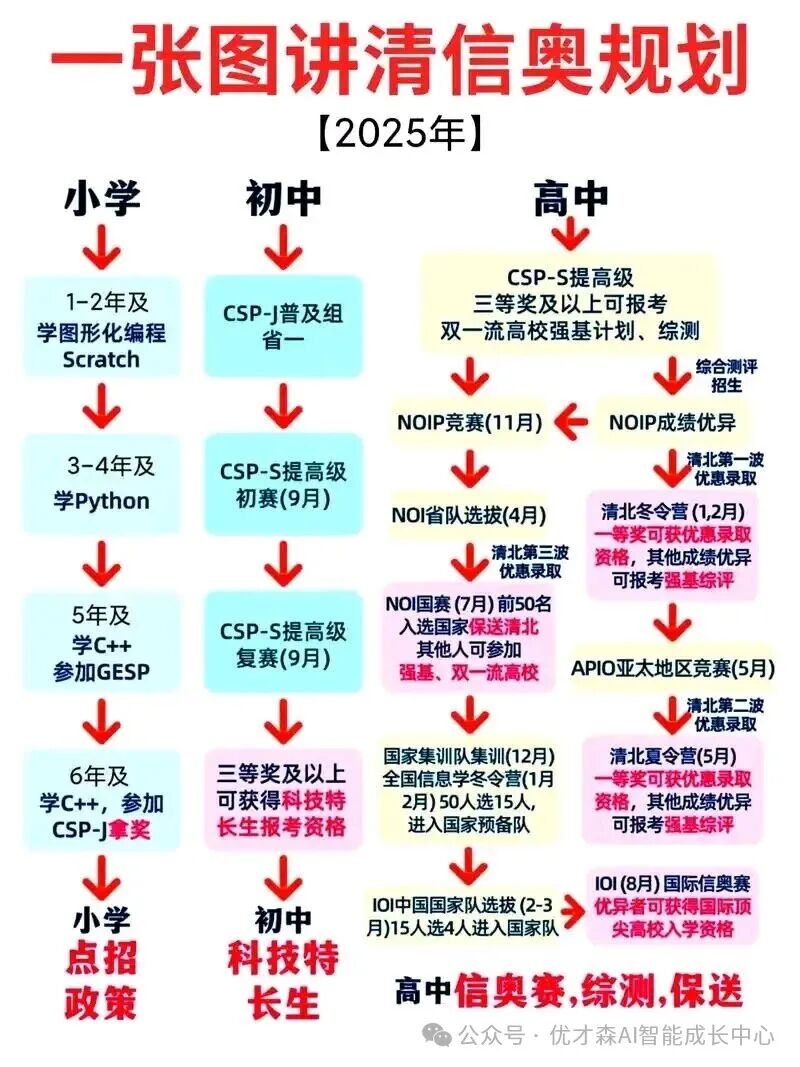
We can understand this inevitable connection from the following core aspects: 1. Unification of core programming concepts (the most fundamental connection) Regardless of how the languages change, the underlying computational thinking is interconnected. The success of Scratch lies in its perfect concealment of complex syntax, allowing you to directly grasp these core concepts: · Sequence: The basic logic of program execution from top to bottom in order. In Scratch, this is the order of block assembly, while in Python/C++, it is the order of code writing. · Loop: Repeatedly executing a segment of code. The repeat block in Scratch corresponds to the for/while in Python and C++. · Condition: The logical judgment of if…then…else…. The if…then block in Scratch corresponds to the if…else… statements in Python/C++. · Variable: Storing and manipulating data. You can create variables and change their values in Scratch, which is completely consistent with the concept of variables in Python/C++. · Event: Triggering a segment of code when something happens (like clicking the green flag or pressing a key). This directly corresponds to event listening and handling mechanisms in Python/C++. · Function/Custom Block: Encapsulating a commonly used segment of code, giving it a name for repeated calls. Custom blocks in Scratch are an intuitive representation of functions or methods in Python/C++. Conclusion: By learning Scratch, you have actually mastered all the core logical concepts common to all programming languages without the burden of syntax. This serves as the cognitive foundation for subsequent learning of any text-based language. 2. A natural transition from “graphical” to “textual” This is a key leap in the learning path. · Scratch (Graphical/Modular): Programming by dragging and dropping blocks, focusing on logic rather than syntax. The advantage is that it is intuitive, fun, and error-free (no spelling mistakes or missing semicolons). The downside is that it is difficult to complete complex and large projects. · Python (Textual/High-level): When you feel limited by Scratch in implementing complex ideas, Python is the perfect next step. It is like an “advanced version of Scratch” where you need to type keywords like if, for, def instead of using blocks. · Connection: Python’s syntax is very close to natural language, making it simple and easy to understand. The logic you are familiar with in Scratch can almost be translated line by line into Python code. For example, creating a simple counting loop has the same logical thinking; only the expression has changed. · Advantages: You are no longer limited to the blocks provided by Scratch; you can call a vast array of third-party libraries (like Pandas for data analysis, TensorFlow for AI), and develop websites, games, tools, etc., greatly expanding your capabilities. 3. Deep exploration from “high-level abstraction” to “low-level control” After mastering high-level languages like Python, you may become curious about how computers actually execute your code. This is where C++ comes into play. · Python (High-level, Highly abstract): You do not need to worry about how memory is allocated and reclaimed (there is an automatic garbage collection mechanism), and variable types are very flexible (dynamic typing). You can focus more on solving the problem itself rather than the details of the computer. This is known as “programmer-friendly”. · C++ (Intermediate, Close to the system): C++ transforms you from a “driver” into a “mechanic”. · Memory management: You need to allocate memory (new) and free memory (delete) yourself, understanding the concept of pointers. This allows you to truly understand how data is stored and accessed in memory. · Performance control: Because it operates at a lower level with minimal runtime overhead, C++ programs have extremely high execution efficiency. It is used in fields that require high performance, such as game engines, operating systems, and high-frequency trading systems. · Compiled language: You need to compile (Compile) it into machine code before running it, which helps you better understand how code transforms into CPU instructions. Connection: The programming thinking (loops, conditions, functions) you cultivated in Scratch and Python is still fully applicable in C++. However, C++ requires you to apply these thoughts in a more precise and rigorous manner, and it increases your understanding of the underlying workings of the computer. For example, in Scratch/Python, you “use” variables, while in C++, you can also “manipulate” the addresses of variables in memory (pointers). Summary and Analogy A good analogy: Learning Scratch is like learning to ride a bicycle with training wheels. You focus on learning the core skills of balance, pedaling, and turning without falling. Learning Python is like removing the training wheels and riding normally. You have mastered all the core skills and can go anywhere, more freely and quickly. Learning C++ is like learning the mechanical principles of a bicycle and how to build one. You not only know how to ride but also understand how the chain transmits power, how gear ratios affect speed, and even how to modify or build a faster bike. Advice for Learners This path is very natural and efficient: 1. Elementary school students/absolute beginners: Start with Scratch, aiming to create interesting projects, thoroughly understand concepts like loops, conditions, and variables, and enjoy the fun of creation. Do not rush to leave Scratch. 2. Middle school students/beginners with a foundation: When you feel that Scratch cannot realize your more complex ideas (like processing data, creating web applications, or more complex games), start learning Python. You will find that you progress rapidly because you already possess most of the logical thinking. 3. College students/those wishing to delve into computer science: After mastering Python or similar high-level languages, if you are interested in fields like computer science, game development, or high-performance computing, then challenge yourself with C++. At this point, the purpose of learning C++ is very clear: to understand the underlying principles and pursue performance, rather than to learn basic programming logic. Therefore, the learning of Scratch, Python, and C++ is by no means isolated, but rather an inevitable progression from shallow to deep thinking, from virtual to real capabilities, and from coarse to fine control. The former is always a solid foundation for the latter.