The differential electrical signal is significantly affected by transmission delay skew, especially for 800G and 1.6T optical modules.Y10T65 Why the 800G optical module focuses on the delay of differential signal lines (included in “Trends and Cases in Optical Communication Technology – Volume Y10”).Yesterday, I wrote about the impact of PCB optical fibers on skew.Y11T56 Google/Intel: PCB differential line pitch design reduces the impact of optical fiber effects on skew for 112Gbps PAM4 signals..I previously wrote about the “core” structure processing of Sumitomo coaxial cables and its impact on skew, Y11T39 Sumitomo: Skew control of RF soft cables.Today, I will discuss Luxshare’s evaluation of skew in differential cables used for 800G DAC, which has been a hot topic in recent years, Y11T2 Amphenol OSFP packaged copper DACCommon dual-core differential coaxial RF cables, Twin-ax, have various structures, but the basic idea is the same. They consist of differential signals, a dielectric, a shielding layer, and a protective sheath.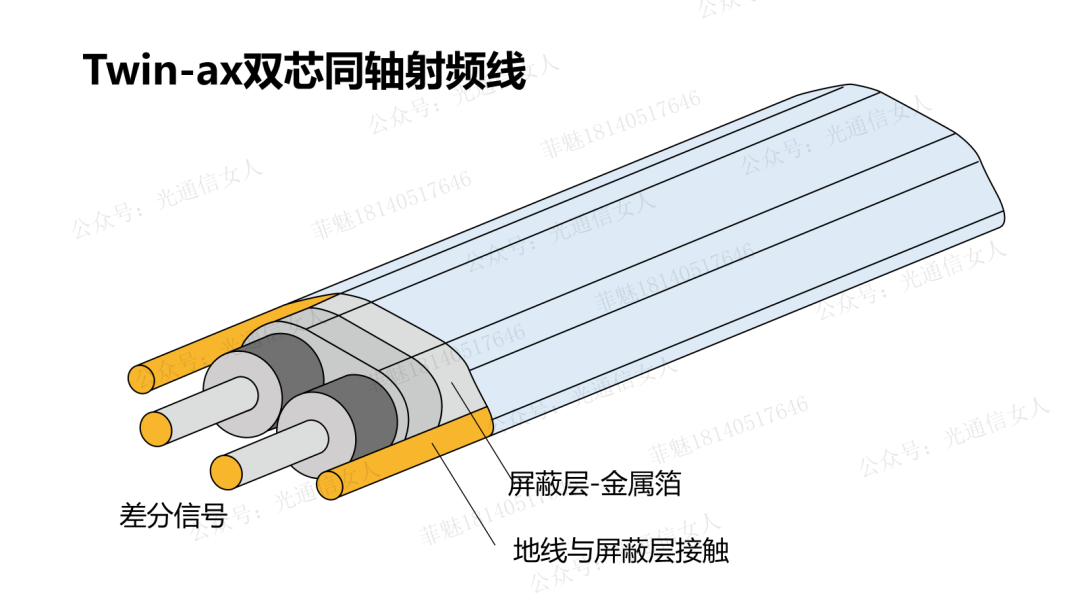
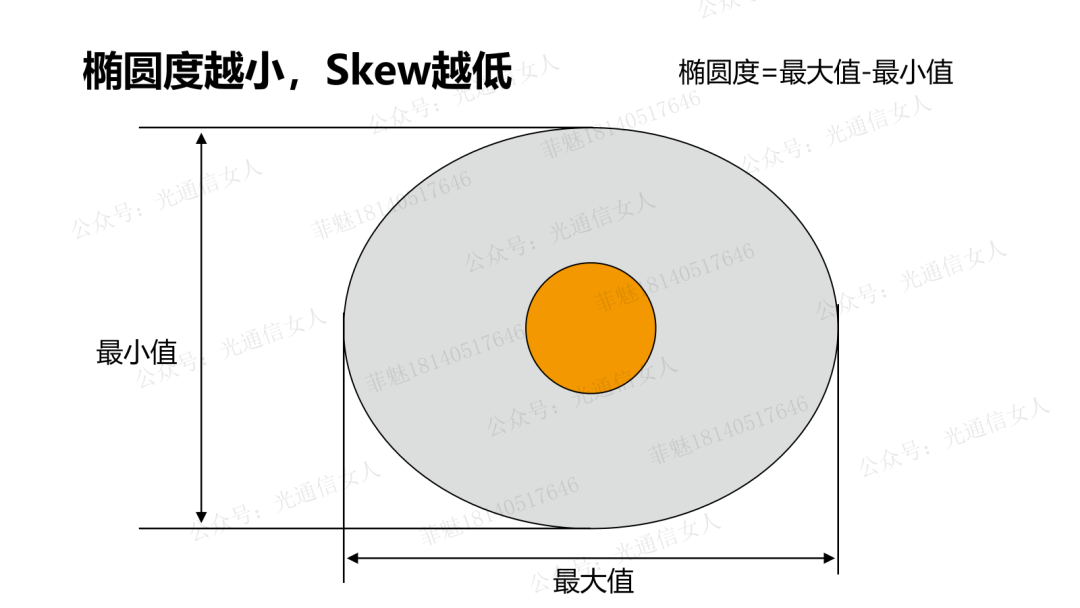
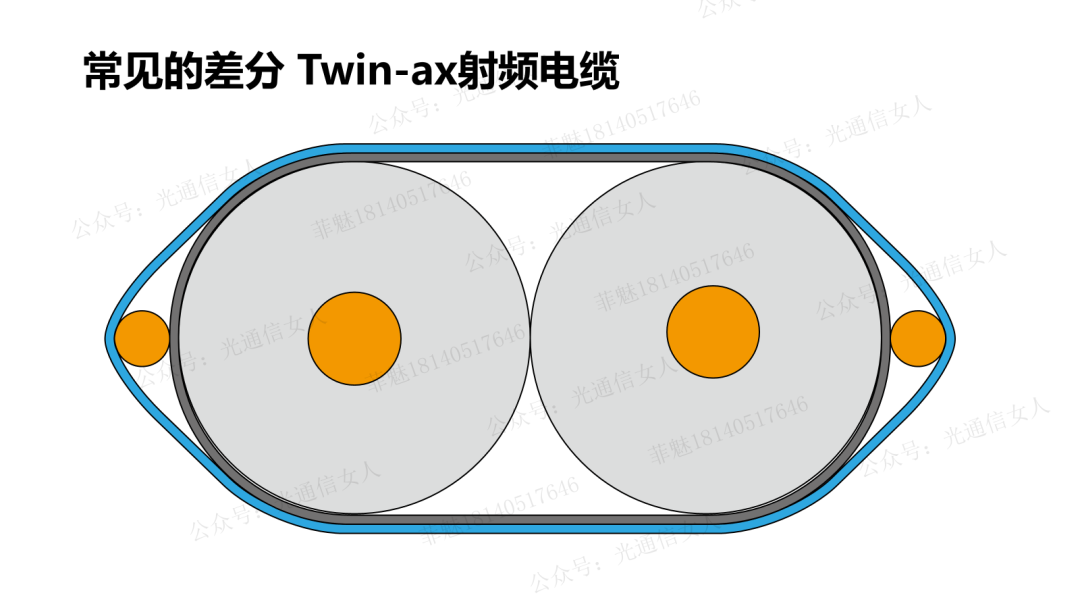 In an ideal scenario, the dielectric and conductive signal form two concentric circular structures. However, during production and application, various compressions or uneven forces can lead to a “non-circular” phenomenon.The closer the structure is to an ideal circle, the lower the ovality, and the smaller the skew.
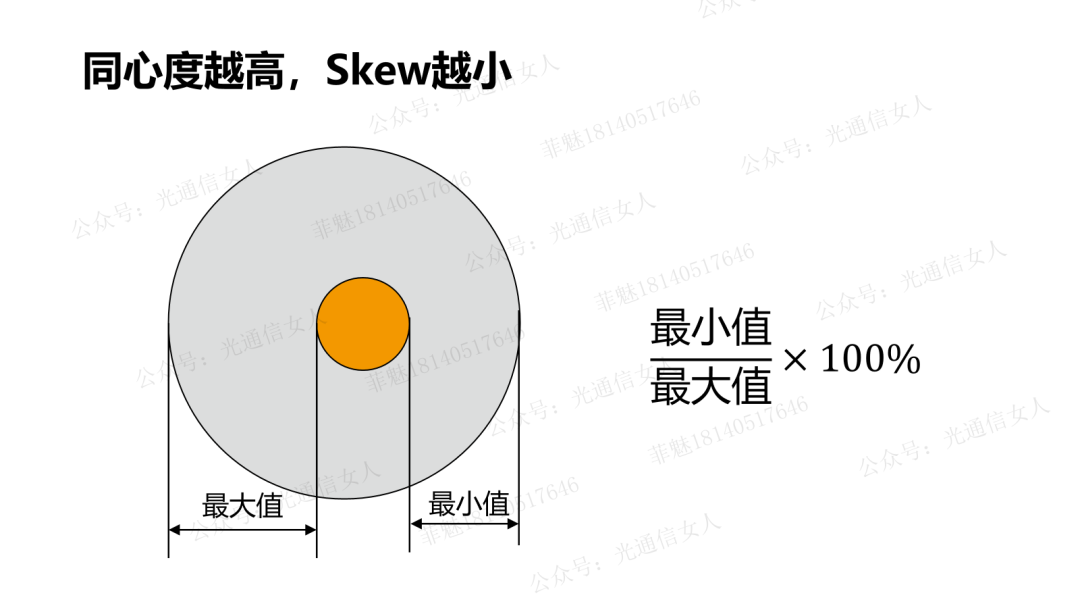
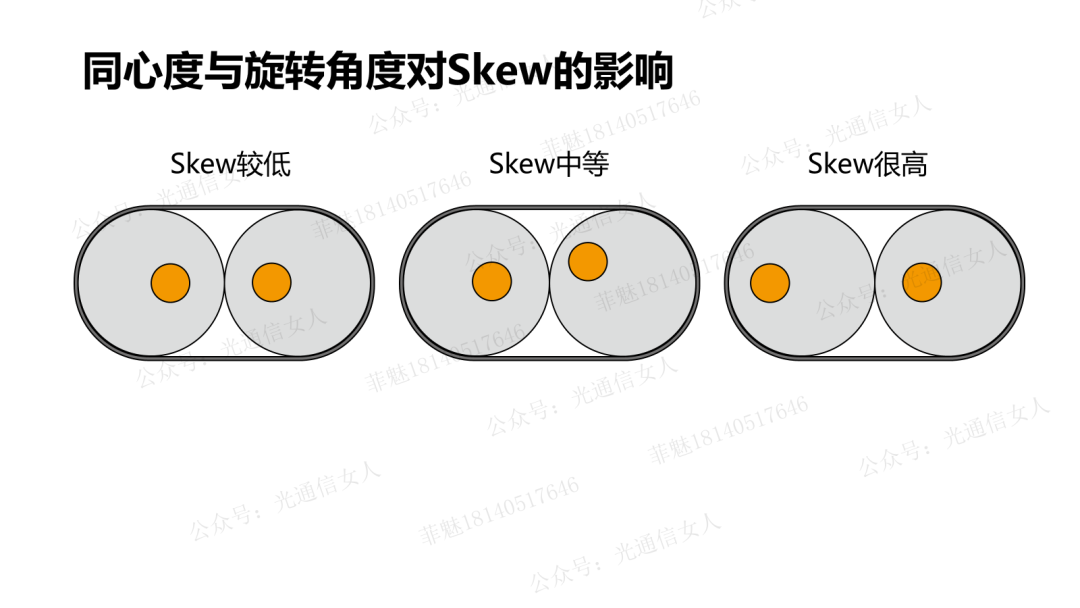
 The higher the concentricity of the coaxial cable, the smaller the offset of the differential line.
 In the manufacturing process, in addition to the extrusion process of coaxial cables that may have production deviations, there are also many manufacturing processes based on “winding”.
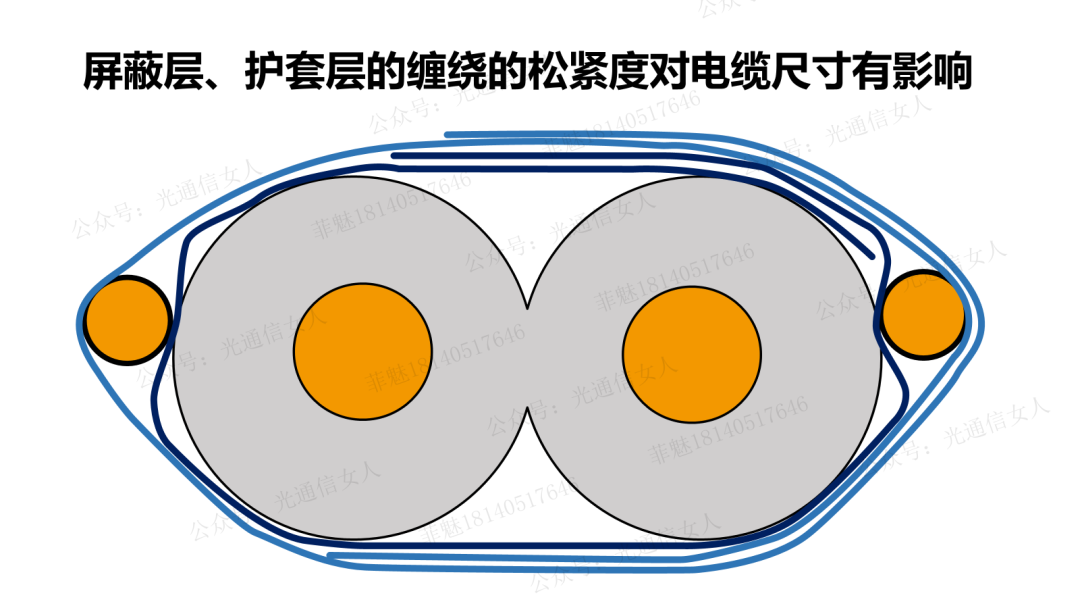
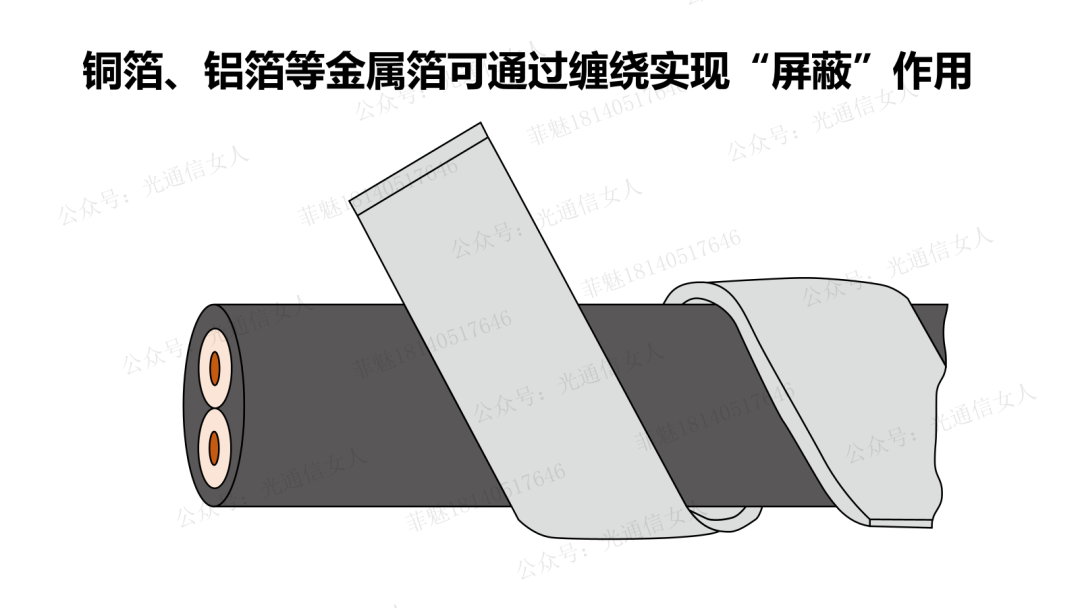 The winding production process has certain differences in tightness, which can affect the concentricity, ovality, and other dimensions of the cable. This also impacts the delay of differential signals.
 When a coaxial cable produces only a 1% dimensional deviation, the differential delay for a traditional cable of 1m scale is as follows.
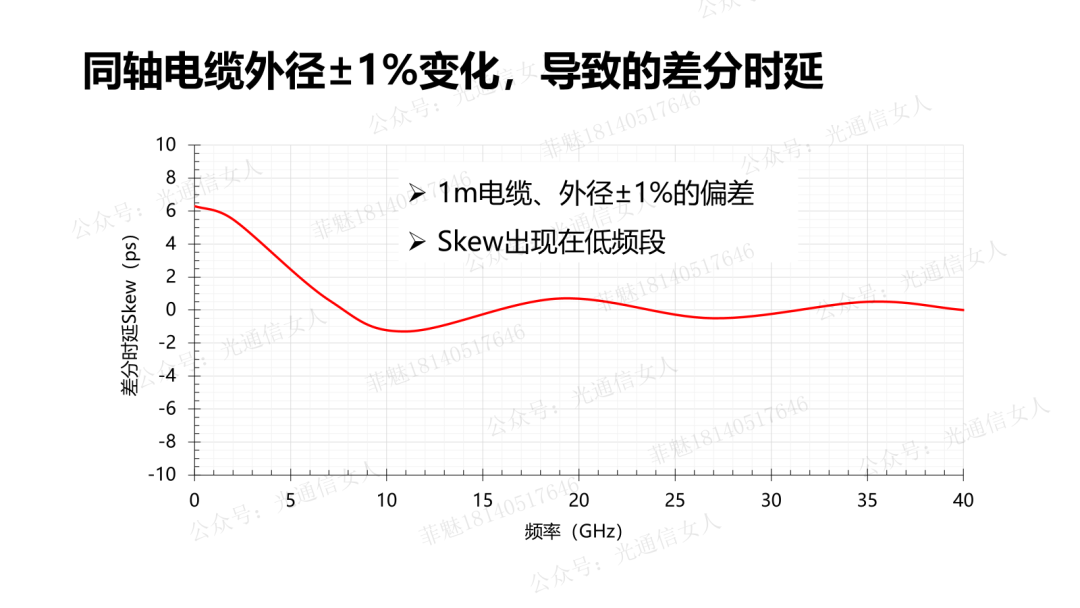 There is a rule that skew is largest in the low-frequency range, which is beneficial for high-frequency signals. The reason is that high-frequency signals have shorter wavelengths, and the coupling between differential lines can cancel out part of the delay.For a differential pair made up of single signal lines with the same eccentricity, different rotation angles also affect skew differently.Choosing an angle of 0 results in high skew, while rotating to 180 reduces skew.
 Additionally, increasing the coupling between differential cables can reduce skew.
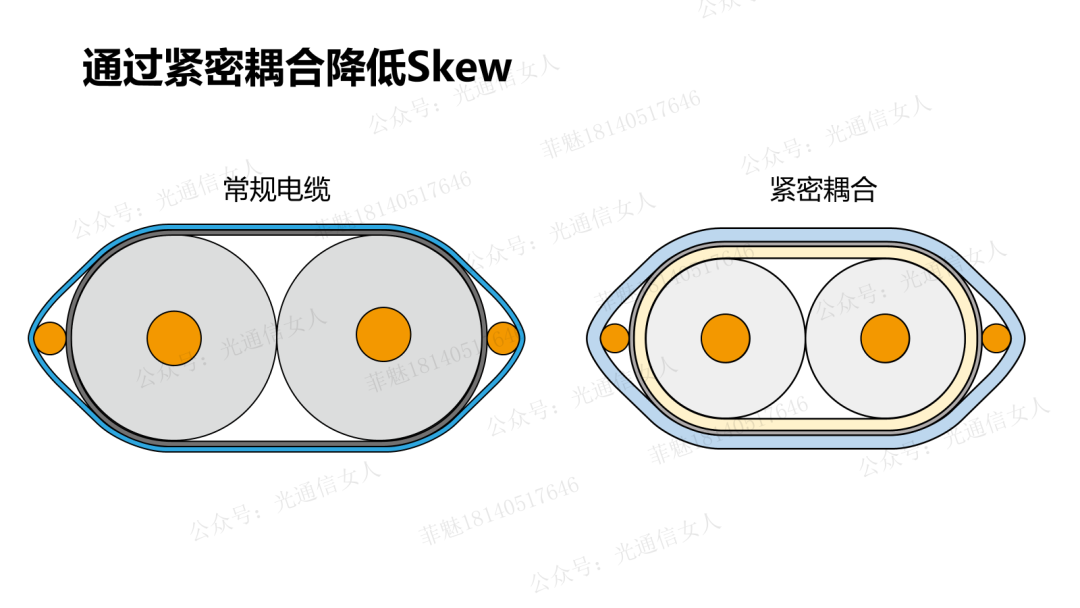
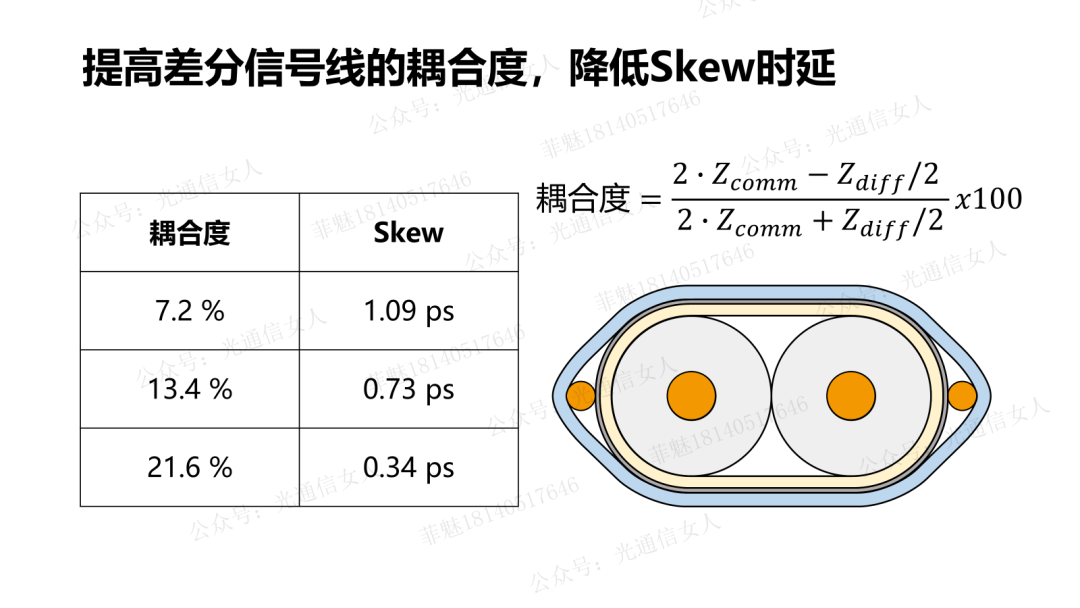 Designing tightly coupled differential cables is also a way to reduce skew.
 Due to the different material systems such as copper wire, RF dielectric, shielding materials, and protective layers, there is a significant difference in the CTE thermal expansion coefficients, leading to considerable dimensional changes.For example, Y11T54 ByteDance 224Gpbs C2M RF signal research, Y11T2 Amphenol OSFP packaged copper DAC, mentions that fluoropolymer dielectrics (such as PTFE, a commonly used fluoropolymer RF resin) have particularly high CTE.The CTE of copper wire is approximately 17ppm/℃, while the CTE of PTFE dielectric is 100~200 ppm/℃, which leads to relative changes in skew during the expansion and contraction of differential signals across different temperatures.The following image shows the skew changes from 0-70℃.
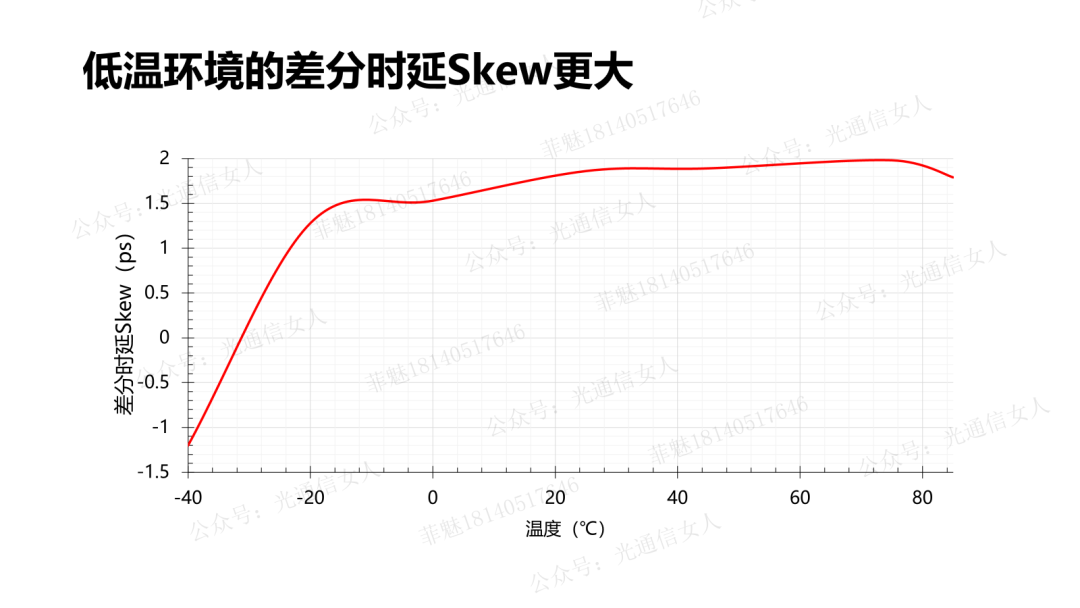
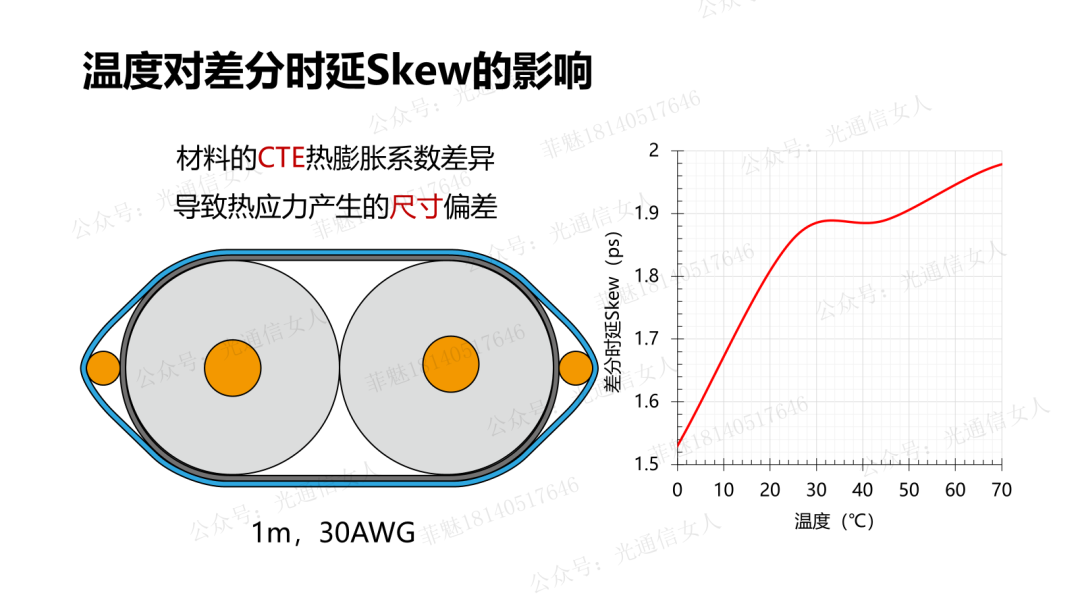 From 0-70℃, extending the range to -40 to 85℃ also shows that lower temperatures produce greater skew.
 Let’s briefly discuss the high-speed optical modules and high-speed electrical modules used in AI scenarios, which have extreme requirements for RF signals.Tomorrow evening, there will be a basic analysis for an hour and a half, and all day Saturday will be focused on the technical trends of optical modules, optical devices, and optical chips in AI scenarios. For detailed inquiries, please contact Feimei at 18140517646.