[Join the GGAI Intelligent Automotive Industry Group (Autonomous Driving Industry Group 3, Vehicle Networking Intelligent Cockpit Group 2, Intelligent Commercial Vehicle Industry Group), add WeChat: 15818636852. Limited to intelligent connected software and hardware enterprises, automotive parts and OEM manufacturers]

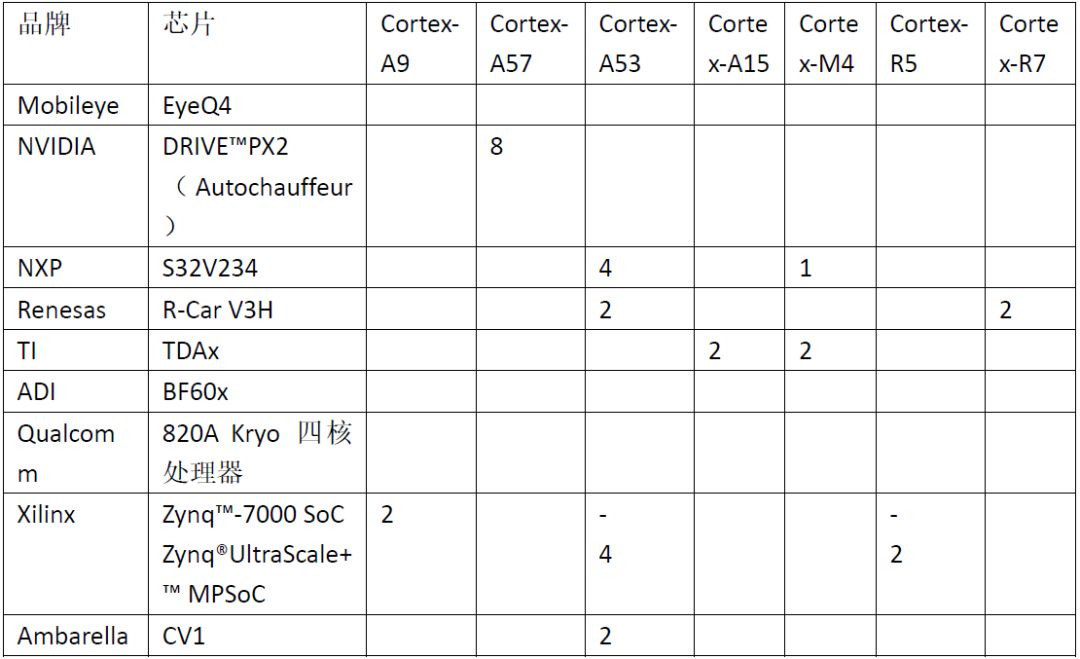
The above shows the mainstream CV chips on the market, which include Cortex series chips. These chip manufacturers cover GPU, CPU, FPGA, etc., but all cannot do without the company with the same logo – ARM.
The True Semiconductor Leader
ARM is a semiconductor IP provider based in the UK. More than 95% of smart devices globally use ARM’s solutions, including in the automotive industry.
Its partners include Intel, IBM, Huawei, Samsung Semiconductor, NEC, SONY, Philips, TI, NXP, Qualcomm, and others. It can be said that ARM’s influence is present in every aspect of our lives. However, despite its significant role in the chip industry, ARM’s annual revenue is not comparable to that of other chip giants.
Intel’s total revenue for the year 2017 was $62.8 billion, a 6% increase from $59.4 billion in 2016, with a net profit of $9.6 billion, down 7% from $10.3 billion in 2016; Qualcomm’s revenue in 2017 was approximately $23 billion; NXP’s revenue for the year was $9.26 billion; Broadcom’s revenue in 2017 was $17.636 billion, a 33% increase year-on-year with a gross margin of 63%… In contrast, ARM’s revenue for the fiscal year 2017 was only about $1.83 billion, an 8% increase year-on-year.
Although ARM struggles to compete with downstream manufacturers in terms of revenue, it undeniably holds significant influence in the industry. According to the market share disclosed by SoftBank at the 2017 World Congress, ARM’s market share in smartphones is >99%, modems >99%, in-vehicle information devices >95%, and wearable devices >90%.
In 2017, systems-on-chip (SoC) based on ARM saw a volume of 2.13 billion (up from 1.77 billion in 2016), capturing 39% of the overall market share, bringing ARM’s historical chip volume to 120 billion.
In 2017, the company earned over $600 million just from licensing, which included 45 Cortex-A (high-performance, dense) licenses, 16 Cortex-R (fast response) licenses, and 58 Cortex-M (small, low-power) licenses.
In the automotive sector, ARM’s market share for in-vehicle infotainment (IVI) and advanced driver assistance systems (ADAS) was 90% and 10%, respectively, with market values of $4 billion and $8 billion, with plans to increase the market value to $15 billion each by 2026.
On July 18, 2016, SoftBank acquired ARM for $32.17 billion, completing the largest acquisition in European technology history. Masayoshi Son, who invested in Alibaba and gained over 2700 times returns, stated, “I believe ARM will become my most important investment because no one on Earth can live without chips – chips are in cars, in refrigerators, everywhere.”
Therefore, if we are to identify the true leader in the semiconductor industry, it must be ARM.
Cortex-A
Among ARM’s processor solutions, there are Cortex-A, Cortex-R, Cortex-M, as well as machine learning and security processors. The most commonly seen in this article are the first three solutions.
ARM Cortex-A series application processors provide a range of solutions for devices that undertake complex computing tasks, such as hosting rich operating system (OS) platforms and supporting various software applications. The Cortex-A series supports scalable clusters with single-core and multi-core configurations.
Cortex-A processors utilize multi-core technology to provide scalability of up to four cores for traditional MPCore processors and up to eight cores for DynamIQ processors – enabling higher computational throughput in CPU systems. Multi-core processing allows any of the four component processors within the cluster to shut down when not in use, such as when the device is in standby mode, to save power.
This is why we often see Cortex-AXX being dual-core or quad-core in many processors. DynamIQ-based processors also enhance data security and privacy, advanced security, RAS features, and integrated AI capabilities, enabling DynamIQ-based systems to offer a wide range of solutions. CPUs designed based on DynamIQ technology can achieve advanced computing functions in machine learning and artificial intelligence.
The most widely used Cortex-A53 processor has one to four cores, each with an L1 memory system and a shared L2 cache, based on the Armv8-A architecture. It is a low-power processor with 64-bit capabilities, suitable for various devices demanding high performance in power-constrained environments.
Cortex-A53 processors can integrate various Arm technologies into SoCs, including graphics IP, system IP, and physical IP.
Devices such as Xilinx’s Zynq®UltraScale+™ MPSoC, Ambarella’s CV1, NXP’s S32V234, and Renesas’ R-Car V3H all use Cortex-A53, even Qualcomm’s 820A designed specifically for automotive applications utilizes Armv8 architecture designed Kryo. NVIDIA and TI also use products from the Cortex-A series.
Cortex-M
Arm Cortex-M processor series is a range of scalable, energy-efficient, and easy-to-use processors that meet the needs of future intelligent and connected embedded applications. Cortex-M processors provide multifunctional connectivity, comprehensive code reuse, standard security, and advanced energy efficiency.
Cortex-M3, Cortex-M4, and Cortex-M33 are suitable for all applications that require a balance between 32-bit performance and energy efficiency, integrating digital signal processing (DSP) and floating-point operations to quickly and efficiently handle digital signal control applications, such as sensor fusion, motor control, and power management.
Cortex-M4 takes advantage of integrated DSP, SIMD, and MAC instructions in microcontrollers to simplify overall system design, software development, and debugging. With an optional floating-point unit (FPU), the speed of single-precision floating-point operations can be increased tenfold compared to equivalent integer software libraries. Highly optimized DSP libraries built using these can be freely obtained from the Arm website.
Cortex-M series processors have advantages of low power consumption, low cost, and ease of use, and processors from TI and NXP also utilize Cortex-M4.
Cortex-R
Arm Cortex-R real-time processors provide high-performance computing solutions for embedded systems where reliability, high availability, fault tolerance, and/or deterministic real-time responses are required. Cortex-R processors are used in products that must always meet performance requirements and timing deadlines.
Additionally, Cortex-R processors are used in electronic systems that must be functionally safe to avoid hazardous situations, such as in medical applications or automated systems.
For functional safety applications, Arm offers Cortex-R5 and Cortex-R52, which provide advanced integrated functional safety features and virtualization support. Cortex-R7 and Cortex-R8 provide extremely high performance and consistency to meet the demands of applications like modems and storage.
Cortex-R7 is a high-performance 4G modem and storage, available in single-core or dual-core configurations, suitable for mobile processing technologies (28nm HPM). The R7 MPCore processor is a mid-range processor suitable for deep embedded real-time systems, consisting of one or two Cortex-R7 processors in a single MPCore device. It implements the ARMv7-R architecture and includes Thumb-2 technology for optimal code density and processing throughput.
Each processor includes an optional floating-point unit (FPU). If an FPU is instantiated, there are two possible designs, optimized FPU (single precision and half precision), or full FPU (single precision, half precision, and double precision).
Cortex-R5 processors are based on the functionality set of Cortex-R4, featuring enhanced error management, extended functional safety, and SoC integration capabilities, suitable for deep embedded real-time and safety-critical systems. Optional safety documentation packages simplify certification processes through standards such as ISO 26262 and IEC 61508, obtaining higher levels of certification.
The optional FPU implements the Arm Vector Floating Point architecture VFPv3, with 16 double-precision registers, compliant with IEEE754 standards. FPU performance is optimized for single-precision calculations and (optional) fully supports double precision.
The Cortex-R5 is used in Xilinx’s Zynq UltraScale+ solutions, where its flexible FPU enables users to realize customized floating-point computing solutions, which is particularly crucial for current ADAS manufacturers. The dual-core ARM Cortex-R5 real-time processing unit is responsible for real-time processing and video codec unit (VCU).
This unit provides multi-standard video encoding and decoding capabilities, including high-efficiency video coding (HEVC) compliant with H.265 standard, advanced video coding (AVC) compliant with H.264 standard, reaching 4Kx2K at 60fps frame rate, or 8Kx4K at lower frame rates.
Conclusion:Among the solutions launched by the nine chip manufacturers, only Mobileye and ADI have not featured ARM. Mobileye’s EyeQ4 uses a set of industrial-grade quad-core MIPS processors running at 1GHz, while the EyeQ series chips utilize MIPS core architecture, not ARM architecture.
The MIPS architecture is a reduced instruction set computing (RISC) architecture developed in the 1980s. The designers of this architecture later founded a company named MIPS to develop and sell MIPS processors. MIPS was later acquired by multiple companies, finally falling into the hands of the British chip company Imagination Technologies (IMG) in 2013.
Mobileye’s chief engineer stated that there is a high likelihood that Mobileye’s EyeQ series chips will continue to use MIPS architecture in the future.
ADI’s Blackfin® processors are a new type of 16-32 bit embedded processors designed to meet the computational requirements and power constraints of today’s embedded audio, video, and communication applications. Blackfin processors are based on the microcontroller architecture (MSA) jointly developed by ADI and Intel.
Another company is Qualcomm. In 2015, Qualcomm began to launch its 64-bit custom microarchitecture “Kryo”. Previously, Qualcomm had been using the Krait architecture, which was a secondary development based on the ARM architecture. The Snapdragon 810 directly adopted ARM Cortex-A57/A53 cores.
The Snapdragon 820A automotive chip released by Qualcomm in 2016 used a 14nm FinFET process, a 64-bit Kryo quad-core CPU, and an Adreno530 GPU, based on the 64-bit custom microarchitecture Kryo.