According to a report by Electronic Enthusiasts Network (Author: Huang Jingjing)Analyst Ben Reitzes from Wall Street research firm Melius Research predicts that Nvidia’s market value could reach $9 trillion by 2030. In July of this year, Nvidia’s valuation reached $4 trillion, based on this calculation the company’s market value will more than double in the next five years.He expects that assuming Nvidia captures 30% of the market share, by 2030 Nvidia’s annual revenue will reach approximately $600 billion.IDC data shows that the global AI server market size will reach $125.1 billion in 2024, increasing to $158.7 billion in 2025, and is expected to reach $222.7 billion by 2028. Among these, the share of generative AI servers will increase from 29.6% in 2025 to 37.7% in 2028. In 2024, China’s AI computing power market size will reach $19 billion, a year-on-year increase of 86.9%, and is expected to reach $25.9 billion in 2025, a year-on-year increase of 36.2%.We see that applications in data centers, AI, cloud computing, etc. remain strong, and the demand for computing power from core processors (such as CPU, GPU, DPU, ASIC, etc.) will continue to soar, presenting significant challenges and huge opportunities for the power supply systems of these main chips. Some domestic and foreign manufacturers are actively entering this market to provide a wealth of power supply solutions.
MPS
In the second quarter of 2025, MPS achieved a record quarterly revenue of $664.6 million, a 4.2% increase from the first quarter of 2025 and a 31.0% increase from the second quarter of 2024. This performance reflects the ongoing advantages of a diversified market strategy, consistent execution, continuous innovation, and a strong focus on customer needs.MPS stated that it has begun the first shipments of power supply solutions to support customers’ new AI products based on Application-Specific Integrated Circuits (ASIC).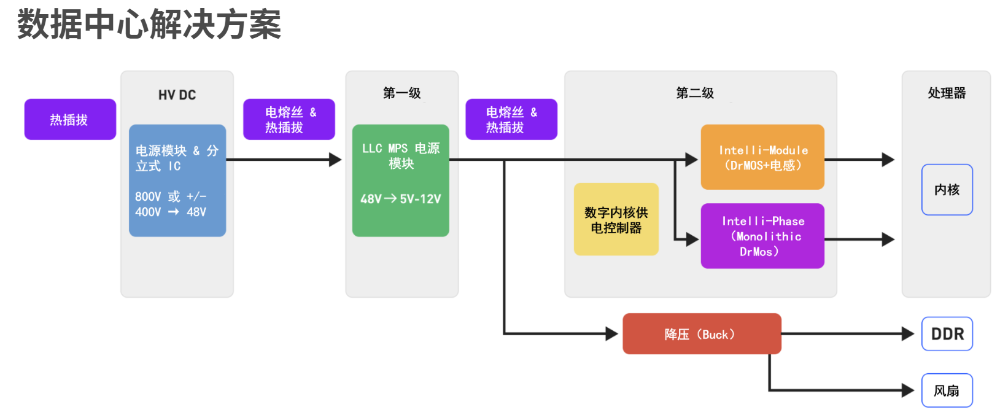 Image: MPS Data Center Solutions
- 800V Modules and Devices: Isolated high-power solutions designed for next-generation data center racks
- 48V Modules & Devices: LLC power modules and components designed for high current density and thin packaging
- Intelli-module: 3D vertical integration structure with higher current density and superior heat dissipation performance
- Buck: Compact stackable design solutions that have passed rigorous testing to ensure usability in extremely challenging environments
- Power Fuses & Hot-Swap: Utilizing advanced proprietary monolithic process technology, integrating power FETs and control logic devices
- Intelli-Phase (Monolithic DrMOS): Featuring excellent high efficiency and QST technology (Quiet Switching Technology)
- Digital Controllers: Designed to eliminate labor-intensive system fine-tuning tasks
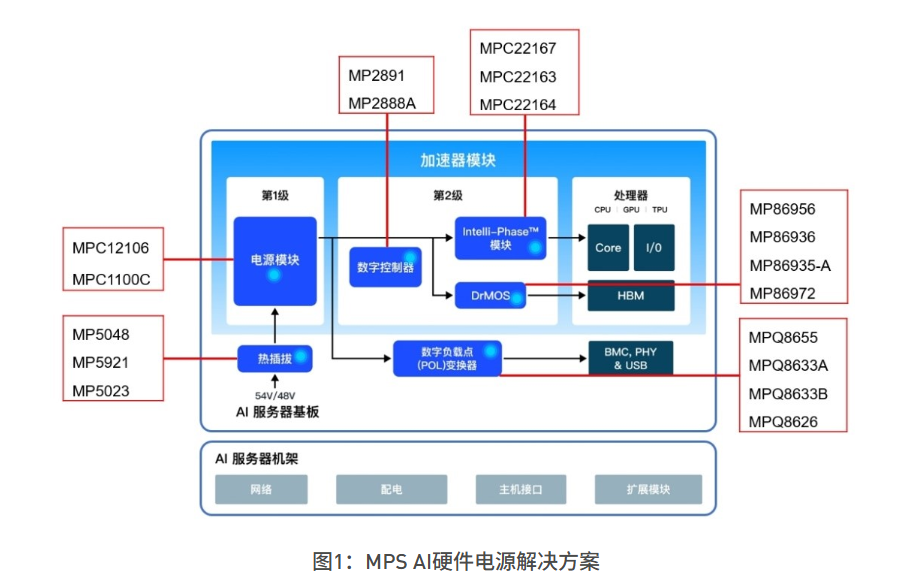 MPS’s AI power solutions feature innovative designs, are more compact, and have lower distribution losses, enhancing the computing power of data centers within a given rack range. MPS’s power conversion technology occupies less space on the motherboard, allowing all processors to be more closely integrated, achieving greater computing power in a smaller space. To address the heat dissipation issues in high power density power modules, MPS takes a multi-faceted approach: on one hand, optimizing internal structures and device designs to improve power conversion efficiency, reduce power consumption, and minimize heat generation, ensuring stable operation of the equipment; on the other hand, designing modules with top heat dissipation to facilitate heat sink design; furthermore, the devices are compatible with liquid cooling applications, enhancing server cooling effects through liquid cooling, thereby further maximizing power performance and significantly increasing power per rack.
Jingfeng Mingyuan
Jingfeng Mingyuan’s DCDC complete power solutions (multi-phase digital controllers, Smart DrMOS, POL, eFuse/HotSwap) meet the power specification requirements of various server platforms, with industrial-grade products providing high wattage, high efficiency, high density, and high frequency applications.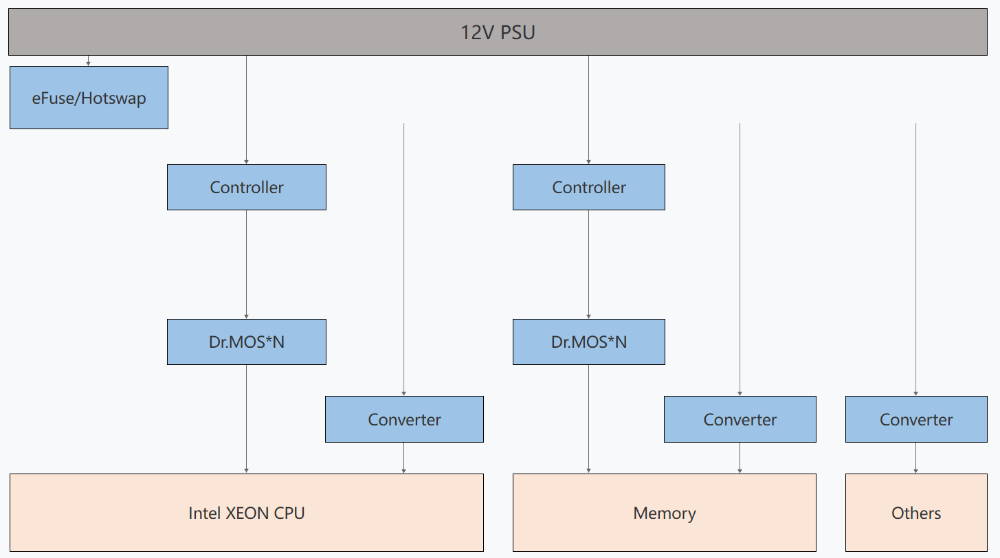 Recently, Jingfeng Mingyuan launched the innovative Smart DrMOS intelligent integrated power device chip, achieving a breakthrough in high efficiency, high density, and intelligent power management, significantly enhancing system energy efficiency with its fully integrated design, excellent high-performance characteristics, and low static power consumption.This product series uses self-developed high current packaging, including frame and stacked packaging, and employs monocrystalline process BCD technology. The fully integrated design achieves simplicity and order, with different specifications of packaging forms adaptable to various DrMOS types.Jingfeng Mingyuan’s DrMOS product series is widely applicable to operating conditions with input voltages of 3V-24V and loads of 50A-90A, with operating frequencies up to 1.5MHz. It can meet the power supply needs of high wattage, high efficiency, and high power density chips, achieving high-frequency miniaturized power supply solutions with excellent thermal and EMI performance.The chip integrates a current detection circuit with a gain of 5μA/A or 10μA/A, providing excellent current sampling accuracy and transient response performance. At the same time, it integrates a temperature detection circuit on-chip, providing real-time junction temperature monitoring and protection alarms. Both quickly and accurately transmit power-level current and temperature information, enabling rapid interconnection with processor loads for precise closed-loop control of processor power.The Jingfeng Mingyuan DrMOS series products support comprehensive protection functions, including Over-Temperature Protection, Over-Current Protection, High-side MOSFET Short Protection, and Under-Voltage Lockout, ensuring the operational safety of the entire power supply system.Previously, Jingfeng Mingyuan was the first domestic power chip company to enter Nvidia’s recommended supplier list, and has also entered Intel’s supplier system, with POL obtaining AMD AVL.In the first half of 2025, Jingfeng Mingyuan achieved revenue of 731 million yuan, a year-on-year decrease of 0.44%; net profit attributable to the parent company was 16 million yuan, a year-on-year increase of 151.67%; net profit excluding non-recurring gains and losses was 13 million yuan, a year-on-year increase of 170.44%; gross profit margin remained stable, with a comprehensive gross profit margin of 39.60%, a year-on-year increase of 4.18 percentage points.Jingfeng Mingyuan stated that the company continuously reduces costs and increases efficiency through process iteration and strengthening supply chain management, resulting in an overall increase in gross profit margin compared to the previous year. In addition, the company’s product structure is continuously optimized, with improvements in technology and product capabilities in the motor control driver chip field, and rapid growth in the high-performance computing power chip business. In the first half of this year, high-performance computing power chips achieved sales revenue of 35 million yuan, a year-on-year increase of 419.81%.Jingfeng Mingyuan announced that its high-performance computing product line’s digital multi-phase controllers, DrMOS, POL, and eFuse full series products have achieved mass production and entered the scale sales stage, especially for new generation graphics card applications, with multiple overseas and domestic customers starting large-scale shipments. Through continuous BCD process and product innovation, the performance of the second-generation DrMOS chips has significantly improved, and costs have decreased, having been adopted by multiple customers and entering mass production.
Jiewa Technology
Jiewa Technology provides a complete analog product portfolio for the computing field, including DC-DC, eFuse, LDO, power modules, signal chains, and more. The company’s DrMOS and multi-phase business are continuously advancing, with 30A~90A DrMOS and 6-phase, 8-phase multi-phase controllers having achieved mass production ramp-up. Currently, the company has formed a complete product matrix of DrMOS + multi-phase in applications such as PC servers, AI, and autonomous driving.Multi-phase power supplies, as power management chips that convert electrical energy into higher or lower voltage, current, or power, are primarily designed to meet the power supply needs of large load main chips such as CPU/GPU, and have now become the mainstream solution for CPU/GPU power supply.。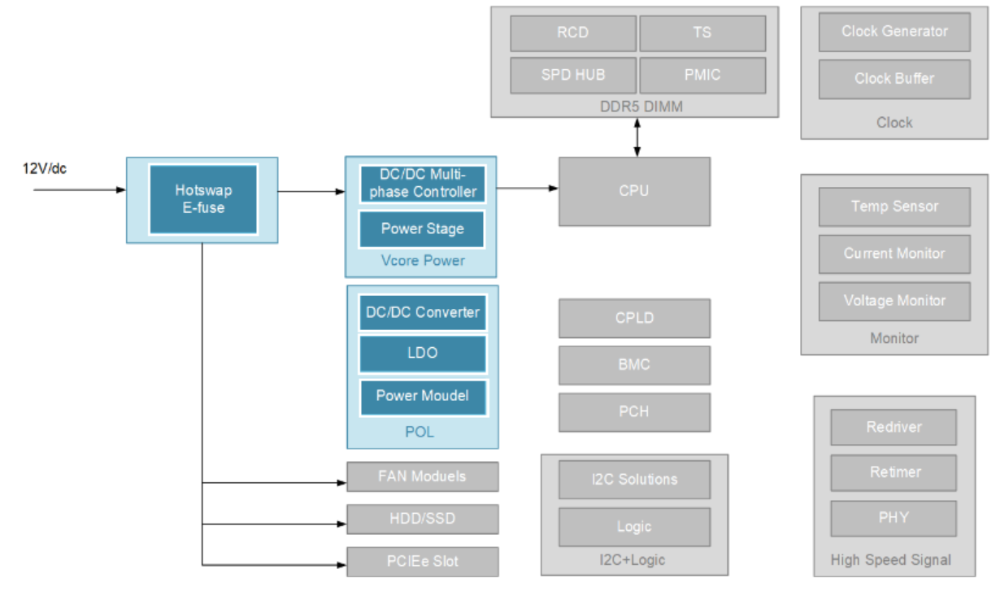 Jiewa Technology’s first quarter 2025 report shows that the company achieved operating revenue of 528 million yuan, a year-on-year increase of 60.42%; net profit loss of 113 million yuan, a year-on-year reduction in loss; net cash flow from operating activities of 24.82 million yuan, turning positive; total R&D investment of 191 million yuan, a year-on-year increase of 36.18%.The company is expanding into emerging application areas, enhancing its competitiveness and market share in new energy, computing, and automotive sectors. In 2024, in the new energy sector, the company will launch ultra-high voltage PMIC chips for solar applications based on its own processes; in the networking and security sectors, the company will launch multiple PoE Ethernet power supply chips; in the automotive electronics sector, the company will launch several high and low side driver chips and automotive lighting driver chips, with the new generation automotive DrMOS achieving mass production; in the computing field, the company will launch multiple multi-phase controllers and DrMOS high current products.Jiewa Technology stated that multi-phase power products (multi-phase controllers and DrMOS) belong to the company’s power management chip category. The company’s power management chips achieved operating revenue of 1.646 billion yuan in 2024, a year-on-year increase of 28.84%. As the market demand in the computing and automotive sectors stabilizes, the penetration rate of the company’s high-end products such as multi-phase controllers and DrMOS is gradually increasing; in the future, the company will continue to leverage its technological accumulation advantages, actively expand into emerging application areas, and deepen its layout from low power to high power across the entire series to further meet customer needs.
Conclusion
A recent report from Nomura Securities shows that Nvidia GPUs currently hold over 80% of the AI server market share, while ASICs account for only 8% to 11%. By 2025, the combined shipment volume of ASIC chips from Google and Amazon AWS is expected to be about 40% to 60% of Nvidia GPU shipments. By 2026, with large-scale deployments from Meta and Microsoft, ASIC shipments are expected to surpass Nvidia GPUs. At that time, the era of ASICs will officially arrive. However, it is expected that both technologies will coexist for a long time, providing solutions for different demand scenarios.Regardless, the demand for high-performance power management chips in AI servers is surging, with the value of power management chips for a single AI server being 3-5 times that of traditional servers, and core products such as DrMOS and multi-phase controllers deeply benefiting from the wave of computing power upgrades.

Disclaimer: This article is original from Electronic Enthusiasts Network, please indicate the source above when reprinting. For group communication, please add WeChat elecfans999, for submission, exposure, and interview requests, please send an email to [email protected].
More Hot Articles to Read
-
SoftBank invests $2 billion to rescue! Intel faces a critical moment, with the Trump administration likely to become the largest shareholder
-
AI Energy Disruptor! SOFC will become the “New Power King” of data centers
-
Tencent: No need to continue purchasing Nvidia H20 chips
-
Explosion at Japanese trifluoride factory: storage prices may rise, domestic manufacturers urgently fill the gap
-
So exciting! Humanoid robot 1500-meter race, this company wins! Moreover, the robot runs autonomously throughout the process
Click to Follow and Star Us
Star us to not miss any updates!