Currently, there is an increasing need for edge intelligent hardware to locally process environmental data generated in real-time by sensors and smart devices in fields such as autonomous driving, smart home systems, and industrial control, in order to minimize decision-making latency. Neuromorphic hardware, which can accurately simulate various biological neuron behaviors, is expected to drive the development of ultra-low power edge intelligence. Existing research has explored hardware with synaptic plasticity (i.e., the ability to adaptively strengthen or weaken synaptic connections), but to fully simulate learning and memory processes, multiple plasticity mechanisms, including intrinsic plasticity, need to work in concert.
To address these issues, the research team led by Professor Zhou Peng and Researcher Bao Wenzhong from the National Key Laboratory of Integrated Chips and Systems, in collaboration with Professor Chai Yang from the Hong Kong Polytechnic University, has proposed a novel bio-inspired neuron structure using wafer-level 2D semiconductor (MoS2) materials based on the principles of dynamic random-access memory (DRAM). This structure achieves the first-ever integration of Intrinsic Plasticity, Spike Timing Coding, and Visual Adaptation in a single hardware platform. Recently, the related results were published in the internationally renowned journal Nature Electronics under the title “A Bio-inspired Neuron with Intrinsic Plasticity Based on Monolayer Molybdenum Disulfide.”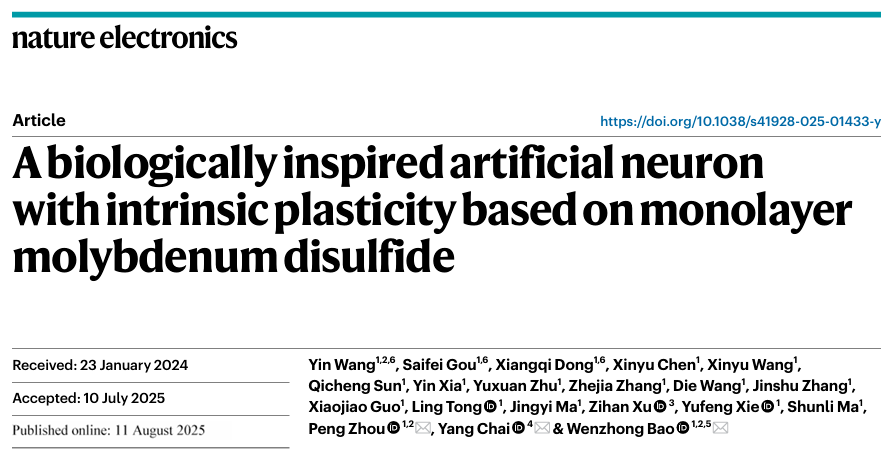
Neuromorphic hardware is key to simulating brain-like information processing. Current research results still rely on resource-intensive silicon-based CMOS hardware and pulse frequency-based coding strategies, lacking effective spatiotemporal sparsity, and consuming much more power compared to biological systems. Furthermore, previous device studies have focused on synaptic plasticity mechanisms, neglecting phenomena such as action potential threshold modulation and resting potential shifts, which are aspects of intrinsic plasticity in neurons. To solve this problem, the researchers developed an Integrate-Fire neuron module based on DRAM and inverter structures using wafer-level MoS2 materials to simulate the integration and discharge mechanisms in neural dynamics. This work utilizes the write voltage of DRAM to set the resting membrane potential of the neuron cell and simulates the integration process of the neuron through the leakage current of the 2D DRAM transistors. When the membrane potential reaches the inverter’s flip threshold, the neuron triggers a voltage pulse. Input information is encoded in time, simulating the characteristics of biological neurons, with a single pulse power consumption of only 2.82nJ. In simple terms, the researchers can adjust the resting potential of the neuron by modulating the write voltage of the DRAM to simulate intrinsic plasticity.
At the same time, this work leverages the excellent optoelectronic properties of MoS2 to enable the neuron to achieve energy-efficient temporal coding in response to light or electrical pulse stimuli. The gate bias in the neuron module can be globally adjusted to modulate the optoelectronic response of the MoS2 transistors, simulating the variable light sensitivity of photoreceptor cells in the human retina. By globally reducing light sensitivity in bright environments and increasing it in darker environments, the module can accurately encode visual images. These results indicate that the neuron module can achieve light adaptation and dark adaptation similar to the human visual system.
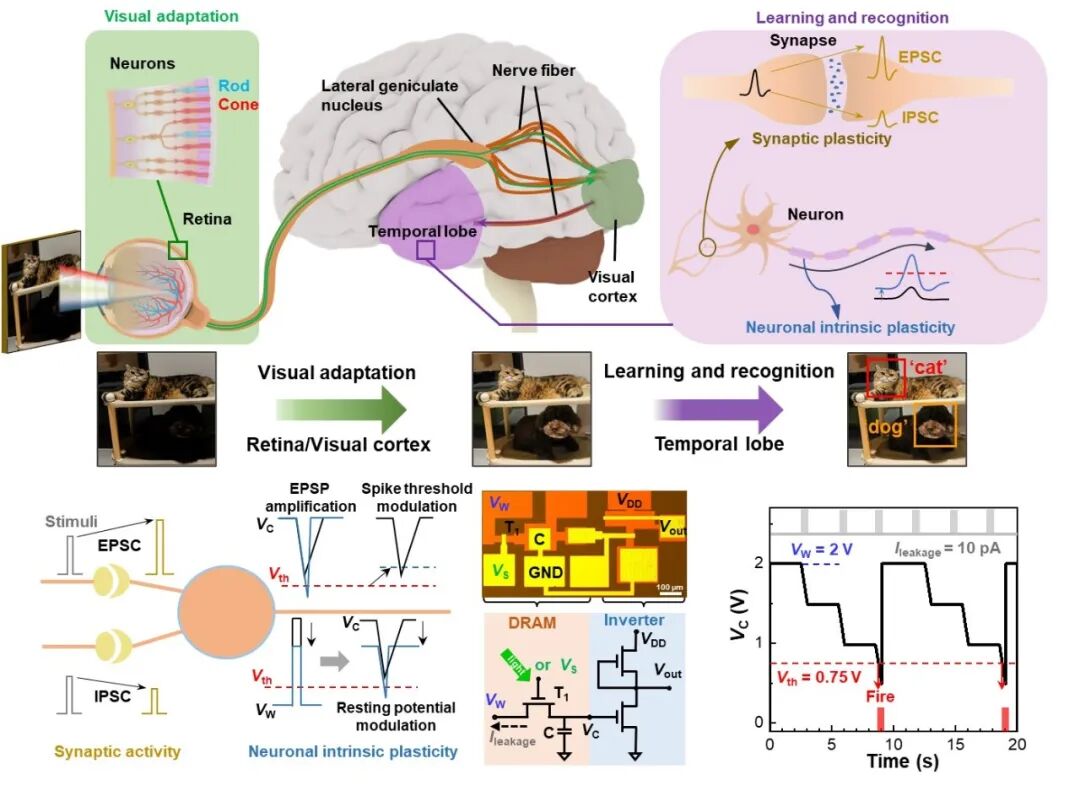
Figure 1. 2D DRAM bio-inspired neuron circuit simulating human brain visual adaptation and feature recognition.
Based on the aforementioned 2D optoelectronic synergistic neurons, the researchers developed a bio-inspired neural network (BioNN) for image recognition, using the 2D DRAM neuron module as the image preprocessing and computation layer. This neuron can simultaneously perform pulse timing coding, intrinsic plasticity modulation, and visual adaptation biological neural dynamics processes, breaking the limitations of traditional neuromorphic hardware architectures and integrating perception, memory, and computation, thus achieving efficient integrated brain-like visual event processing. In the future, the 2D neuron module could serve as a universal basic unit for expanding into large-scale neuromorphic computing systems, deeply integrating with advanced sensors, memory, and brain-like algorithms to efficiently construct everything from edge intelligent terminals to large-scale distributed brain-like networks. Its applications in autonomous driving, smart healthcare, robotic perception, and brain-machine interfaces will provide foundational support for low-power, real-time responsive intelligent systems and promote the evolution of brain-like computing technology towards a form that is closer to biological neural systems.
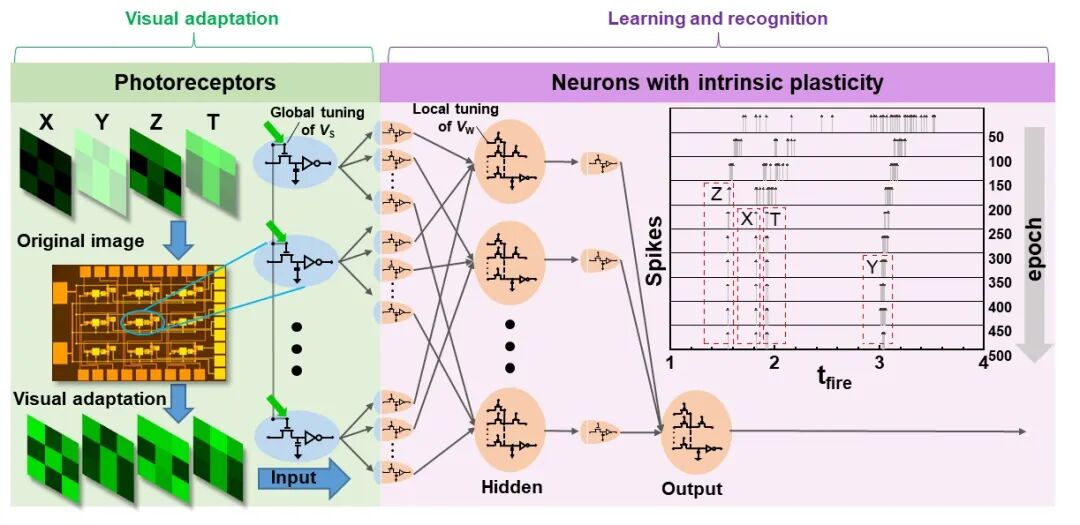
Figure 2. Bio-inspired neural network circuit achieving visual adaptation and feature recognition.
The research team has over a decade of technical accumulation in the process integration and circuit application of 2D semiconductors. This breakthrough has established a full-chain innovation capability from atomic-level material control, device physical mechanism design, wafer-level chip fabrication, to brain-like computing architecture circuits. Professor Zhou Peng, Vice Dean of the School of Integrated Circuits and Micro-Nano Electronics at Fudan University, representing the research team, stated that this breakthrough fully leverages the ultra-low power advantages of 2D semiconductors, thus promoting artificial intelligence computing to evolve towards a high-efficiency form that is closer to biological neural systems, while also opening up new pathways for the application of 2D semiconductors in edge intelligent hardware and brain-like visual systems. Currently, team members have also begun focusing on the engineering implementation of research results, aiming to pave the industrialization path of 2D semiconductors from “1 to 10.”
Professor Zhou Peng and Researcher Bao Wenzhong from the National Key Laboratory of Integrated Chips and Systems at Fudan University, along with Professor Chai Yang from the Hong Kong Polytechnic University, are co-corresponding authors of the paper. Young researcher Dr. Wang Yin, postdoctoral fellow in the research group Gao Saifei, and doctoral student Dong Xiangqi are co-first authors. The research work was supported by the National Key R&D Program of the Ministry of Science and Technology, the Shanghai Municipal Science and Technology Commission’s key technology R&D program on “Advanced Materials,” and other projects in the basic research special zone.
Paper link: https://www.nature.com/articles/s41928-025-01433-y (click “Read the original” to access)