There is some very important news
ST has added a new product line to its STM32 family
—— H7
H stands for High Performance (this is my speculation) 7 indicates that this is a modification based on the ARM Cortex-M7 architecture. Familiar engineers might ask, isn’t there already an STM32F7 based on the M7 architecture? So what’s different about the H7? In fact, the H7 represents a higher performance than the F7, making it the new flagship of the STM32 product line. In most parameters, it has a performance advantage of twice that of the F7. Let’s briefly go over the origins of the Cortex-M7. The Cortex-M7 is a brand new generation of Cortex-M series architecture released by ARM on September 24, 2014, aimed at the high-end embedded application market. 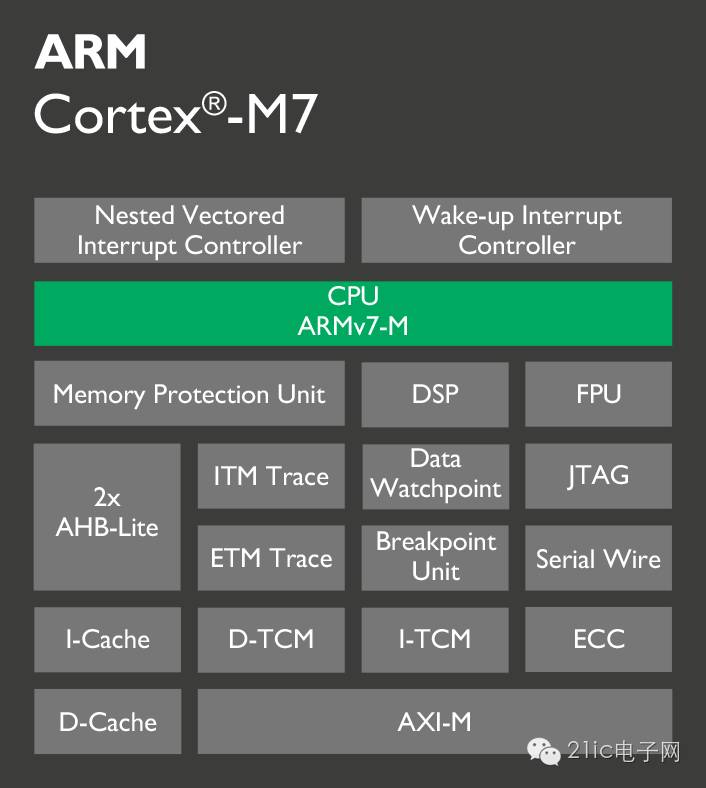 At the time of its release, ARM publicly stated that the Cortex-M7 architecture uses a six-stage pipeline, superscalar with branch prediction design, a 32-bit instruction set, and can provide 2000 CoreMark performance at 400MHz frequency using 40nm LP technology. The first to obtain the Cortex-M7 license was Freescale (now acquired by NXP), followed by ST and Atmel (now acquired by Microchip). It was initially thought that TI and NXP would also follow up with purchases… but they did not. Now let’s compare the M7 core MCUs from these three companies· Freescale released the Kinetis KV5x series based on Cortex-M7· ATMEL launched the SMART V series (KV7x), and later enriched its Cortex-M7 product line with the SAMRT E and SMART S series.· ST announced on the second day after ARM released the Cortex-M7 that it would start developing the STM32F7.· Just recently, ST released the STM32H7, pushing the capabilities of the Cortex-M7 to unprecedented extremes. The actual shipping times of these three companies were not too far apart. Below, I will make a horizontal comparison of the most popular products in these product lines.
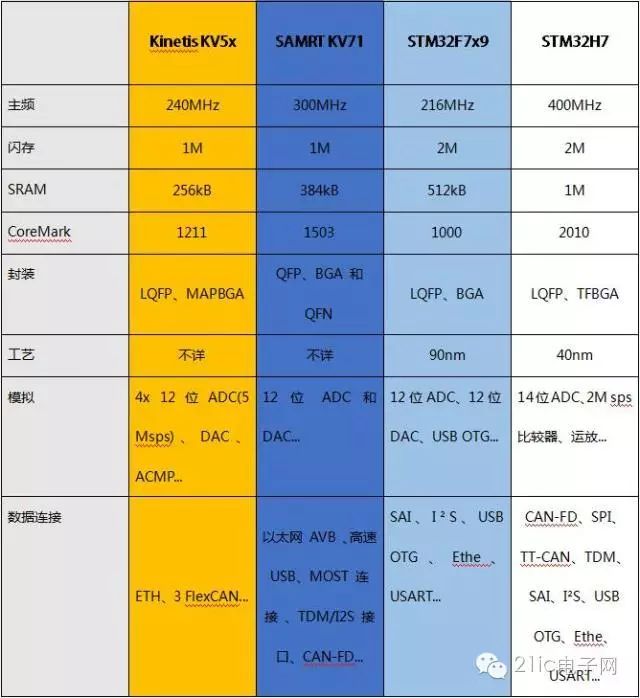 From the comparison in the table above, we can see that although they are all based on the Cortex-M7 architecture, the STM32F7 is somewhat inferior to the Kinetis KV5x and SAM V7x. However, in the early stages, none of these three chips achieved the 2000 CoreMark score claimed by ARM at the release of the Cortex-M7. Two years later, leveraging the advantages of new 40nm technology, large flash memory, and RAM, the STM32H7 successfully achieved a high score of 2010, effectively squeezing the last drop of blood from the Cortex-M7 core.
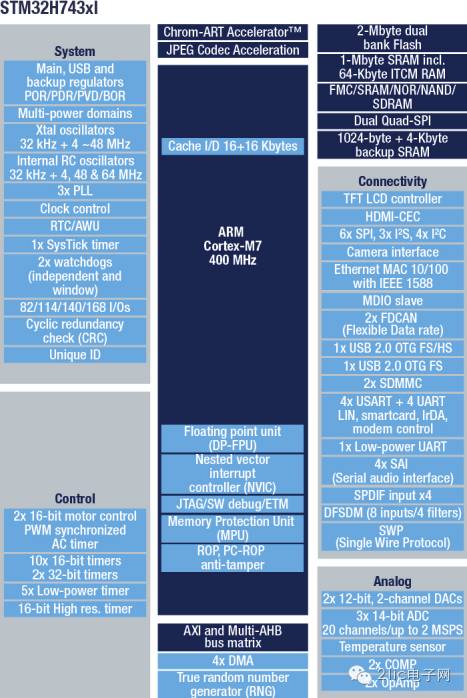 The STM32H7 has successfully set a new record for the highest performance among all processors based on the Cortex-M series cores. For current embedded system applications, I believe the H7 is fully capable of handling any high-end applications, and it can perform image processing and audio processing very smoothly in current embedded applications. The H7 may even replace low-end Cortex-R series processors in some areas. As for higher-end applications, they may not be the focus of Cortex-M core processors. After the mergers and acquisitions of Atmel and Freescale, it may be difficult for them to develop new high-performance microprocessors as quickly as ST has. ST has consistently shown steady growth in its performance, and this stable environment has also contributed to the birth of the STM32H7.Finally, let me show you a few cool images! The STM32H7 EVAL development board, I know you all want one!
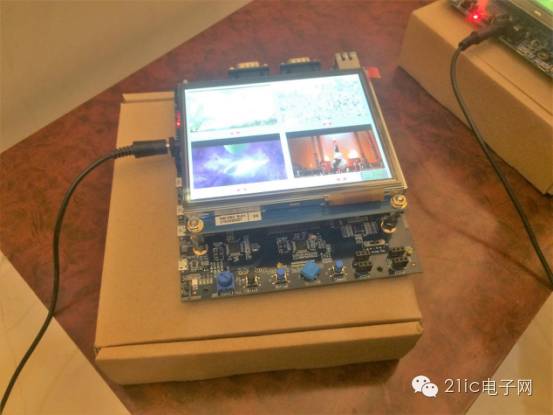 STM32H7 EVAL running four graphical interfaces after RTOS installation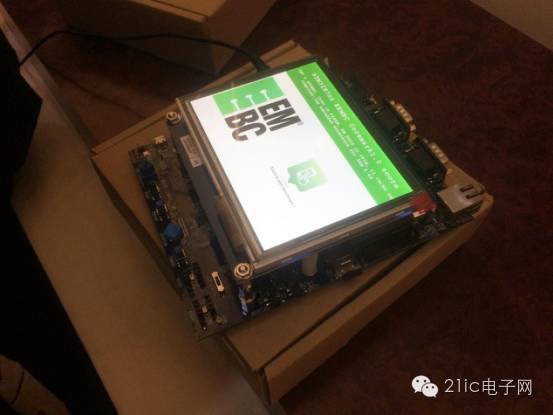
Running an EMBC for scoring, I bet you all can do it? 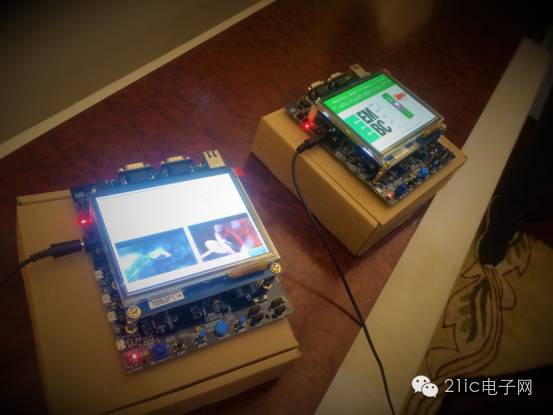 There are images to prove it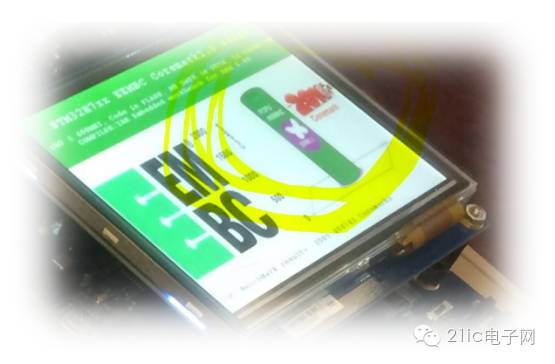
Special Recommendation
The three major treasures of analog engineers: differential signals, clock data recovery, and channel equalization, have you understood them all?

If you can’t tell the difference between ARM and x86 architectures, don’t tell me you understand CPUs!

The most successful chip in history can produce so many variations
