For every developer dealing with APIs and network requests, a reliable HTTP(S) debugging tool is indispensable. HTTP Toolkit has gained a good reputation in the developer community for its elegant UI and one-click interception feature. However, as many have experienced, its “semi-open source” model, where the free version has functional limitations, often leaves developers seeking ultimate efficiency and complete control feeling constrained.
Fortunately, the open-source world offers us numerous powerful and even more flexible alternatives. These tools are not only completely free but often provide unexpected surprises in terms of depth of functionality and scalability. Next, we will delve into several top open-source alternatives that may become the next essential tool in your toolbox.

mitmproxy: The Ultimate Swiss Army Knife for Command Line Enthusiasts
If HTTP Toolkit focuses on intuitive UI, then mitmproxy takes command line efficiency and flexibility to the extreme. It is an interactive man-in-the-middle proxy tool developed in Python, providing unparalleled control for advanced users and automation scenarios.
- Core Advantages
- Cross-Platform Command Line Interface Through
<span>mitmproxy</span>(Terminal UI),<span>mitmweb</span>(Web UI), and<span>mitmdump</span>(Pure Command Line), mitmproxy adapts to different workflows. Whether you want to view and modify traffic in real-time in the terminal, operate through a web interface, or write scripts for automation, it can meet your needs. - Powerful Scripting Capabilities This is the core competitive advantage of mitmproxy. You can write scripts in Python to modify any HTTP/HTTPS requests and responses passing through the proxy. Whether you want to automatically block specific requests, simulate API responses, inject custom headers, or execute complex decryption and authentication logic, it can all be easily achieved through scripting.
- Transparent Proxy and Protocol Support: mitmproxy supports transparent proxy mode, allowing easy interception of client traffic that is not proxy-aware (such as mobile applications or IoT devices). Additionally, it has robust support for HTTP/2 and WebSocket.
Below is a simple UML sequence diagram illustrating the workflow of mitmproxy as a man-in-the-middle proxy:
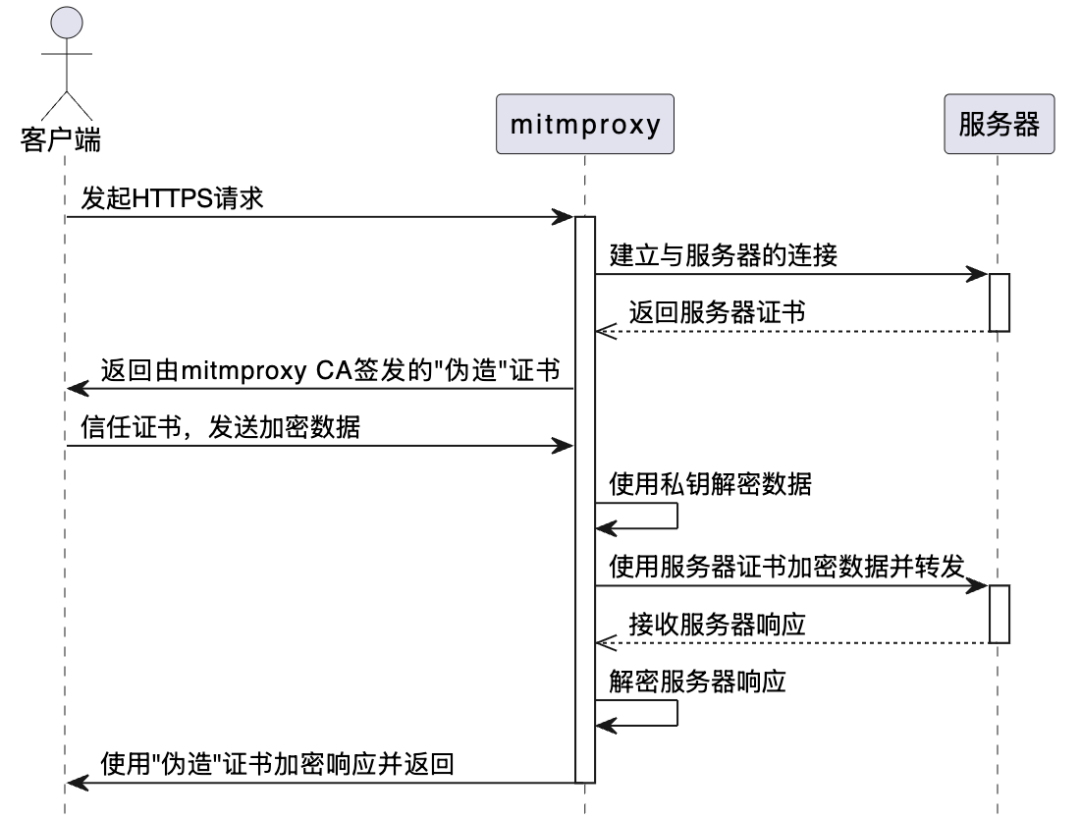
For developers who are passionate about automated testing, security analysis, or require fine-grained programming control over network traffic, mitmproxy is undoubtedly the most powerful open-source choice available today.
Insomnia REST Client: The Comprehensive Tool for API Development and Debugging
Insomnia initially started as a client tool focused on building and testing API requests, similar to Postman. However, after years of development, it has evolved into a comprehensive API design, debugging, and testing platform, with core functionalities remaining open source.
- Core Advantages
- Elegant UI and API Management Insomnia provides a very clean and efficient user interface for organizing and managing complex collections of API requests. Features such as environment variables, code snippet generation, and authentication helpers are all included.
- Powerful Request Debugging In addition to basic HTTP request sending, Insomnia supports various protocols such as GraphQL, gRPC, and WebSocket. Its timeline view clearly displays every detail of the request, from DNS resolution to TLS handshake, and response reception, all at a glance.
- Plugin Ecosystem Insomnia has an active plugin community. You can extend its functionality by installing plugins, such as integrating custom authentication processes, adding new template tags, or linking with other services.
- Integrated Design and Testing It is not just a debugging tool; it also integrates API design (supporting OpenAPI/Swagger) and automated testing capabilities, allowing you to write test suites to validate API correctness.
For developers whose primary work involves API development, integration, and testing, Insomnia provides a more focused and comprehensive integrated environment than HTTP Toolkit.
Hoppscotch: A Web-Based Open Source API Development Platform
Hoppscotch (formerly Postwoman) is a completely web-based open-source API request builder. Its biggest feature is its lightweight and convenient nature, requiring no installation of any desktop application; it can be used directly in the browser.
- Zero Installation, Cross-Platform As a PWA (Progressive Web App), Hoppscotch can run in any modern browser and can be “installed” on the desktop, providing an almost native experience.
- Real-Time Collaboration Team members can easily share API collections and collaborate in real-time, which is very helpful for team development and API documentation synchronization.
- Comprehensive Protocol Support Similar to Insomnia, Hoppscotch also supports various protocols such as HTTP, GraphQL, WebSocket, Socket.IO, and MQTT.
- Self-Hosting Options For enterprises with data privacy and internal deployment needs, Hoppscotch offers self-hosting options, allowing the entire platform to be deployed on their own servers.
If your team needs a lightweight, collaborative API tool that requires no installation, Hoppscotch is an extremely attractive choice.
Feature Comparison Summary
To provide a more intuitive comparison, we have organized the following table:
| Feature | HTTP Toolkit (Free Version) | mitmproxy | Insomnia | Hoppscotch |
|---|---|---|---|---|
| Core Positioning | General HTTP(S) Interception and Debugging | Command Line Driven Interception and Scripted Modification | API Development, Debugging, and Testing Platform | Web-Based API Development and Collaboration Platform |
| Open Source Model | Semi-Open Source (Core Features Free) | Fully Open Source (MIT License) | Fully Open Source (Apache 2.0) | Fully Open Source (MIT License) |
| UI Interface | Desktop GUI | Terminal UI / Web UI | Desktop GUI | Web UI (PWA) |
| Scripting and Automation | Limited Functionality | Very Strong (Python Scripts) | Strong (Plugins and Test Scripts) | Weaker |
| API Request Building | Supported | Weaker (Mainly for Interception) | Very Strong | Very Strong |
| Protocol Support | HTTP/2, WebSocket | HTTP/2, WebSocket | GraphQL, gRPC, WebSocket | GraphQL, WebSocket, MQTT, etc. |
| Collaboration Features | None | None | Supported | Very Strong |
| Best Use Cases | Quick, Intuitive Desktop and Mobile Application Traffic Analysis | Automated Testing, Security Penetration, Deep Traffic Customization | API Development, Integration, Automated Testing | Team Collaboration, Rapid API Prototyping, Zero Installation Needs |
Conclusion
HTTP Toolkit is undoubtedly an excellent tool that lowers the barrier to HTTP(S) traffic interception and analysis. However, when the functionality of the free version cannot meet your needs, or when deeper customization and automation capabilities are required, the open-source world offers a broader horizon.
- If you are a backend developer or security researcher who loves the command line and seeks ultimate automation and control, mitmproxy will be an irreplaceable tool.
- If you are a developer focused on API design, development, and testing who wants to accomplish all tasks in a unified environment, Insomnia will provide a smoother and more comprehensive experience.
- If your team values agile collaboration and needs an API tool that requires no installation and is available anytime, anywhere, then Hoppscotch is undoubtedly the best choice.
Exploring and selecting tools that fit your workflow is a key step in enhancing development efficiency. We hope this in-depth analysis helps everyone find the open-source tool that can truly “unlock greater power.”