
From smartphones to smart cars, from smart homes to smart healthcare, smart sensors are like invisible tentacles, sensing every corner of our lives and quietly changing the way we interact with the world.
When your smartphone automatically adjusts its brightness, when you enjoy lane-keeping assistance while driving, and when your smartwatch records your heart rate and blood oxygen data, behind all of this, smart sensors are working silently.
These invisible technological cornerstones are evolving at an astonishing speed, supporting our increasingly digital and intelligent lives.
Market Size: Explosive Growth, China Leads the World
The global sensor market is expected to exceed $500 billion by 2025, with the Chinese market reaching 500 billion RMB, accounting for over 30% of the global share.
Data shows that from 2022 to 2025, the compound annual growth rate of the Chinese sensor market will reach 15%, far exceeding the global average growth rate of 10%. China has become the fastest-growing region in the global MEMS market, with dual advantages of policy dividends and application market accelerating the maturity of the industrial ecosystem.
Shenzhen has also clearly stated that by 2025, the added value of the smart sensor industry will reach 8 billion RMB, doubling from 4 billion RMB in 2021.
Technological Evolution: Miniaturization, Intelligence, and Multi-Functional Integration
MEMS (Micro-Electro-Mechanical Systems) technology is leading the miniaturization revolution of sensors. By 2025, the MEMS sensor market is expected to exceed 120 billion RMB, accounting for 24% of the overall market.
Smart sensors are ushering in the era of edge computing. The penetration rate of smart sensors integrated with AI chips is expected to rise from 18% in 2022 to 35% in 2025. OmniVision Technologies’ OV08X series image sensor, which includes a neural network processor, can achieve real-time target recognition while reducing power consumption by 40%.
New materials are also continuously breaking performance boundaries. The sensitivity of graphene gas sensors has increased by 100 times, and silicon carbide high-temperature sensors can withstand temperatures exceeding 600°C. These innovations are reshaping the technical standards in high-end scenarios such as industrial detection and aerospace.
Application Scenarios: Ubiquitous from Consumer Electronics to Smart Manufacturing
In the automotive electronics field, the penetration rate of new energy vehicles has exceeded 40%, driving the market size of automotive sensors to over 100 billion RMB, with annual shipment growth rates of laser radar and millimeter-wave radar exceeding 50%. Each smart car requires more than 30 MEMS sensors, accounting for 12% of the cost.
In the field of industrial automation, the localization rate of industrial sensors has increased from 30% to 50%, with a surge in demand for pressure and vision sensors. The market size is expected to reach 80 billion RMB by 2025.
In the healthcare sector, the aging population is accelerating the emergence of a 60 billion RMB medical sensor market, with continuous glucose monitoring and wearable devices becoming core growth points. The cost of implantable glucose monitoring sensors has dropped to 50 RMB per piece, and by 2025, the penetration rate among diabetes patients is expected to reach 15%.
Humanoid Robots: A New Blue Ocean for Sensor Demand
The development of humanoid robots has brought new demands for sensors. Sensors account for about 22.4% of the cost of a single robot, with mainstream solutions including force sensors, tactile sensors, IMUs, and vision sensors, with a total value of approximately 89,600 RMB per unit.
Under neutral estimates, the market size for sensors used in humanoid robots is expected to reach about 84.8 billion RMB by 2035, with a compound annual growth rate of about 46.6% from 2025 to 2035.
Six-dimensional force sensors have become a technological high ground, providing precise environmental perception capabilities for robots by capturing changes in force and torque in three-dimensional space in real-time. For example, installing this sensor on the sole can optimize walking balance, while applying it to the wrist can enhance operational precision to the 0.1N level.
Competitive Landscape: International Dominance and Local Rise Coexist
International giants still dominate the high-end market. Companies like Bosch and Honeywell occupy 70% of the automotive and industrial high-end sensor market, with the price of a single automotive-grade laser radar still exceeding $500, which is twice that of domestic products.
Domestic companies are adopting a “rural encirclement of cities” strategy to break through: Goertek’s MEMS microphones have a global market share of 32%, with cost control below $0.5 per unit; Hanwei Technology’s gas sensors have captured 20% of Sinopec’s supply chain, saving 30% in costs through localization.
The shortcomings in the industrial chain still need to be addressed urgently. The localization rate of high-end MEMS wafer processing equipment is less than 10%, and EDA tools rely on imports, resulting in R&D cycles that are 30% longer than those of international peers.
Future Trends: Integration and Innovation Drive Development
Multi-functional intelligence has become the core development direction. Sensors are evolving towards integrated “perception + computation”. Huaxin Technology is developing a multi-parameter module that integrates temperature, humidity, and gas detection functions, combined with self-developed AI algorithms for real-time analysis of environmental data.
Low-power self-sustaining technologies are continuously breaking application bottlenecks. To meet the trillion-level connection demand of the Internet of Things, energy harvesting technologies (such as vibration and thermal energy recovery) will enable sensors to become passive.
Quantum sensing is opening a new era of precision measurement. The quantum magnetometer developed by the University of Science and Technology of China has a sensitivity of 0.1fT/√Hz, improving six orders of magnitude over traditional sensors, which will revolutionize fields such as brain science and geological exploration.
Policy and Capital: Dual Support for Technological Breakthroughs
National-level strategies empower the sensor industry. “Made in China 2025” lists sensors as core basic components, with cities like Guangzhou and Suzhou building billion-level smart sensor industrial parks, aiming to cultivate 10 leading enterprises with a market value of 10 billion RMB by 2025.
Capital is also vigorously supporting technological breakthroughs. In 2024, financing in the sensor field is expected to exceed 20 billion RMB, with R&D investment accounting for 18% of the listed companies on the Sci-Tech Innovation Board (the industry average is 5%), and companies like Chipone Technology raising over 5 billion RMB to tackle automotive-grade chips.
Shenzhen plans to build a MEMS pilot line with mass production capabilities, providing customized and large-scale processing services for high-end MEMS sensor companies, constructing a complete MEMS product technology innovation chain covering R&D, pilot testing, and mass production.
Tesla’s humanoid robot, Optimus Gen2, is equipped with four six-dimensional force sensors to achieve dynamic balance control; UBTECH’s Walker optimizes multi-scenario operational precision through this component; medical-grade wearable devices can continuously monitor our health data with precision close to that of medical devices.
Smart sensors are no longer just simple data collectors; they are becoming “intelligent”—with built-in AI algorithms that process information directly at the edge; energy harvesting technologies make it possible for them to no longer require external power; quantum sensing pushes measurement precision to unprecedented heights.
All of this is just the beginning.
END
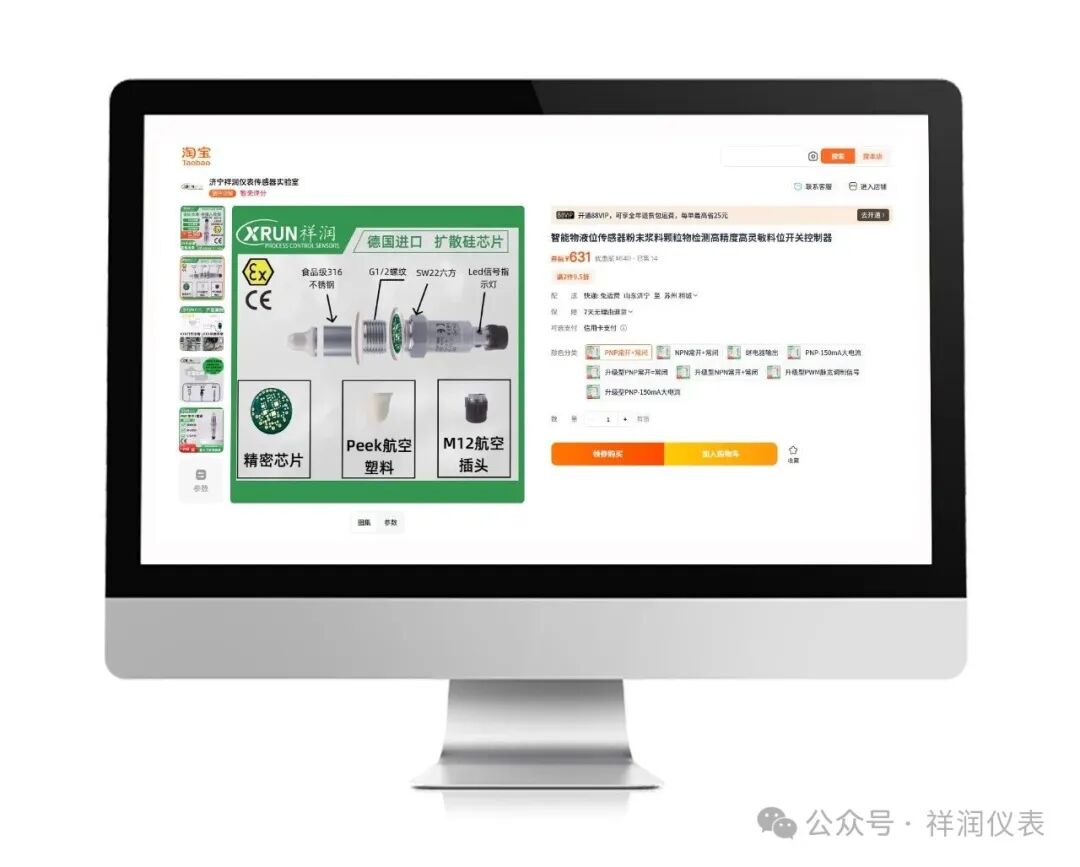
More products can be found on Taobao Mall ⬇⬇⬇
 ★ Source: Xiangrun Instrument ↑ ★ Please indicate the above source when reprinting (can be reprinted after 24 hours) ↑Disclaimer: This article is for informational purposes only and for reference. If there are issues related to the content, copyright, and other matters, please contact us, and we will handle it immediately. If any platform reprints this article, they must take responsibility for it, and Xiangrun Instrument is not responsible for secondary dissemination caused by reprinting.