Recently, the Intelligent Software Center of the Software Research Institute of the Chinese Academy of Sciences has made significant progress in the field of computer systems, with their paperChimera: Transparent and High-Performance ISAX Heterogeneous Computing via Binary Rewriting being accepted at the top international conference in the field of computer systems,EuroSys 2026 (CCF-A category). This research innovatively proposes an efficient binary rewriting method aimed at theRISC-V instruction set, and based on this method, it introduces a new paradigm forISAX heterogeneous computing targeting theRISC-V extended instruction set, achieving transparent and efficient migration of computing tasks between heterogeneous cores without modifying the source code, thus addressing the critical performance bottlenecks of traditional heterogeneous computing systems. Additionally, this achievement provides key technical support for solving the hardware-software adaptation challenges caused by the fragmentation of theRISC-V ecosystem. The main authors of the paper include PhD student He Jiatai (first author), Assistant Researcher Qi Ji (corresponding author), Senior Engineer Yu Jiageng, and Researcher Wu Yanjun.
The proposedISAX (ISA+eXtension) heterogeneous computing architecture allows different cores (or processors) to share the same base instruction set while supporting different extended instruction sets. For example, some cores only support the base instruction set, while others additionally support vector instruction sets. This type of heterogeneity is quite common in theRISC-V architecture. For such scenarios, theISAX system only needs to perform binary translation on a small number of extended instructions and write the results into the binary file, automatically switching between different versions of instructions at runtime based on the environment, thereby effectively reducing heterogeneous scheduling overhead and achieving user transparency.
Existing methods have significant limitations in achieving the above goals: compilation methods rely on cumbersome configuration of compilation toolchains, consuming excessive resources and time; binary rewriting methods incur severe performance losses. On one hand, compilation methods require generating dedicated binary files adapted to specific hardware from source code through specific compilation toolchains based on hardware configurations. However, in edge scenarios, due to the high heterogeneity of device types, the resource and time costs consumed by the compilation process itself and toolchain configuration are unacceptable. In contrast, binary rewriting methods rely on existing binary analysis techniques to generate dedicated binary files through static analysis and instruction fragment modifications to support transparent scheduling. However, since binary analysis techniques cannot fully analyze and recover binary control flow, existing methods often adopt conservative strategies, ensuring that all possible control flows do not fail through inefficient rewriting methods or heavy runtime checks. Although this strategy guarantees correctness, it inevitably incurs significant runtime performance overhead.
To address this challenge, the team proposed an innovative solution based on co-design of hardware and software: as long as runtime errors are deterministic and recoverable, high performance of binary rewriting can be maintained while ensuring correctness. Specifically, the team utilized the encoding characteristics of theRISC-V instruction set to ensure that all unrecognized control flows trigger deterministic errors at runtime (such as segmentation faults or unrecognized instruction errors), and safely recover these errors through a lightweight runtime mechanism. With this mechanism, this research achieves efficient and transparent migration and scheduling between heterogeneous cores without the need for source code.
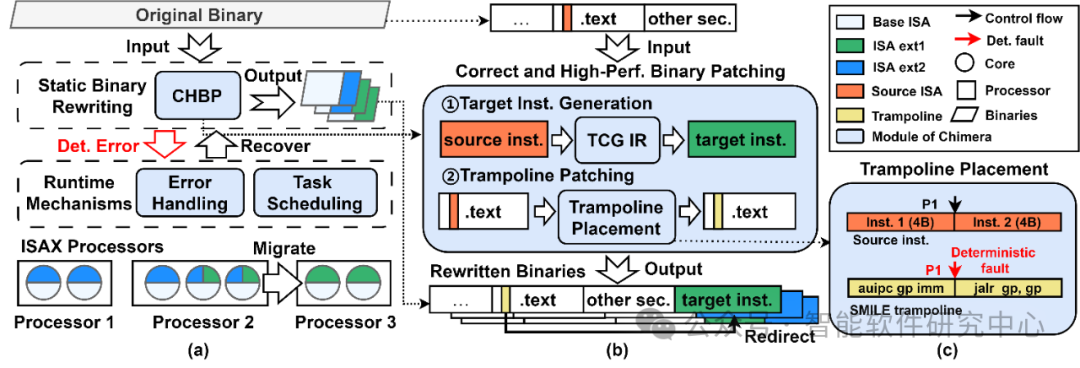
Overview ofChimera
To comprehensively evaluate the performance ofChimera, the team conducted comparative experiments with various state-of-the-art heterogeneous computing systems, including native compilation-basedMELF (which relies on source code and is opaque to users), binary rewriting-basedSafer (which does not guarantee correctness), and runtime scheduling-basedFAM (Fault And Migration). The experimental results show that on hardware with inter-core instruction set heterogeneity,Chimera incurs only about3.2% additional performance overhead compared to native compilation methods, while achieving an average performance improvement of about12.5% and33.1% compared toSafer andFAM, respectively. Furthermore, to further evaluate the performance of the rewritten binary files ofChimera, the team compared them with various state-of-the-art binary rewriting methods using theSPEC CPU2017 benchmark. The experimental results indicate that the method ofChimera achieves a performance improvement of up to42.5% compared to existing binary rewriting methods.
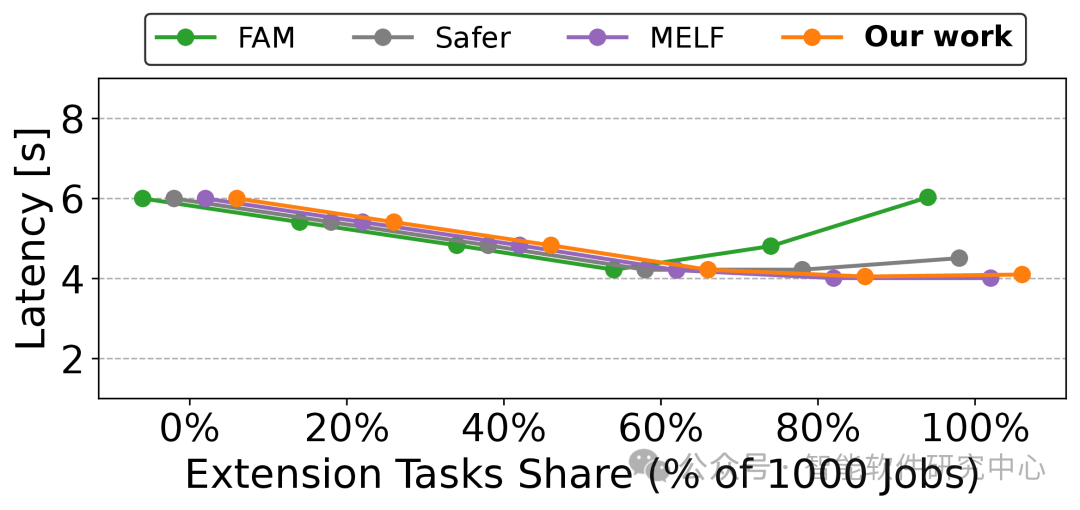
Performance Evaluation ofChimera
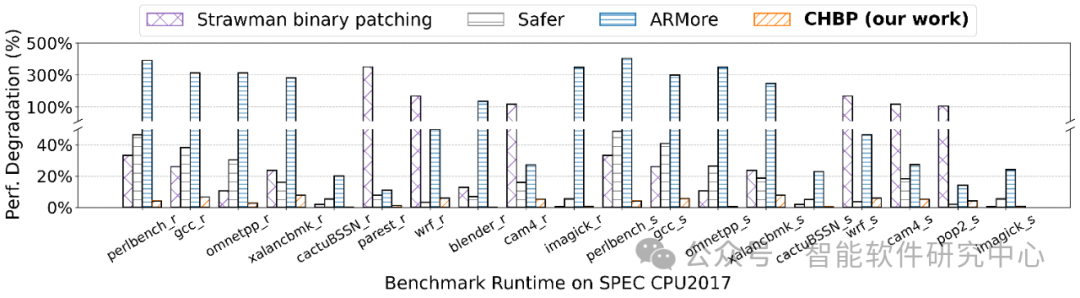
Performance Evaluation of Rewritten Binary Files ofChimera
In summary, this work proposes a new paradigm for heterogeneous computing based onRISC-V ISAX (ISA+eXtension), effectively resolving the hardware isolation and performance loss caused by semantic fragmentation in traditional heterogeneous computing systems, highlighting the unique advantages of theRISC-V architecture in heterogeneous computing. As the“Rosetta Stone” of theRISC-V architecture, this work achieves efficient execution of anyRISC-V binary program on heterogeneousRISC-V processors, seamlessly integrating with the existing software ecosystem without modifying the source code, and provides pioneering exploration at the system software level to address the fragmentation challenges ofRISC-V.