Rise.
Author I Yang Wenjing
Reported I Investment界PEdaily
A long-awaited lively scene in Shenzhen’s semiconductor circle.
On September 4, the “X-Day” Xili Lake Roadshow for the semiconductor and integrated circuit industry was held at the International Conference Center of Shenzhen University Town. The investment community observed that six companies focusing on core semiconductor segments took the stage one by one, covering key tracks such as chip design, EDA tools, advanced packaging, third-generation semiconductors, and storage IP.
“Shenzhen is one of the cities in China with the greatest growth potential in the semiconductor industry.” Over a hundred VC/PE firms, banks, insurance institutions, and companies from the semiconductor and integrated circuit industry gathered at the scene, bustling with activity, vividly illustrating Shenzhen’s deep engagement in the semiconductor industry.
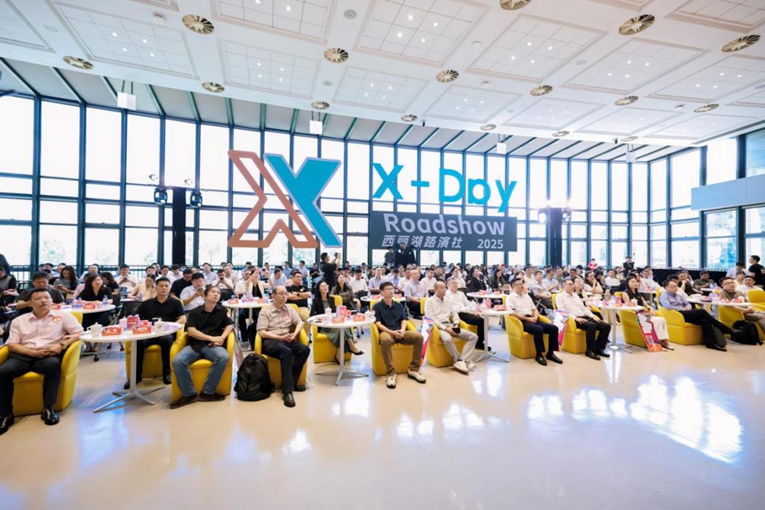
A number of semiconductor companies have come to Nanshan
“We are on the same starting line as international advanced manufacturers like Sony and Hamamatsu, Japan,” said CFO Shu Xun of Lingming Photon.
In 2018, a group of overseas PhDs returned to China to establish Lingming Photon, landing in Nanshan, Shenzhen. CEO Zang Kai and several co-founders come from a technical background, aiming to enter the fields of 3D camera chips and high-speed optical communication. After seven years, Lingming Photon has raised nearly 600 million through four rounds of financing, from early dollar funds to recent investments from cornerstone capital, SAIC investment, and Zhejiang Jin Kong.
Chuangfeixin Technology was established in 2015, with technology starting in 2011, and is the only supplier of mature mass production of semiconductor OTP in mainland China. “Currently, all of the top ten suppliers in the semiconductor IP track are from overseas companies, which means that the lifeblood of storage IP in the upstream IP track of the semiconductor field is in the hands of others.” Therefore, breaking the blockade was also the original intention of the team’s establishment.
The Chuangfeixin team mostly comes from global semiconductor companies like Micron, Spansion, AMD, and Intel, with founder Wang Zhigang being an undergraduate from Tsinghua University. They have now secured investments from Tsinghua-related funds, Chengdu Zhongke Micro, Zhuhai Lidong, and Shenzhen Investment Control.
Zhizheng Semiconductor CEO Tan Zhiming entered the semiconductor industry in 1982. In 2023, the wafer foundry Huazhi separated a etching equipment company, officially starting operations for Zhizheng Semiconductor, focusing on the research and development of third-generation semiconductor equipment.
In addition to obtaining funding from the Hong Kong Science and Technology Fund, Zhizheng Semiconductor has also received angel round financing from investors such as Guokexin Dongfang, Guokuan Yaoneng, and Wangzhong Capital. Tan Zhiming stated, “What we sell is not just equipment, but also the key for customers to access mass production of third-generation semiconductors.”
From Nanshan, Shenzhen, Weihe Technology is a 5G intelligent cellular communication chip design company, jointly invested by Guanghetong and Shenzhen Huitong Jin Kong. It later secured investments from Intel Capital, Skyworth Investment, Ivy Capital, and Xigao Investment, with the core team previously being part of Intel’s iPhone chip team.
In 2022, Weihe Technology’s general manager Fu Hui and team members saw the development opportunities in the semiconductor industry and resolutely returned to China to start a business. Fu Hui recalled that at that time, they could only communicate via video conference, but Shenzhen’s investment promotion and entrepreneurial enthusiasm deeply impressed the team.
Ruiwo Micro Semiconductor focuses on advanced semiconductor packaging. In 2012, the team proposed the idea of chip cross-packaging, spending four years turning the idea into a technical solution, which was later incubated at the Shenzhen Third Generation Semiconductor Research Institute and Ningbo Yongjiang Laboratory, landing in Shenzhen.
Currently, the Ruiwo Micro team has achieved disruptive processes in fan-out packaging and 3D packaging. Founder and general manager Shen Guang bluntly stated, “It has been very difficult to work on technology in recent years, and the road ahead will also be difficult, but we must find our unique path.”
Finally, the last to take the stage was Riguang Xinshe founder and CEO Lin Yizhou. This is a company focused on the research and development of digital backend EDA tools, with a team possessing decades of experience in ultra-large circuit signing, dedicated to solving the “bottleneck” problem in the EDA field.
“Developing industrial software requires a lot of experience. The common point of our team is that we are all Tsinghua graduates, have studied for PhDs abroad, and have continuously accumulated experience in large companies. Later, everyone wanted to return to China to do something together.” Currently, Riguang Xinshe is backed by Yuanhe Puhua, Huayi Venture Capital, Skyworth Group, and other investors.
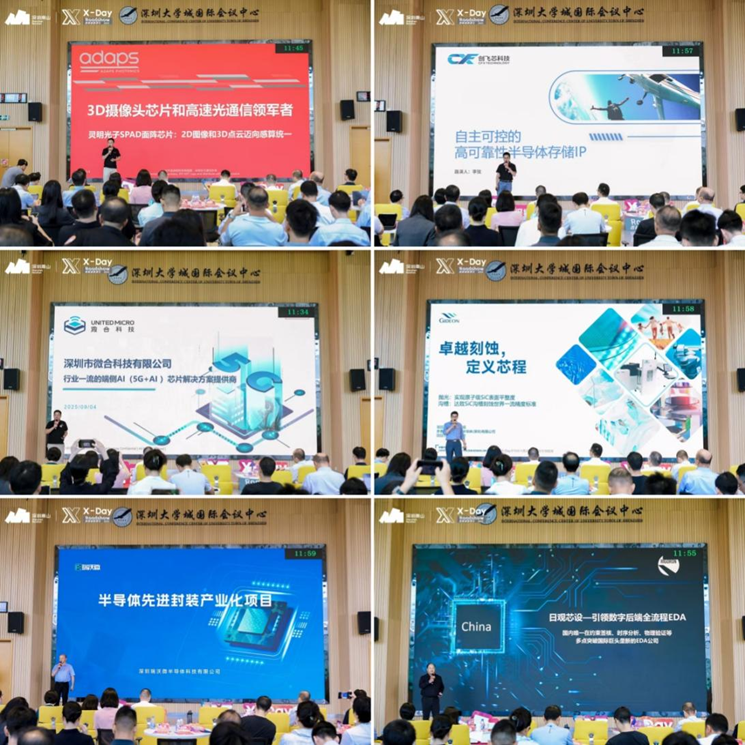
This is the seventh event of the Xili Lake “X-Day”, focusing on the semiconductor and integrated circuit industry, with a number of startups and investors arriving.
Chasing Battle
Shenzhen Strives for Semiconductors
“Why is the Pearl River Delta lagging behind the Yangtze River Delta in semiconductors?”
Once, this question deeply pierced the industrial community of the Pearl River Delta, and Shenzhen, known as the “Silicon Valley of China,” is filled with a sense of crisis. In 2020, Guangdong sounded the assembly call for the integrated circuit industry, and a massive industrial revolution began.
The latest scene was in July this year, when the “Several Measures of Shenzhen City to Promote the High-Quality Development of the Semiconductor and Integrated Circuit Industry” were implemented, introducing ten measures to support the optimization and upgrading of the entire semiconductor and integrated circuit chain, strengthening, stabilizing, and supplementing the chain, and comprehensively enhancing the core competitiveness and innovation leadership of the industry chain.
The investment community learned that a fund targeting Shenzhen’s semiconductor and integrated circuit industry—Saime Industry Private Equity Fund—was subsequently established. This fund has a strong background, backed by Shenzhen Venture Capital and Shenzhen Heavy Investment, with an initial scale of 5 billion yuan, mainly targeting key projects and leading enterprises in Shenzhen’s semiconductor and integrated circuit sectors.
This themed session of the “X-Day” Xili Lake Roadshow focusing on the semiconductor and integrated circuit industry is one of the reflections. This year, Nanshan has held seven “X-Day” events, receiving 185 project registrations to date, connecting 102 companies with over 2000 investment institutions, with a total financing amount exceeding 360 million yuan and bank credit exceeding 100 million yuan, successfully landing the first technology insurance order.
Witnessing the current trend of semiconductor mergers and acquisitions, this event also held a sub-forum for the “Mergers and Acquisitions Action Camp” in Nanshan District, facilitating closed-door connections for eight listed companies in the semiconductor and integrated circuit fields and ten financing and acquisition projects from across the country.
“Objectively speaking, Shenzhen’s semiconductor industry is not the earliest to develop, nor is it the most advantageous, but with the rise of AI hardware, there are huge opportunities from Shenzhen to the Greater Bay Area. Driven by demand, more and more semiconductor startups will be attracted to gather here,” pointed out Chen Xiangming, founder and chairman of Ginkgo Valley Capital, noting that AI will become a new peak for the semiconductor industry.
Just like the semiconductor company Xinkailai, which is currently highly anticipated, is from Shenzhen. It is reported that Shenzhen has now built a complete industrial chain system covering “upstream supporting industries – midstream production – downstream application scenarios,” with several districts such as Nanshan, Baoan, Longgang, Longhua, Pingshan, and Futian each having their own advantages.
Taking Nanshan, Shenzhen as an example, it is focusing on specialized chips such as artificial intelligence chips, edge computing chips, as well as core chip designs like RF front-end chips, baseband chips, and optoelectronic chips, possessing a number of design companies with independent innovation capabilities, and financing is also showing a characteristic of “Nanshan leading, multiple points blooming.”
“The entire world of consumer electronics is in the Greater Bay Area. Shenzhen’s advantage lies in the ability to produce everything from sand to final consumer products, which are then sold globally, forming a closed-loop ecosystem.”Shu Xun, CFO of Lingming Photon, lamented, “Such an ecological system only exists in Shenzhen.”
Looking back to 2001, the number of registered semiconductor industry chain enterprises in Shenzhen first broke 100; by 2025, the number of registered semiconductor-related enterprises in Shenzhen is expected to exceed 77,000, with the scale of the integrated circuit industry exceeding 140 billion yuan, producing 50 listed companies, 14 unicorns, and over 200 specialized small giant enterprises.
The journey is long, and the domestic semiconductor industry is a battle that cannot be lost. For Shenzhen, this city can always play its cards to become a king bomb at critical moments.