
All You Need to Know About Samsung Exynos
Development of NPU Technology
(Click the image above to review previous content)
In the previous article, we learned about the CPU* (Central Processing Unit) in mobile devices. Today, we will continue to introduce the processor optimized for deep learning algorithms—NPU.
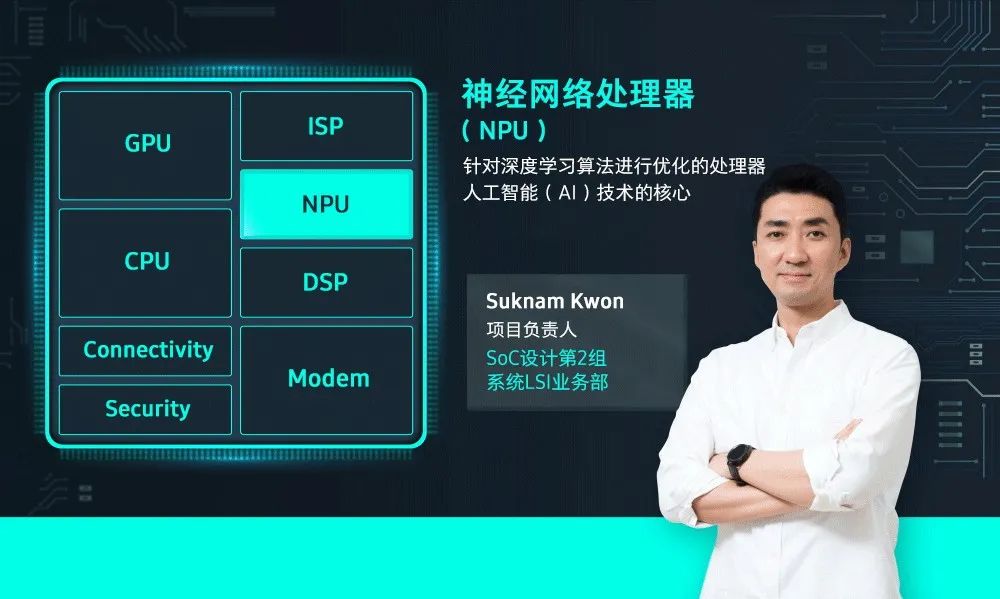
NPU (Neural-network Processing Unit) is a processor optimized for deep learning algorithms. It can process large amounts of data quickly and efficiently, similar to human neural networks, and is mainly used for AI algorithms.
Although it may seem complex, it is widely used in various smart devices. For example, with the help of NPU, smartphone cameras can automatically recognize objects and people based on the environment in the viewfinder and focus accordingly. It can automatically activate food filters when photographing food and even remove unwanted objects from the image.
 ▲ With the development of NPU, AI removal features in new smartphones have been enhanced. In the past, AI computations were performed by the GPU* (graphics processing unit). However, due to structural differences in hardware, the computational efficiency was lower. Now, AI computation is primarily handled by NPU, allowing for more efficient data processing on mobile devices. NPU is optimized for parallel data computation, enabling AI algorithm-based applications to run faster at lower power consumption.
 ▲ Project leader Suknam Kwon has been dedicated to NPU development since the second-generation NPU and is currently the head of the NPU team.The development of Exynos’s NPU began in 2016, with the first SoC* (System on Chip) equipped with NPU being the Exynos 9820, which was used in the Galaxy S10 released in 2019.“Project leader Suknam Kwon said:
Six years ago, when the first working group was established, we had only about 20 people. But now, including members from overseas research institutions, our team has grown to ten times that size.
”Kwon has designed hardware for SoCs and has been committed to NPU development since the second-generation product.“He also stated:Today, NPU is a highly regarded field, but in the past, it was unfamiliar and new, and we could only learn related knowledge from overseas videos and university lectures.”In the past, NPU applications were limited to areas like image detection. However, in the AI era, the market demand for high-performance IP with strong computing capabilities is continuously increasing, NPU can enhance image quality, improve voice service capabilities, etc.Furthermore, as IP performance increases, size and power consumption also increase, making it crucial to build efficient logic architectures.
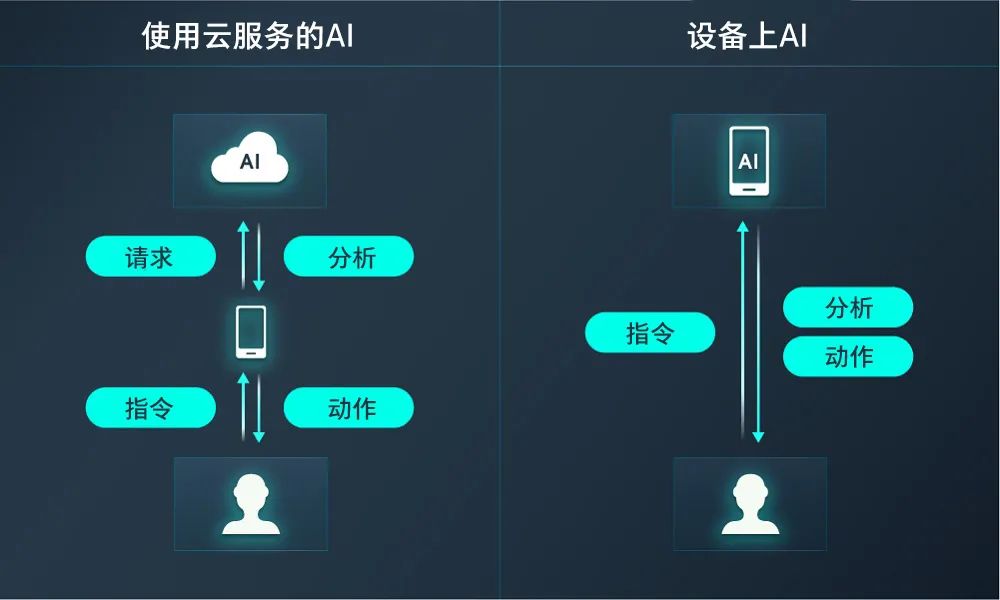
▲ Comparing AI using cloud services and AI on devices
As NPU becomes more powerful, it has further improved in object recognition speed and image quality enhancement.Compared to the previous generation, the NPU built into the new generation of Exynos processors has doubled in performance.The SoC design team has independently developed six generations of NPU products, possessing rich expertise and practical experience.“Kwon stated:
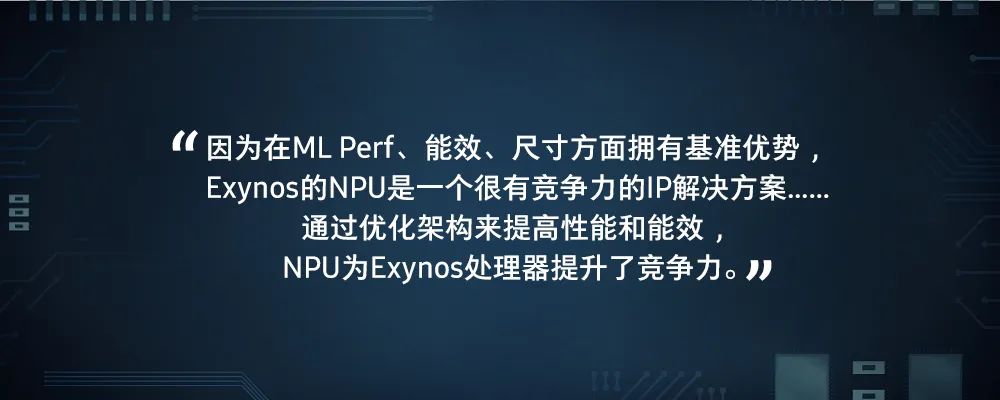
With advantages in benchmarks such as ML Perf, energy efficiency, and size, Exynos’s NPU is a very competitive IP solution.
”
In the future, technology applications related to NPU are expected to further develop.
“Kwon said:On-device AI is a technology that allows AI computation to be performed directly on smartphones without going through servers. This technology will be more widely applied in the future and can reduce the risk of personal information leakage. For this reason, the performance of mobile NPU needs to be further enhanced. Currently, a single NPU can be used for many computations, but I predict that in the future, each application will have specific AI algorithm requirements, making it important to develop NPUs tailored to specific fields.”
When asked about issues related to autonomous driving, Kwon discussed the future role of NPU in the industry.
“He stated:In the near future, advanced driver-assistance systems (ADAS) will become a reality, which requires underlying hardware to have the capability to process massive amounts of data to execute autonomous driving algorithms in real-time.To achieve this goal, higher performance NPU is needed, and Samsung is developing powerful NPUs for autonomous driving devices to meet market demands.”
At the end of the interview, Kwon shared milestone moments during the development process.
“He said:Every year, the Exynos series products are equipped with higher-performance NPUs, which is very meaningful. NPU will continue to be a key IP in the future market.Developing NPU has promoted the mutual growth of the company and myself, and I feel very proud. This is a field that can turn ‘imagination’ into ‘reality’.”
In the next article, we will introduce a high-performance modem that uses AI technology to make communication smoother.
*CPU: Central Processing Unit
*Deep Learning: A technology that enables machines to learn, infer, and reason using data like humans.
*In mobile SoCs, efficiency means consuming less power or achieving faster speeds.
*GPU: Graphics Processing Unit*SoC: System on Chip

*The product images, models, data, functions, performance, specifications, etc., in this article are for reference only. Samsung may improve the above content; please refer to the actual product, product manual, or Samsung Semiconductor official website (https://semiconductor.samsung.com/cn/). Unless otherwise stated, the data involved in this advertisement are all Samsung’s internal test results, and the comparisons involved in this advertisement are all compared with Samsung products.