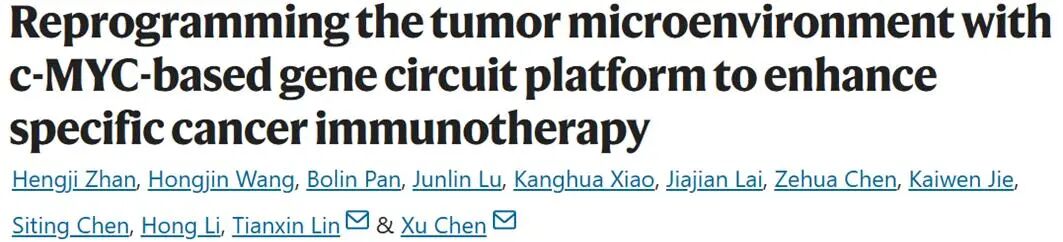
Hello everyone, today I will introduce an article published in Nature Communications titled “Reprogramming the tumor microenvironment with c-MYC-based gene circuit platform to enhance specific cancer immunotherapy.” The corresponding authors of this article are Dr. Xu Chen and Professor Tianxin Lin from Sun Yat-sen University Affiliated Sun Yat-sen Memorial Hospital, whose main research directions include mechanisms of urological tumors and translational medicine.
Immunotherapy methods (such as CAR-T, PD-1 inhibitors, etc.) have achieved significant clinical success in many types of cancer, but a large proportion of patients with solid tumors experience very limited therapeutic effects. A major hypothesis for this phenomenon is that intratumor heterogeneity (ITH) constrains the efficacy of cancer immunotherapy. This phenomenon is mainly manifested by uneven antigen expression and distribution, immune evasion, and is closely related to tumor resistance and cancer recurrence. The c-MYC protein has been shown to be a key coordinator in the progression of ITH, and high expression of c-MYC in cancer cells has been demonstrated to lead to immune evasion and failure of immunotherapy. Therefore, the authors of this article proposed and constructed a c-MYC expression-responsive gene circuit platform (cMSC), combined with a cell-to-cell communication system (CtC), to achieve precise immunotherapy targeting heterogeneous tumor cells.
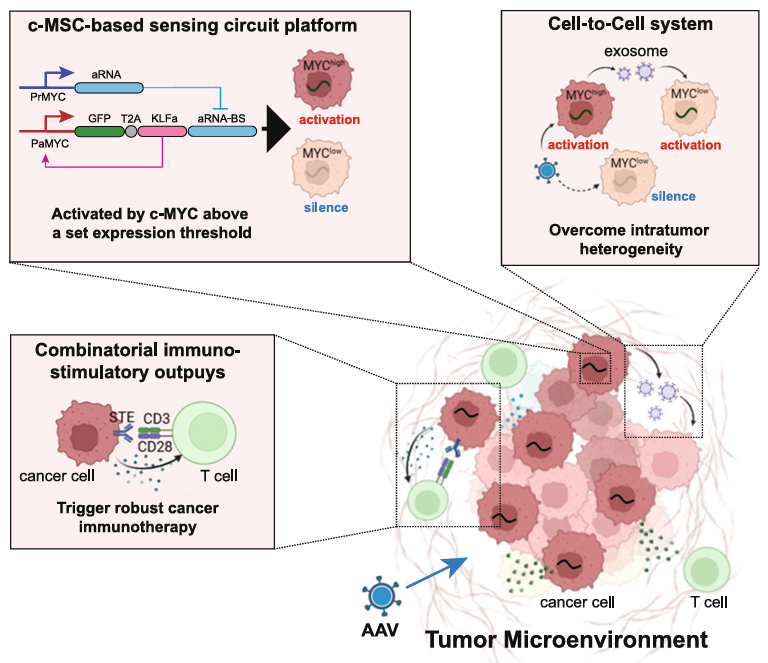
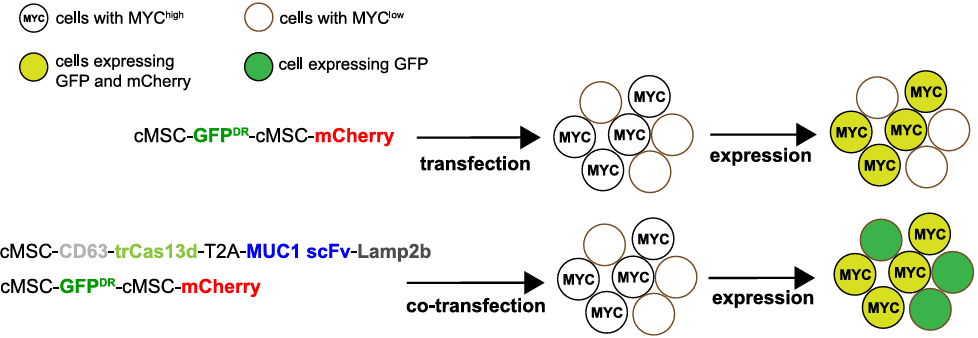
The construction of this core gene circuit aims to reprogram the tumor cell microenvironment by sensing the c-MYC expression level in cells, thereby enhancing T cell recognition and killing ability, achieving comprehensive clearance of heterogeneous tumor cells. This gene circuit mainly consists of two parts. The first is the cMSC (c-MYC Sensing Circuit): this circuit includes a bidirectional regulatory system, where the PaMYC promoter activates downstream gene expression only when c-MYC is highly expressed, while the PrMYC promoter activates a ribozyme system when c-MYC is lowly expressed, degrading target mRNA to prevent non-specific expression; additionally, a KLFa positive feedback system is incorporated into this circuit to enhance PaMYC-driven gene expression, increasing system sensitivity and output strength. The second is the CtC (Cell-to-Cell Communication) system: this system utilizes exosomes and constructs engineered exosomes using the CRISPR-dCas13d system, which can transfer mRNA from c-MYC high-expressing cells to low-expressing cells, achieving the diffusion of therapeutic signals within the tumor. The exosome surface is modified with MUC1-scFv to target MYC low-expressing cells, improving delivery efficiency and overcoming ITH.
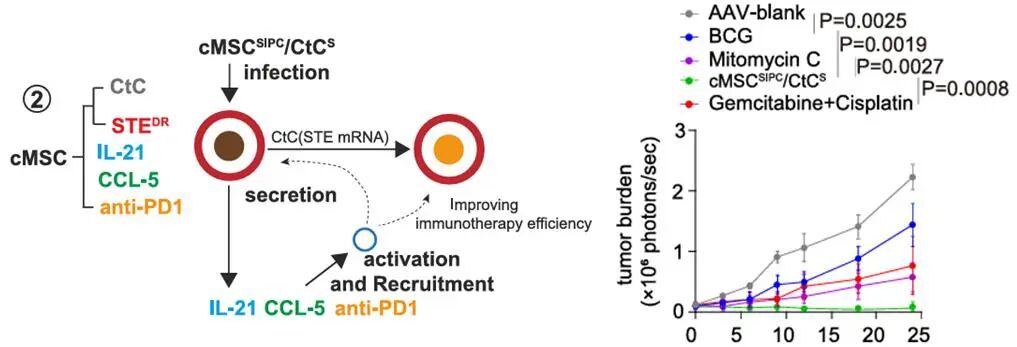
After successfully constructing the two parts of the gene circuit, the authors attempted to deliver various immune-activating factor mRNAs to the tumor, including: STE (T cell engager) to activate T cells; IL-21 to enhance T cell activity; CCL5 to promote T cell infiltration; and anti-PD1 to block immune suppression pathways. This method showed significantly better tumor clearance effects than single treatments or traditional immunotherapy. In an in situ bladder cancer mouse model, the authors treated with bladder perfusion of AAV-cMSC/CtC, resulting in complete tumor disappearance in 50% of the mice, significantly prolonged survival, and no obvious toxic side effects, outperforming traditional drugs. The authors also tested this system in patient-derived tumor models and organoid models, with experimental results showing good efficacy, indicating strong clinical translational prospects for this gene circuit, especially in tumor subtypes with high c-MYC expression (such as basal-type bladder cancer).
In summary, this article constructs an intelligent, programmable c-MYC sensing gene circuit platform (cMSC/CtC) that achieves efficient and specific cancer immunotherapy by precisely identifying tumor cells, reprogramming the immune microenvironment, and overcoming tumor heterogeneity.
Article Author: FTY
Editor: MB
DOI: 10.1038/s41467-025-63377-3
Original link: https://doi.org/10.1038/s41467-025-63377-3