Introduction By utilizing standard greenhouse climate sensing (CO2, temperature, humidity), accurately estimate the dry weight of lettuce, online identify and correct deviations in key model parameters, achieving low-cost and high-precision non-destructive monitoring of crops.
Research Background and Scientific Issues The precise climate control of high-tech greenhouses relies on an accurate understanding of crop status. However, direct measurements of key crop traits such as leaf area, fruit count, and dry weight are often costly and destructive. Data assimilation techniques, particularly Kalman filtering, can combine model predictions with sensor information to infer crop status from easily measurable climate data, helping to address the aforementioned challenges.
However, the effectiveness of this method is highly dependent on the accuracy of the dynamic model. As the system changes slowly over time, model parameters (such as light use efficiency) inevitably deviate, affecting the accuracy of state estimation. Although previous studies have attempted to apply filtering algorithms to estimate crop or climate states, most have used linearized models or failed to achieve online parameter correction, which has significant limitations in highly nonlinear greenhouse systems.
Therefore, can we utilize only standard indoor climate measurement data (CO2 concentration, temperature, and humidity) to performjoint state-parameter estimation for a nonlinear crop growth model, accurately estimating the unmeasurable crop dry weight while online correcting deviations in key model parameters?
Research Design and Core Methods The study is based on a classic nonlinear dynamic model of lettuce in greenhouses, describing the evolution of four core state variables: crop dry weight, indoor CO2 concentration, air temperature, and humidity. To achieve online parameter correction, the key but difficult-to-accurately-determine parameter in the model—light use efficiency (p4)—is treated as a new state variable, forming an augmented state vector together with the original four states.
Before estimation, the empirical observability Gramian is used to analyze the nonlinear augmented system. The analysis confirms that, theoretically, all five augmented states (including crop dry weight and light use efficiency parameter) can be fully observed from the three standard measurements of indoor CO2 concentration, temperature, and humidity.
Based on this, the Ensemble Kalman Filtering (EnKF) algorithm is employed to perform joint estimation. EnKF is a filtering method suitable for strongly nonlinear systems, approximating the probability distribution of states through a particle “ensemble” and continuously updating the optimal estimate of the augmented state (crop state + model parameters) based on measured data. The entire study is validated through simulation experiments, using real outdoor meteorological data to drive the model, simulating the “real” greenhouse environment and crop growth process.
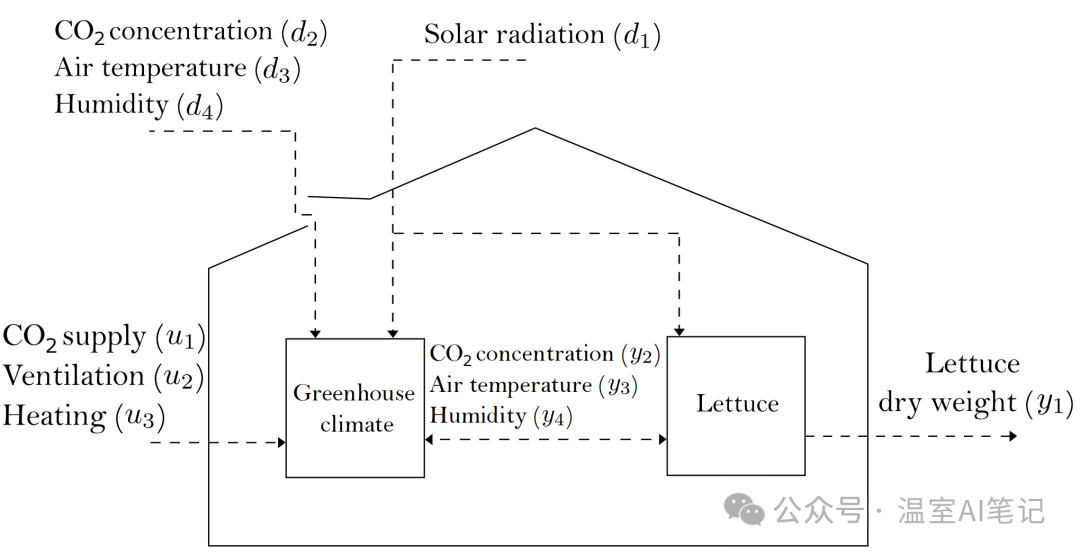
Figure 1. Schematic diagram of the lettuce greenhouse model, showing the interactions between control signals, external disturbances, greenhouse climate, and lettuce dry weight.
Core Results and Discussion The simulation study set up a challenging scenario: the initial value of the light use efficiency parameter had a deviation of up to 50%, and the initial estimate of crop dry weight also differed from the true value. The input to the filter was solely the simulated indoor CO2, temperature, and humidity measurements, which were also superimposed with measurement noise.
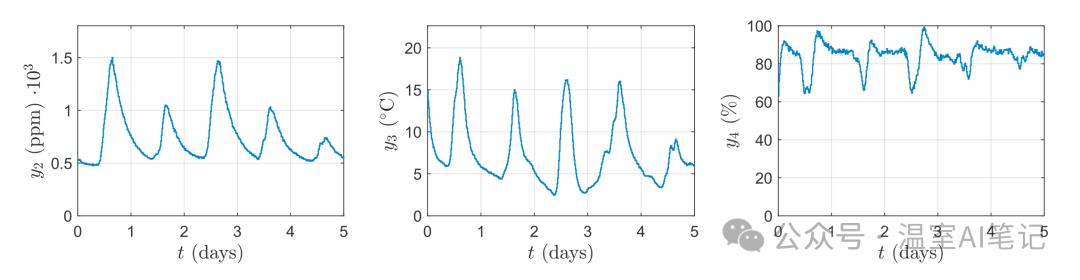
Figure 2. Three sets of indoor climate measurement data used to drive the ensemble Kalman filter: CO2 concentration (left), temperature (middle), and relative humidity (right).
The results indicate that approximately three days after the simulation began, the estimated value of the light use efficiency parameter (p4), which initially had a significant deviation (red dashed line in the figure below), successfully converged to its true value (blue solid line), effectively correcting the model error.
Thanks to the successful correction of the parameter, the estimation of crop dry weight (x1) also rapidly converged from the erroneous initial value to the true growth trajectory. Compared to the case without using the filter and relying solely on the erroneous model for open-loop prediction, the use of the EnKF joint estimation framework reduced the mean root mean square error by approximately 50% for dry weight estimation. This demonstrates that the method can effectively compensate for the dual impacts of model parameter uncertainty and initial state error, achieving precise tracking of core crop physiological indicators based solely on climate data.
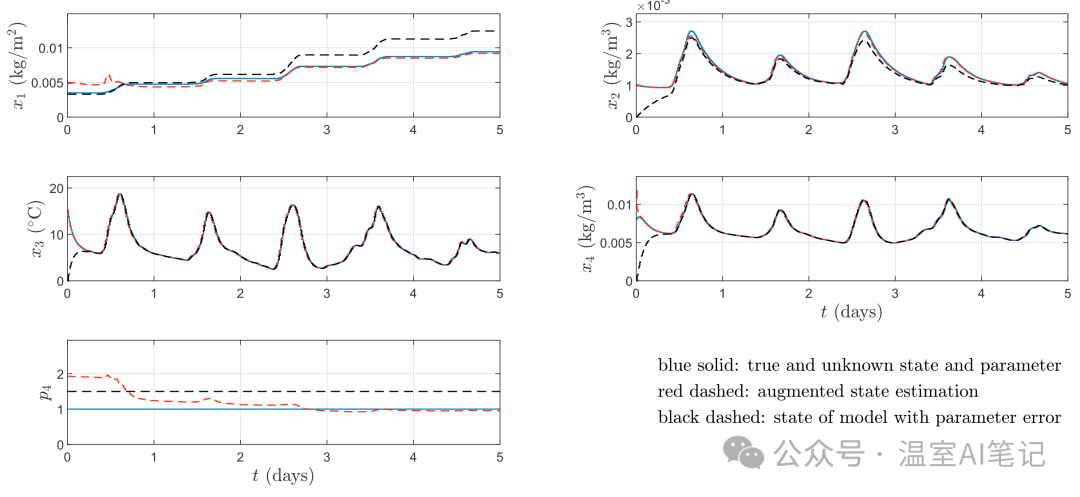
Figure 3. Results of the joint estimation of the augmented states. The figures from top to bottom, left to right are: dry weight (x1), CO2 concentration (x2), temperature (x3), humidity (x4), and light use efficiency parameter (p4). The blue solid line represents the true value, the red dashed line represents the filtered estimate, and the black dashed line represents the model prediction with parameter errors.
Research Outlook Future work will focus on applying this framework in real greenhouse environments, validating it with measured data from platforms such as NPEC (Netherlands Plant Eco-Phenotyping Center). Additionally, sensitivity analysis of measurement noise levels is also an important follow-up research direction to determine the minimum accuracy requirements for sensors needed to achieve reliable estimates.
ReferencesTitle: Nonlinear Observability Analysis and Joint State and Parameter Estimation in a Lettuce Greenhouse using Ensemble Kalman FilteringChinese Title: 利用集合卡尔曼滤波在生菜温室中进行非线性可观测性分析与状态-参数联合估计Authors: Sjoerd Boersma, Simon van Mourik, Bolai Xin, Gert Kootstra, Daniela Bustos-KortsAffiliation: Farm Technology Group, University of Wageningen, Holland (瓦赫宁根大学农业技术组)Journal: IFAC PapersOnLine, 2022DOI: 10.1016/j.ifacol.2022.11.129Disclaimer: This article is for academic sharing only, and the views expressed are those of the original authors. For detailed content, please refer to the original text. (Comments and literature recommendations are welcome.)