Editor’s Note
This issue continues to publish a series of interpretative articles by Yan Shi on the “21st Century CPS Education Report” from the U.S. (including the curriculum structure design and insights of the 21st Century CPS Education Report, and an overview of the report). The article interprets the report’s professional curriculum planning and course classification in light of the concept of “New Engineering” construction, and offers references and reflections.
0 Introduction
The 21st Century CPS Education Report [1-2] (hereinafter referred to as the “report”) is based on the engineering education professional accreditation system [3], in compliance with the requirements of the Accreditation Board for Engineering and Technology (ABET), and provides a four-year curriculum plan for five undergraduate majors. Here, “professional courses” refer to the “professional education courses” in the course classification table (see Table 1). We aim to interpret the report’s professional curriculum planning and teaching aspects primarily from the perspectives of “educators” and “instructors,” combined with the concept of “New Engineering” construction.
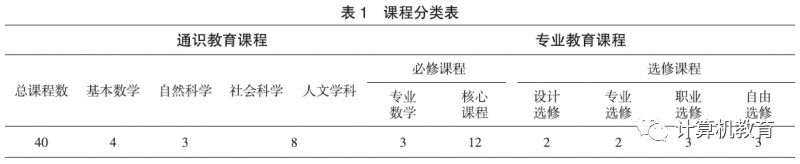
1 Curriculum Classification Guidelines
The “report” believes that CPS is an emerging engineering field with significant economic and social benefits. Major industrial sectors such as transportation, medicine, energy, national defense, and information technology increasingly require a talent pool capable of designing and engineering CPS products and services. These products and services tightly integrate information elements (computational hardware and software) with physical components and manage their interactions and impacts on the physical environment. A special committee formed by the National Academies of Sciences, Engineering, and Medicine invited industry professionals from various fields to discuss the growing importance of CPS in the industry and the demand for CPS skills, producing numerous recommendations for how CPS education should set its curriculum. The committee ultimately formed the following guiding opinions:
(1) Identified six foundations of the CPS discipline: basic computational concepts, computing in the physical world, discrete and continuous mathematics, cross-applications, CPS system development, and modeling. It is clear that CPS education transcends traditional dynamic system models (ordinary differential or difference equations), reflecting not only physical impacts at the entity level but also the intersections and interactions between “information (Cyber)” and “entities (Physical)”.
(2) Emphasized the importance of understanding the characteristics and principles of sensors. Sensors serve as the hardware bridge between the physical and information worlds. Understanding the constraints of sensors and the physical world, and using sensors appropriately is essential. Programmers need to know these principles and how to process them through signal processing techniques to ensure that the CPS they develop functions correctly. Principles required for signal processing include linear signals and systems theory, analog and digital filtering, time-domain and frequency-domain analysis, convolution, linear transformations (such as discrete Fourier transform and fast Fourier transform), signal noise and statistical features, machine learning, decision-making, and sensor fusion. In CPS, alongside considering the reliability of sensors, the implementation of these signal processing techniques on embedded CPUs, real-time operation, and safety-critical features are crucial, while classical signal processing courses generally do not cover these issues.
(3) Control is one of the main components of CPS. Relevant elements of control theory include networks, hybrid systems, stochastic systems, and the stability and optimization of digital system control technologies. Particularly important in the information domain is the control of distributed systems and the impact of inherent delays.
(4) Networks, wireless, and real-time systems have deeply penetrated our economy and society; understanding the basic principles of these topics is vital for CPS engineering. Knowledge students need to acquire includes:
• Communication and networks. Understanding the physical layer principles, protocols, and layered architecture of CPS, and knowing the practical performance of wireless communications is necessary.
• Real-time. Students need to understand real-time scheduling theory, timing semantics in programs, and clock synchronization in networks.
• Distributed systems. The distributed nature and networking of CPS in many applications should be incorporated into CPS education. Even though traditional engineering or computer science courses cover distributed systems and networking, these courses often do not address CPS issues. CPS combines hardware implementations with software that runs algorithms, all operating in real-world environments.
• Embedded systems. Strong teaching and training in the principles, programming, algorithms, software design, methods, and platforms (architecture and operating systems) of embedded software are essential for developing reliable and high-quality CPS system information components.
• Physical characteristics. Understanding and being able to model the physical characteristics of the environment and hardware platforms is crucial. Software design principles should meet safety, reliability, real-time, risk management, and security requirements, and these methods for addressing real-world physical issues should be part of the curriculum.
• Human-computer interaction. Human factors engineering, environmental control, and understanding and computing human behavioral responses are very important for many CPS. An important design principle is to make CPS easy to operate, control, and maintain. Similar to other engineering disciplines, practical projects and interdisciplinary teamwork are also fundamental to understanding and applying core principles.
The committee also noted the gaps in currently operational systems, such as vulnerabilities to network attacks and poor interoperability. It is recommended to introduce the following features and related design methods in early CPS courses, and to integrate them throughout CPS curricula and programs.
• Security and privacy. All information technology-based systems are susceptible to network attacks. Many CPS systems are highly vulnerable because they operate in open environments or interact via wireless communication. Security and privacy risk technologies are crucial for CPS system design.
• Interoperability. Particularly in large-scale CPS, systems will consist of many components from different vendors, some of which may have different operational conditions. Achieving all CPS goals will require interoperability between heterogeneous components and systems. Achieving interoperability requires knowledge of how to define and use common architectures, standardized interfaces, and data standards.
• Reliability and trustworthiness. Many CPS systems will become part of our daily lives, and the practical application of CPS requires high reliability and trustworthiness. Due to the limited computational power, memory, and resources of many CPS devices, this brings forth new challenges. The best systems are those that consider reliability (and safety) from the design phase, rather than continually fixing issues during testing. CPS must also possess robustness to cope with uncertainties that may be difficult to quantify from the outset of design. To ensure these uncertainties are addressed, they must be tracked and managed during the implementation phase.
• Power consumption and energy management. The compact size and autonomous operation of some CPS components make energy management critical and should be a priority in design considerations.
• Safety. With the application of CPS in daily life, ensuring the safe operation of CPS for humans and the environment is very important. Risks associated with these operations should be assessable and manageable.
• Stability and performance. Since CPS are dynamic and stochastic, their stability encompasses the linear or nonlinear nature of the system, bandwidth, sampling rate, poles and zeros of the system, model noise and uncertainties, and limitations of sensors and actuators (e.g., noise or saturation).
• Ergonomics and usability. Ergonomic design, human-friendly environments, and understanding and computing human behavior and responses are important for many CPS applications.
2 Professional Curriculum Content Design
2.1 Basic Principles of Curriculum Planning
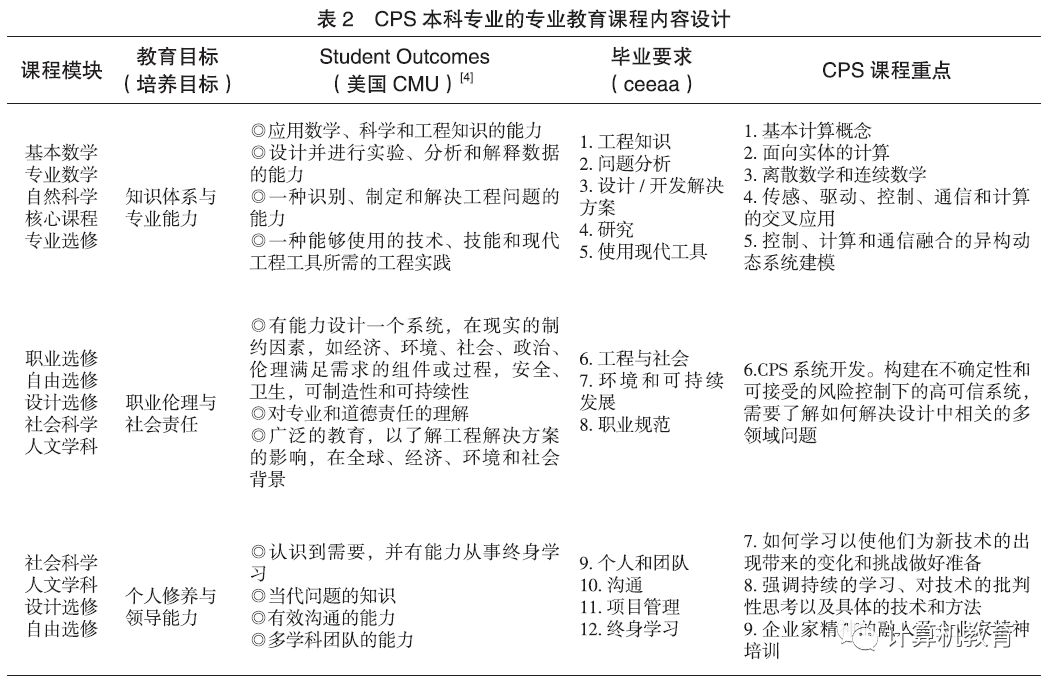
The report highlights the key points of professional curriculum planning, taking the CPS major in the report as an example. The basic principles of professional education curriculum planning summarized in the report are outlined in Table 2.
2.2 Example of Course Content Setup
The report also provides clear requirements and examples for the specific course content setup. Below are examples of course content setup provided by the report.
(1) Example of Course Content Setup One:
Course Name: Embedded Software for Life-Critical Applications.
Offering University: University of Pennsylvania, Insup Lee, Sanjian Chen.
Course Code: CIS 541/441.
Prerequisites: C or Java programming, introduction to computer architecture or operating systems.
Course Description[5]: This course focuses on CPS, with an emphasis on real-time issues. CPS is the integration of computing and communication with physical processes. Embedded computers monitor and control physical processes in real time. As these embedded computers become increasingly networked, a revolutionary transformation is expected. Just as personal computers have transformed from word processors into global communication devices for information collection and sharing, embedded computers will transition from small standalone systems to CPS through perception, monitoring, and control of our physical environment.
The course aims to study the principles, methods, and technologies for building highly reliable and secure CPS. Topics include requirements analysis and modeling, intelligent models, trustworthy cases, hazard analysis, real-time programming and communication, real-time scheduling and virtual machines, feedback control of computer systems, testing and verification, and evidence-based certification.
The course will also include a series of safety-critical embedded system implementation projects, such as pacemakers or infusion pumps.
Course Topics:
1. Introduction to CPS
• CPS Applications
• Characteristics and Challenges
2. Requirements, Modeling, and Analysis
• Model-Based Development
• Requirements Acquisition and Modeling
• State Machines, Timed Automata
• Properties and Model Checking
• User Mental Models
• Architecture Description Languages
• Code Generation and Synthesis
3. Implementation Paradigms and Techniques
• Real-Time Operating Systems
• Programming Paradigms and Languages
• Composition and Feedback-Based Real-Time Scheduling
• Feedback Control in Computer Systems
• Virtual Machines, Hypervisors, Kernel Isolation
• Components, Plug-and-Play Functionality of Embedded Systems
• Mixed-Criticality Systems
• Concepts of Distributed Real-Time Systems: Ordering, Global Time, Clock Synchronization
• Security and Privacy
4. Verification, Testing, and Certification
• Test Coverage and Generation
• Model-Based Testing
• Closed-Loop Testing
• Runtime Monitoring and Verification Techniques
• Human-Computer Interaction
• Modularization and Evidence-Based Certification
• Hazard Analysis, Assurance Cases
Lecture Notes:
1. Introduction to CPS
2. Introduction to Real-Time Embedded Systems
3. Real-Time Operating Systems, Virtual Machines, Hypervisors
4. Real-Time Scheduling: EDF, RM, Servers, Priority Inversion
5. Multiprocessor Real-Time Scheduling
6. Real-Time Programming Languages and Paradigms
7. Distributed Real-Time Systems: Global Ordering, Global Time, Clock Synchronization
8. Feedback in Computer Systems
9. Medical CPS
10. Challenges in Pacemaker Design
11. Case Studies
12. Quality Issues in Medical Devices — FDA Perspective
13. Formal Modeling and Model Checking
14. Extended Finite State Machines, Timed Automata
15. UPPAAL Toolset: Timed Automata and Timed CTL, Model Checking
16. Code Generation/Synthesis for State Machines
17. Testing, Test Coverage, Test Generation
18. Real-Time Testing, Model-Based Testing, Closed-Loop Testing
19. Runtime Verification
• Architecture Description Languages, AADL
20. Human-Computer Interaction: User Interfaces
21. User Mental Models
22. Project Introduction: Modeling and Implementation of Pacemakers, Cases and Demonstrations
(2) Example of Course Content Setup Two:
Course Name: Introduction to Embedded Systems: CPS Approaches.
Offering University: University of California, Berkeley, Edward A. Lee, Sanjit A. Sehsia.
Course Code: EECS 149 / 249A.
Prerequisites: Signals and Systems, Computer Architecture, Discrete Mathematics.
Course Description: The course introduces students to the design and analysis of computational systems that interact with physical processes. Applications of these systems include medical devices and systems, consumer electronics, toys and games, assistive living, traffic control and safety, automotive systems, process control, energy management and protection, environmental control, aircraft control systems, communication systems, instrumentation, critical infrastructure control (e.g., power, water resources, and communication systems), robotics, and distributed robotics (remote monitoring, telemedicine), defense systems, manufacturing, and smart buildings.
The course focuses on the interaction between practical design and system models (including software components and system dynamics). The primary emphasis will be on constructing highly reliable systems with real-time and concurrent behaviors.
This course is offered as a general undergraduate course (EECS 149) and a graduate course (EE C249A and CS C249A). Students participating in the graduate course are required to complete additional assignments and have higher expectations for the project.
The course includes a series of laboratory practices, culminating in a team project that must involve different topics covered in the course.
Course Topics
1. Computational Models
• Finite State Machines
• Threads
• Ordinary Differential Equations
• Hybrid Systems
• Discrete Events
• Data Flow
2. Basic Analysis, Control, and System Simulation
• Simulation
• Reachability Analysis
• Controller Synthesis
• Continuous-Time System Estimation
3. Interaction with the Physical World
• Sensor/Actuator Modeling and Calibration
• Concurrency of Multiple Real-Time Streams
• Inaccurate Data Processing in Software
4. Embedded Platforms
• Real-Time Operating Systems
• Execution Time Analysis
• Scheduling
• Concurrency
5. Distributed Embedded Systems
• Protocol Design
• Predictable Networks
• Security
Lecture Notes:
1. Overview of CPS
2. Sensors and Actuators
3. Model-Based Design and Continuous Dynamics
4. Memory Architectures
5. Input and Output
6. Modal Behavior and Discrete System Modeling
7. Extensions and Timed Automata
8. Composition of State Machines
9. Hierarchical State Machines
10. Reduction and Temporal Logic
11. Comparison of State Machines
12. Reachability Analysis
13. Temporal Logic in CPS
14. Multitasking
15. Operating Systems, Microkernels, and Scheduling
16. Scheduling Inversion
17. Execution Time Analysis
18. Synchronization, Reaction, and Data Flow Models
19. Security in Embedded Systems
20. Networked Embedded Systems
3 Insights and References from the Report
Analyzing the discussions on professional education curriculum planning and content setup in the report, combined with other relevant information, we believe the following points are worth referencing:
1) The setup of courses and course content follows engineering education and professional accreditation standards.
Courses should be oriented toward social needs, fully understanding the demands of enterprises and seriously considering the opinions of industry experts. The report introduces major representatives from participating companies in the seminar, including:
(1) Ford R&D and Advanced Engineering Department in the automotive industry pointed out why the demand for CPS talents is increasing in the automotive industry. Although fundamental automotive engineering knowledge (such as powertrains, combustion, and emissions) remains essential, automotive engineers also need to be able to design, develop, and test communication, sensing, and more complex computer control systems. Ford hopes that future employees will have a stronger foundation in CPS.
(2) Honeywell in the air traffic industry believes that CPS plays an increasingly important role in air transportation, as many CPS-intensive systems (such as aircraft, airports, air traffic control, maintenance, and passenger services) constitute the air traffic environment.
(3) John Deere’s system architect in the agricultural and construction equipment industry noted that the agricultural and construction equipment industry is becoming CPS-intensive. For instance, the company produces partially or fully autonomous vehicles, providing wireless MESH and onboard information service connections between vehicles, remote updates, and product fault diagnostics, and is developing new applications for the agricultural data collected from its products. Furthermore, a large industrialized farm today is a system of systems (SoS), requiring a systematic approach to develop and deploy products and services, which is entirely different from traditional farms that focus on individual products.
(4) Medtronic believes that medical devices are increasingly powerful in health functions, including monitoring and diagnosing patient health, sustaining life (pacemakers), or improving physical conditions by alleviating pain. However, today’s engineers do not possess all the capabilities required to develop future medical devices.
(5) The Jet Propulsion Laboratory (JPL) in aerospace is responsible for designing, building, deploying, and operating spacecraft systems, with major projects including the Mars Science Laboratory “Curiosity” rover and the “Cassini” probe. JPL finds it challenging to find graduates who already possess the necessary CPS skills and other engineering skills and intends to cultivate new employees through practical projects and guidance from senior engineers.
(6) SimuQuest, a CPS development tools company, is a software company that develops products supporting model-based systems engineering. The company explicitly states the key knowledge and skills they seek in employees: controlled object modeling, algorithm design, control system design, understanding networks, and engineering processes. CPS skills also have a new focus, including uncertainty, timing, and delay management, as well as collaborative simulation.
It is evident that feedback from enterprises plays a crucial role in the curriculum planning for CPS education.
2) The syllabus is the most important document of a course.
Reviewing the webpages of the two courses listed in the report [5-6], we can see that the syllabi written by the instructors are comprehensive and rigorous, including the course objectives, textbooks and reference materials used, course content, schedule, assignment requirements and submission deadlines, exam dates, grading structure, grading criteria, subject policies (including attendance, late submissions, etc.), and academic policies (handling of cheating and plagiarism). The syllabus should also include contact information for the instructor and teaching assistants, along with their office hours. It serves as both a “manual” for the “product” of the course and a “contract” between instructors and students. For students, as long as they comply with the requirements of the syllabus, passing the course should not be a significant issue. For instructors, the syllabus serves as guidance and a constraint, as they generally cannot arbitrarily change the teaching content and schedule listed in the syllabus during the teaching process, and exams can only assess the content included.
3) The teaching process is strict, and the teaching methods and models are diverse.
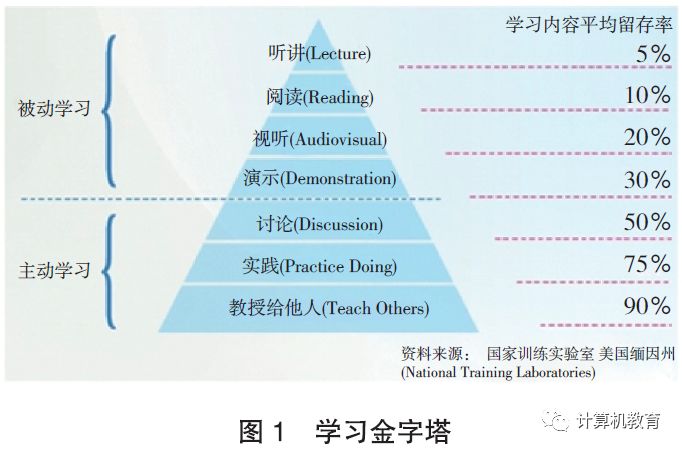
Taking the “Introduction to Embedded Systems” course at the University of California, Berkeley as an example, a course with two codes does not differentiate between undergraduate and graduate students, but the requirements differ, reflected in the expectation for “additional assignments and higher project requirements,” which is nearly impossible in domestic (referring to mainland China) contexts. However, this teaching organization model is truly “modernized,” reflecting “efficiency” and embodying the modern teaching model of “learning by doing.” It also indicates that classroom instruction is not the most critical aspect of teaching a course; instead, “doing” is paramount. They commonly adopt either small group “seminar-style” teaching or a “large class lecture, small group seminar” teaching model. This contrasts significantly with domestic teaching traditions, as our assessments of teaching primarily focus on how many classes teachers have taught, which is the most important, and in many universities, even the only criterion. Moreover, the basic resources for teaching in domestic universities are mainly concentrated in teaching buildings (classrooms) and classroom instruction. Thus, from teaching philosophy to teaching models, we essentially remain in the agricultural era. The teaching model at the University of California, Berkeley has theoretical underpinnings, as illustrated in Figure 1’s “Learning Pyramid.” Although the specific data in the figure may not be scientifically reliable, the basic trend of the effectiveness of six different teaching and learning methods has been proven in practice.
We can also learn that some good universities in the U.S. have numerous exams, with both large and small exams every week, extensive extracurricular reading materials, many experiments, and a substantial amount of homework for each class. This is nearly impossible domestically.
4) Emphasis on project-based learning.
The report states that project-based learning is vital for CPS education. Project-based learning is increasingly common in current university engineering courses. CPS is particularly suitable for “learning by doing,” with learning occurring in laboratories rather than classrooms. In labs, teachers interact with students, fostering creativity, teamwork, and the effective completion of final products. Students select real-world problems and collaboratively develop comprehensive solutions to these problems. They build hardware, create new hardware systems from existing components, and learn to integrate hardware with effective software to form solutions to real-world problems. In addition to classroom projects, students are often required to complete design course projects (capstone projects), integrating student teams with multidisciplinary expertise to collaborate on large-scale projects.
5) The academic research of instructors is crucial for course teaching.
Although the two courses listed in the report are titled “Introduction,” the breadth, depth, and innovativeness of the actual course content are quite strong. The instructors of these two courses, Edward A. Lee and Sanjit A. Sehsia from the University of California, Berkeley, and Insup Lee and Sanjian Chen from the University of Pennsylvania, are internationally renowned scholars in the field of CPS, and much of the course content is derived from their years of scientific research. This indicates that in top universities in the U.S., there is no issue of “emphasis on teaching” versus “emphasis on research.” For university professors, conducting research is primarily for teaching, and good teaching relies on in-depth academic research. Teaching without research cannot produce high-quality teaching outcomes. This fundamentally differs from our teaching practices, where we “assign teaching tasks” without genuinely caring about whether the instructor has researched the core content of the course. As a result, “teaching by rote” has become the norm.
6) Significant investment in teaching, with a strong emphasis on undergraduate education, and the belief that teaching is the primary duty of professors.
Research is considered the personal interest and hobby of professors. Universities certainly support professors’ research work because teaching without research cannot ensure teaching quality and effectiveness, but teaching interests must not be compromised for the sake of research. Many professors’ salaries are based on their undergraduate teaching workload. Professors must complete their teaching tasks according to undergraduate standards and requirements; otherwise, they risk not receiving their salaries. There is substantial investment in the courses themselves, and schools and departments are generous in their investment in undergraduate courses. It is reported that the MIT Department of Electrical Engineering spends as much as $300,000 annually on a single course, with even the lowest amount exceeding $100,000. This funding does not include the salaries of instructors but is purely invested in the course itself, allocated for use by various student groups.
7) A very well-established TA (Teaching Assistant) system.
For example, in the Introduction to Computer Systems course at CMU, there are three instructors and twelve TAs for about 200 students. TAs play a significant role in teaching a course. Few universities in China have a complete TA system. While domestic universities have a “three assistant” system, it is not the same as the modern TA system.
8) Emphasis on evaluating and monitoring the quality of course teaching.
Top universities in the U.S. place great importance on evaluating course teaching quality, with mature systems and methods in place, such as peer evaluations, evaluations of junior staff by senior staff, and evaluations of teachers by students. Course evaluation is also a significant aspect of engineering education and professional accreditation, while this area is nearly blank in China.
Our interpretation of the report regarding professional curriculum planning and teaching is primarily from the perspectives of “educators” and “instructors” (we will further interpret the report from the students’ perspective in subsequent articles). The report has significant reference value for constructing the “New Engineering” professional curriculum system.For the “New Engineering” to be “new,” it must be reflected in the specific curriculum setup and teaching. In domestic professional curriculum setup, there is often more consideration for the academic attributes and requirements of the discipline, with too little consideration for the needs of enterprises or society. The construction of “New Engineering” should focus on addressing this shortcoming. The actual situation of professional curriculum teaching in domestic contexts is very severe, and reform is urgently needed. The construction of “New Engineering” may be an opportunity.
Indeed, we still face a considerable gap in ensuring the quality of undergraduate education. This gap may not be with world-class universities but with the goals we have set for ourselves. Over 40 years of reform and opening up, we have essentially learned the appearance of advanced universities worldwide, including credit systems, GPA (Grade Point Average), free course selection, flexible academic systems, teaching evaluations, professional accreditation, etc., but what is the actual effect?It seems we have broken away from the teaching system formed during the planned economy era, but we have not yet formed a new teaching system suitable for modern society. From a micro perspective, the teaching model and methods of courses still largely remain in the agricultural era. From a macro perspective, what kind of modern university governance mechanism is suitable for us may not have been completely resolved or may require further improvement. If the quality of our course teaching cannot be fundamentally guaranteed, how can the quality of professional education be achieved? Without good educational quality, can we achieve the goal of striving for world-class universities?
References:
[1] The National Academies of SCIENCES ENGINEERING MEDICINE[EB/OL]. [2017-11-16]. http://www.nap.edu.
[2] Yan Shi. Overview of the 21st Century CPS Education Report from the U.S.[J]. Computer Education, 2018(1): 2-9.
[3] China Engineering Education Accreditation Association. Standards for Engineering Education Accreditation[EB/OL]. [2018-1-11]http://www.ceeaa.org.cn.
[4] Carnegie Mellon University. Home[EB/OL]. [2017-11-20]. https://www.cmu.edu.
[5] Penn Engineering. Teaching[EB/OL]. [2017-11-16]. http://www.cis.upenn.edu/~lee/home/teaching/index.shtml.
[6] Chess. Introduction to Embedded Systems (Fall 2015)[EB/OL]. [2017-11-18]. https://chess.eecs.berkeley.edu/eecs149/index.html.
END
More Exciting:
Professor Zhao Wei from the University of Macau: The Future of Computer Science and the Development of Quality Education
By 2022, build a big platform for “Internet + Education”! The “Action Plan for Educational Informatization 2.0” has arrived
7 images to help you understand the new trends in the IoT industry in 2018
Google AI Interview Questions — Real Questions (with Reference Answers + Strategies)
Are you ready? Artificial intelligence is getting closer to children
National Colleges and Universities AI Computer Education Level Competition!
【Directory】 Computer Education, 2018 Issue 4
Some Advice for University Student Programmers
How long can the computer industry remain hot?
Essentials! 2018 China Artificial Intelligence Industry Research Report (with many images)
[Thinking Collision] Scientific Research in Computer Education (Part 1)
Course Structure Design and Insights from the 21st Century CPS Education Report
Training Innovative Practical Abilities of IoT Major Students Under the New Engineering Background
A total of 612! The Ministry of Education announces the first batch of “New Engineering” research and practice project lists (with many images)
[Directory] Computer Education, 2018 Issue 3
A Complete Knowledge System of Artificial Intelligence
Essentials! Professor Sun Fuchun from Tsinghua University answers all your questions about artificial intelligence!
Training Programs for Computer Majors Under the New Engineering Construction Situation
Professor Zhang Guangbing from Southwest University of Science and Technology: Reflecting on Computational Thinking
Essentials: Where to Find Teaching Papers? Selected over 40 diagrams of computer teaching models (quickly save!)
All emerging jobs in the future will require software engineers, as analyzed in the “2017 Emerging Occupations Report”!
[Directory] Computer Education, 2018 Issue 2
Ranking of Research Hotspots in Computer Science for 2017, the hottest field is actually this!
Professor Yang Shiqiang from Tsinghua University: From Experimental Teaching to Practice Education
Overview of the 21st Century CPS Education Report from the U.S.
Edited by Xi Chunyan: The Spring of Computer Education
[Directory] Computer Education, 2018 Issue 1
Good News: “Computer Education” jumps to Q1 zone in the “2017 China Academic Journal Impact Factor Annual Report (Humanities and Social Sciences)”!
“Computer Education” awarded “2017 China’s Most Internationally Influential Academic Journal”!