





Predicting Chromatin Accessibility in Drosophila Using CNN and Multi-Head Attention

Predicting Chromatin Accessibility in Drosophila Using CNN and Multi-Head Attention
Chromatin accessibility (open chromatin accessibility) has gained increasing attention in the context of gene regulation and evolution, but our understanding of it remains limited. There is particularly little knowledge about how chromatin accessibility develops and evolves.
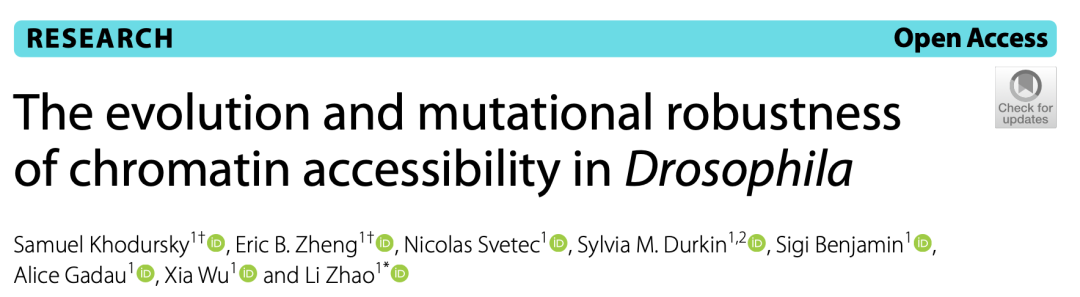
Recently, the Zhao Li laboratory at The Rockefeller University published a research paper titled The evolution and mutational robustness of chromatin accessibility in Drosophila in Genome Biology. The team utilized an innovative deep neural network model to accurately predict ATAC-seq peaks in Drosophila. Their findings not only indicate that chromatin accessibility is highly conserved at the sequence level, but also that these accessible regions, especially newly generated ones, may be key drivers of biological evolution..
Predicting Chromatin Accessibility in Drosophila Using CNN and Multi-Head Attention
Cross-Species Model Generalization and Conservation of Chromatin Accessibility
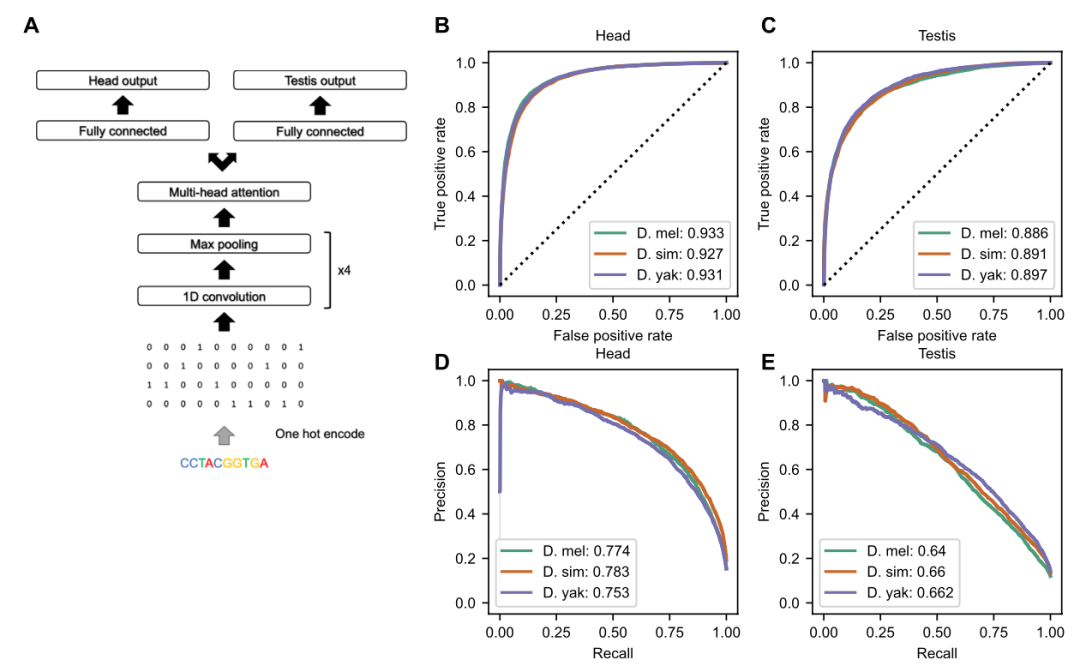
The research team generated a large amount of chromatin accessibility data across three species using high-throughput sequencing methods (ATAC-seq). They trained deep neural network models based on this data and successfully predicted peaks accurately. Surprisingly, these models not only exhibited high predictive accuracy in Drosophila but were also applicable to other insect species, such as the yellow fever mosquito (Aedes aegypti). This further demonstrates the existence of a common gene regulatory mechanism or pattern retained throughout evolution across different species.
Predicting Chromatin Accessibility in Drosophila Using CNN and Multi-Head Attention
Species-Specific Peaks and Evolutionary Diversity of Gene Regulation
The research compared model performance across different species and found that the sequence characteristics of chromatin accessibility are very similar and conserved across species. Nonetheless, the study also pointed out some differences in chromatin accessibility among different species. These species-specific features may mark the evolutionary process of chromatin transitioning from inaccessible to accessible states, providing valuable clues for exploring the evolution of gene regulation. The researchers found that the deep learning model did not perform well in predicting newly emerging open chromatin regions during evolution. This may indicate that new open chromatin regions differ in sequence or features from long-conserved open chromatin. Additionally, the study showed that newly emerging open chromatin also exhibits certain corresponding open chromatin features in homologous closed regions of other species. This suggests that certain regions may be more prone to switching between open and closed states during evolution. However, the biological principles behind this require further investigation to clarify.
In-Depth Exploration of the Mutational Robustness of Chromatin Accessibility
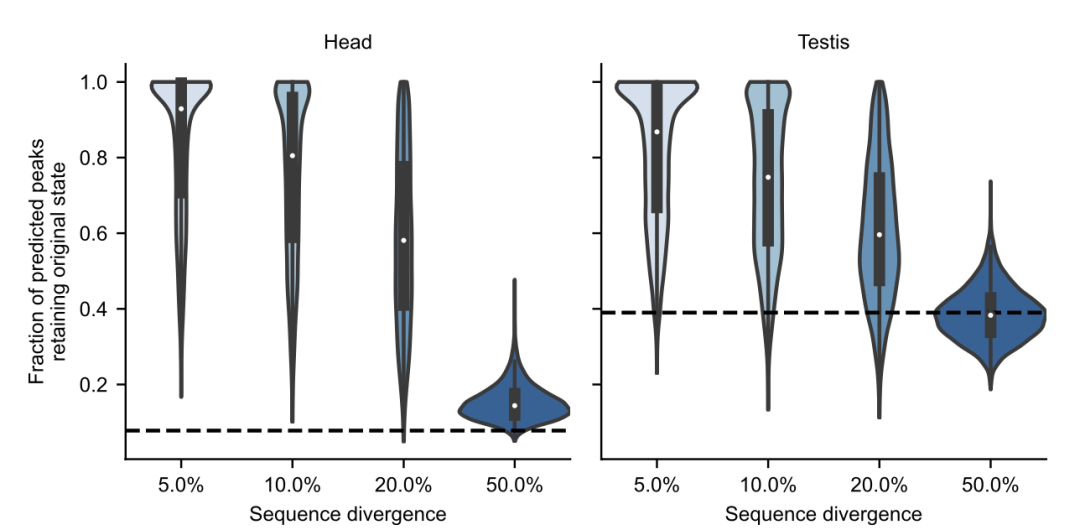
The study further delved into the robustness of chromatin accessibility under genetic mutation pressure (robustness). By conducting large-scale random mutation experiments in a Drosophila model, the research team observed the stability of model outputs. Notably, even when gene sequences exhibited up to 20% variation (equivalent to 200 mutation points), most peaks and non-peak states maintained their original conditions in two different tissue environments.
This result suggests that chromatin accessibility possesses extremely high mutational robustness. This robustness may stem from the heavy-tailed distribution characteristic of mutation effects. In other words, most mutations have negligible impact on chromatin accessibility, with only a few mutations producing significant effects.
Predicting Chromatin Accessibility in Drosophila Using CNN and Multi-Head Attention
Association Between Sequence Redundancy and Chromatin Accessibility
Through computational simulations of knock-in/out mutation analysis, the research team revealed that chromatin accessibility can be accurately predicted by extremely short consecutive sequences. Specifically, sequences as short as 5-10 base pairs also demonstrated significant discriminative ability. This result implies that chromatin accessibility may exhibit sequence redundancy, meaning that multiple different base sequences can lead to the same chromatin state.
This redundancy may serve as an adaptive mechanism in biological evolution, enabling organisms to maintain gene regulatory homeostasis in the face of environmental changes and genetic mutation pressures.
Potential Applications of the Model in Population Genetics and Multi-Tissue Data
The research team utilized the Strong Selection Weak Mutation (SSWM) model for computational simulation experiments. The experimental data indicated that under selective pressure applied only to head tissues, chromatin accessibility could significantly increase in a short period (i.e., within a few generations). Notably, this increase in accessibility also affected other tissues that were not under selective pressure, such as testicular tissues. This further confirms the high plasticity of chromatin accessibility under strong selective pressure.
The study further explored the impact of inconsistent selective pressure directions on chromatin accessibility in different tissue environments. The results revealed that selective effects limited to specific tissues (e.g., head tissues only) could slow down the adaptation process and alter the mutation pathways of chromatin from inaccessible to accessible states. This finding implies the existence of multiple fundamentally non-interfering mutation pathways, providing an explanation for the common occurrence of tissue-specific peaks.
Additionally, the study successfully identified transcription factor binding sequences predictive of chromatin accessibility using TF-MoDISco technology. These sequences include, but are not limited to, GAF, cad, and ttk, which are closely related to chromatin accessibility and play a crucial role in understanding the regulatory mechanisms of chromatin accessibility.
Conclusion
In summary, the team successfully predicted chromatin accessibility in different species and tissues of Drosophila using the CNN + multi-head attention deep learning model. The sequence characteristics of chromatin accessibility demonstrate high conservation during evolution while also exhibiting adaptability and mutational robustness under strong natural selection pressure. This research proves the vast application prospects of deep learning in the fields of gene regulatory mechanisms and evolutionary biology.
Original Link:
https://genomebiology.biomedcentral.com/articles/10.1186/s13059-023-03079-5

Editor: Eleven

Predicting Chromatin Accessibility in Drosophila Using CNN and Multi-Head Attention

Predicting Chromatin Accessibility in Drosophila Using CNN and Multi-Head Attention

Predicting Chromatin Accessibility in Drosophila Using CNN and Multi-Head Attention

Predicting Chromatin Accessibility in Drosophila Using CNN and Multi-Head Attention

Predicting Chromatin Accessibility in Drosophila Using CNN and Multi-Head Attention

Reprint Notice

This article is not original. The copyright belongs to the author. Personal forwarding and sharing are welcome; reprinting without the author’s permission is prohibited. The author retains all legal rights, and violators will be prosecuted.

Predicting Chromatin Accessibility in Drosophila Using CNN and Multi-Head Attention

Leave a Comment