“Standardization is the cornerstone of continuous improvement. Without standards, there can be no improvement.” — Lean Production Principles
Written by | Banble Consulting
Image | AI Generated
Workshop management is the lifeline of manufacturing, the core battlefield where cost, efficiency, quality, and safety intertwine. It is not merely about cleaning and organizing; it is a science, a systematic methodology that requires deep understanding and steadfast execution.
5S Management: The Foundation of Excellent Workplaces (Beyond Cleanliness)
5S (Sort, Set in order, Shine, Standardize, Sustain) is an introductory course in workshop management, yet its deeper value is often underestimated.
Sort (Seiri): The Wisdom of Decisive Abandonment
Core: Distinguish between necessary and unnecessary items, eliminating the latter. This not only frees up space but also releases management energy.
Practice: Implement the “Red Tag Campaign.” Organize cross-departmental teams (production, maintenance, quality, warehouse) to conduct an on-site review of every item: Is it used within a week? Within a month? Does it have a clear designated place? For items with no clear purpose, expired, damaged, or redundant, decisively tag them with a prominent red label, photograph them, and remove them from the workshop. Conduct regular reviews (e.g., quarterly) to establish a “decluttering” mechanism.
Value: Reduces search time, lowers inventory costs, and frees up valuable space, allowing the site to “breathe” freely.
Set in Order (Seiton): The 30-Second Location Rule
Core: Determine a unique, clear, and convenient location and identification for necessary items, achieving “everything has a name and a home.”
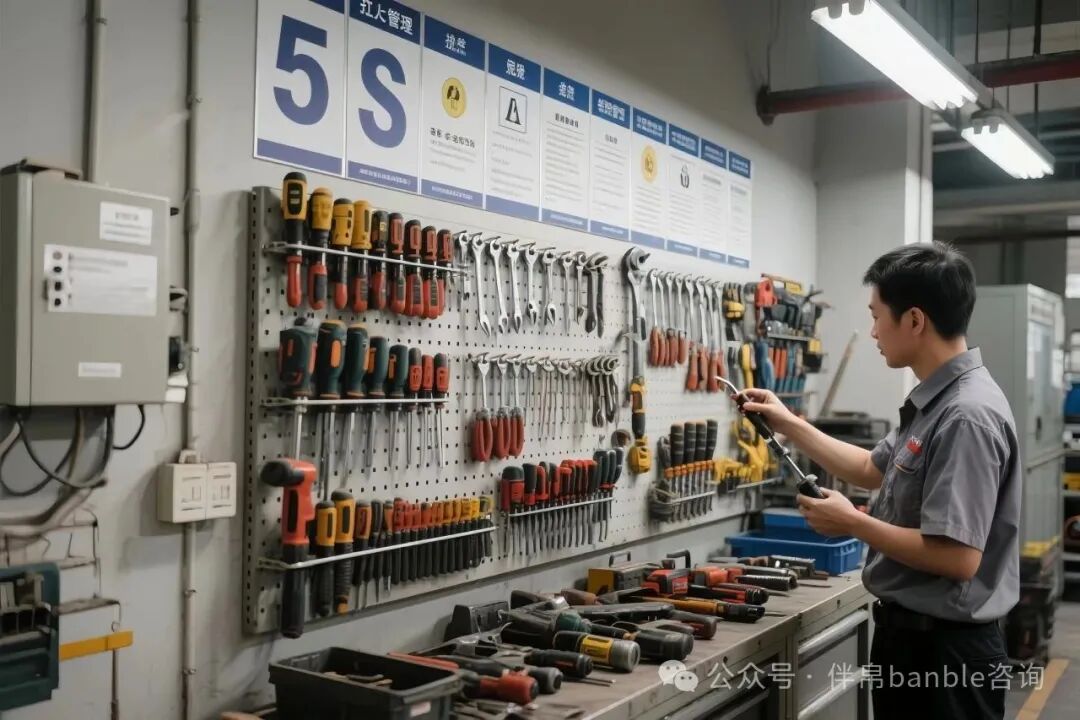
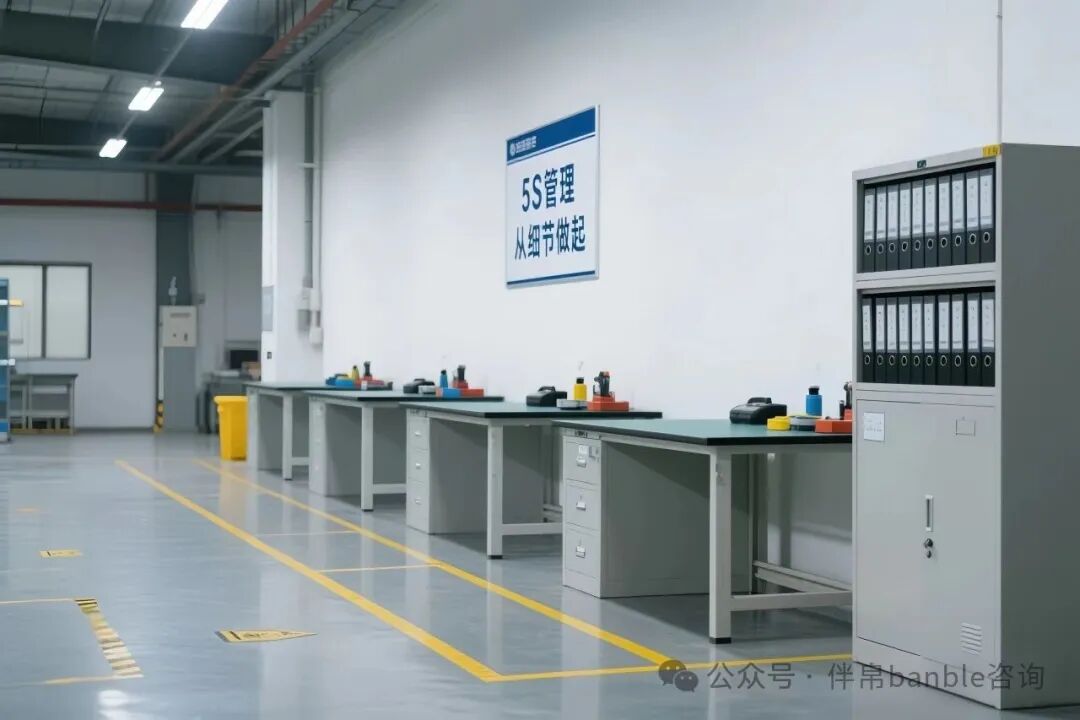
Practice: Use marking lines: Employ yellow-black zebra lines, green pathway lines, blue or yellow positioning tape to clearly delineate areas for equipment, material carts, turnover boxes, pathways, and fire equipment. Use foam padding or outline lines in tool cabinets to ensure each tool is “in its place.”
Visual identification: Label contents with item name, model/specification, quantity, responsible person, and expiration date (e.g., for chemicals). Shelves use “address codes” (e.g., A-01-02), and material card information is synchronized with the system.
Three Determinations Principle: Determine location (clear position), determine container (specify container and capacity), determine quantity (set maximum/minimum inventory levels). For example, only allow storage of processing parts for a maximum of 2 hours next to a workstation; exceeding this triggers a warning light.
Value: Eliminates searching and handling waste, enhances operational efficiency, and prevents misuse.
Shine (Seiso): The Magnifying Glass for Problem Discovery
Core: Thorough cleaning exposes and resolves sources of contamination, faults, and minor defects.
Practice: Establish a cleaning responsibility chart by area, assigning specific people, areas, and standards. Cleaning is not just about dusting and mopping; it is also about “inspection”: checking for loose screws, leaking oil pipes, or worn wires while cleaning equipment; checking for water stains or oil leaks while cleaning the floor. Record discovered issues on the “Cleaning Inspection Sheet” and report for timely repair or improvement.
Value: Maintains a good environment, extends equipment lifespan, early detection of hidden dangers (small issues often precede major failures), and ensures product cleanliness.
Standardize (Seiketsu): Consolidation of Standardization
Core: Standardize and institutionalize the results of the first three S’s, forming norms and habits.
Practice: Develop a visually rich “Workshop 5S Execution Standard Manual,” including various item location maps, cleaning inspection sheets, and scoring criteria. Ensure standards are deeply ingrained through pre-shift meetings, on-site display boards, and new employee training. Establish daily inspections and regular audits (e.g., weekly departmental self-checks, monthly company-level inspections), with results publicly compared.
Value: Maintains results, prevents regression, and lays the foundation for higher-level management.
Sustain (Shitsuke): Self-Discipline Without Reminders
Core: Cultivate employees’ habits and awareness of rule compliance and continuous improvement.
Practice: Leadership sets an example by participating in 5S activities. Encourage employees to propose improvement suggestions (e.g., establish a “Golden Ideas” award). Incorporate 5S execution into performance evaluations and team assessments. Foster a positive atmosphere of “pride in cleanliness and orderliness.”
Value: Forms a culture of continuous improvement, making 5S a self-regulating behavior that significantly reduces management costs.
Visual Management: Making Information Clear at a Glance
Visual management uses intuitive visual signals to instantly convey information about site status, standards, and anomalies, making management transparent and efficient.
Information Visualization:
Production Management Board: Dynamically displays team production plans, actual completion amounts, achievement rates, and anomalies (e.g., equipment downtime, quality issues), with real-time data updates allowing team leaders to make quick decisions.
Andon System: Signal lights (red, yellow, green) and call buttons are set up next to workstations or equipment. When an anomaly occurs (e.g., material shortage, quality issue, equipment failure), employees press the button, and the corresponding light illuminates, simultaneously transmitting information to relevant responsible persons (team leaders, maintenance, materials) on boards or mobile terminals for rapid response.
Electronic Display Boards: Large screens scroll key indicators (OEE, throughput rate, work-in-progress inventory, delivery achievement rate), production performance, important notices, safety reminders, etc.
Item Visualization:
Shape Management: On tool boards, material racks, and equipment operation panels, outline the correct shape and position for items using lines, shadows, or physical outlines, making any absence or misplacement immediately apparent.
Color Code Management: Use uniform color coding. For example: red represents defective products/danger zones/fire equipment, green represents qualified products/safety passages/traffic areas, yellow represents items awaiting inspection/attention zones/rework areas, blue represents work-in-progress/tools. Pipe markings indicate flow direction and medium. Valve markings indicate switch status.
Quantitative Marking: Clearly mark maximum/minimum inventory levels (e.g., MIN/MAX lines), item names, and codes on material boxes, shelves, and line-side warehouses. Use “clear at a glance” material rack designs.
Operational Visualization:
Standardized Work Instructions (SOP): Illustrated with clear steps and highlighted key points (e.g., torque requirements, inspection standards), displayed at the work point within easy reach. Use photos or simple drawings instead of lengthy text.
Sample Display: Set up physical samples of qualified and unqualified products at key positions, accompanied by brief explanations (e.g., burrs, scratches, dimensional deviations), allowing employees to self-check against them instantly.
Warning Signs: Set up prominent, standardized warning signs and markings in dangerous areas, high voltage, rotating parts, and locations where PPE must be worn.
Standardized Work: The Foundation for Stable Quality and Efficiency
Without standards, there can be no improvement. Standardized work is key to stable output and reduced variation.
Develop Scientific Work Standards (SOP):
Precise Content: Based on best practices, clearly define the requirements for people, machines, materials, methods, and environment for each process. Specify operational steps, action sequences, time beats, tools/fixtures used, key quality parameters (dimensions, appearance, torque, etc.), safety precautions, and self-inspection points.
Intuitive Format: Use flowcharts, photos, and videos extensively to assist explanations, striving for clarity and avoiding ambiguity. Language should be concise and clear.
Employee Participation: Involve frontline operators in the development and optimization of SOPs, as they understand the details and pain points of actual operations, ensuring standards are practical and executable.
Training and Execution of Standardized Work:
Effective Training: Use the “I tell you, I show you, you show me” method for training. Ensure employees truly understand the significance and key points of each step. Only allow them to work after passing assessments.
Strict Execution: Emphasize the importance of adhering to standards. Team leaders and process engineers should strengthen on-site inspections and promptly correct deviations. Incorporate adherence to SOPs into employee performance management.
Continuous Optimization of Standards:
Dynamic Updates: SOPs are not static. When better methods are discovered, new equipment is introduced, or quality issues arise, SOPs should be reviewed and updated promptly.
Improvement Proposals: Establish mechanisms (e.g., improvement proposal systems) to encourage employees to suggest optimizations for work standards, which can be adopted and updated after evaluation and validation.
Equipment Management and Maintenance: Ensuring the Lifeblood of Production
Equipment is the foundation of production, and efficient, reliable equipment guarantees capacity and quality.
Total Productive Maintenance (TPM): Equipment Assurance with Full Participation
Autonomous Maintenance (AM): Operators are the first guardians of equipment. Train them to perform daily inspections, cleaning, lubrication, and tightening (the “Seven Steps of Equipment Maintenance for Operators”). Empower them to discover and report minor anomalies.
Professional Maintenance (PM): The maintenance department develops scientific preventive maintenance plans based on equipment historical data and operational status (e.g., regular oil and filter changes, checking for wear on key components), rather than reacting passively.
Early Management: During the selection, procurement, installation, and commissioning phases of new equipment, maintenance and production departments should be deeply involved to ensure equipment is easy to maintain, easy to operate, and highly reliable (maintainability design).
Quick Changeover (SMED): Compressing Changeover Time to the Extreme
Concept: Distinguish all operations during the changeover (or line change) process into “internal operations” (which must be completed while the equipment is down) and “external operations” (which can be prepared while the equipment is running).
Practice:
Separate Internal and External Operations: Move mold preheating, tool preparation, and material preparation to be completed during equipment operation.
Convert Internal Operations to External Operations: For example, complete some assembly or debugging in advance.
Optimize Internal Operations: Use standardized tools (e.g., quick clamps, positioning pins), parallel operations, and functional fixtures (eliminating adjustments). Record and analyze each changeover process to continuously optimize actions.
Value: Significantly reduces downtime, enhances equipment utilization, and achieves flexible production of small batches and multiple varieties.
Equipment Inspection and Status Monitoring:
Daily Inspections: Operators perform inspections according to checklists (including sensory judgments: listening for unusual sounds, feeling for vibrations, smelling for unusual odors, looking for leaks/instrument readings).
Regular Professional Inspections: Maintenance personnel use specialized instruments (vibration analyzers, infrared thermal imagers, oil analysis instruments) for in-depth testing.
Establish Records: Document inspection data, maintenance history, and spare parts replacement status to provide a basis for predictive maintenance.
Personnel Management and Team Building: Activating Core Dynamics on the Shop Floor
No matter how good the system and methods are, they ultimately rely on people to execute. Stimulating team potential is crucial.
Pre-Shift Meetings: The Day Begins with the Morning
Efficient and Pragmatic: Keep it within 10-15 minutes. Content includes: review of yesterday’s production/quality/safety, assignment of today’s tasks (plans, key points, changes), conveyance of important information, safety reminders, and brief motivation. Encourage employees to speak briefly (e.g., difficulties, suggestions).
Fixed Process: Form a standardized process (e.g., lining up, roll call, content delivery, interaction) to ensure information transmission is accurate.
Multi-Skilled Worker Training: Building a Flexible Team
Job Rotation System: Plan to arrange employees to learn operations on different processes and equipment.
Skills Matrix Chart: Visually display the types of skills each employee has mastered and their proficiency levels (e.g., beginner, independent operation, can train others).
Incentive Mechanism: Link skill mastery to compensation and promotion. The more skills an employee has, the greater their value.
Effective Communication and Motivation:
Open Communication: Team leaders should practice “management by walking around,” actively asking employees about difficulties and listening to suggestions. Set up an “Employee Voice” mailbox or hold regular discussion meetings.
Immediate Feedback: Provide timely, specific praise for employees’ good performance (adhering to 5S, identifying hazards, proposing good suggestions) (publicly or privately). Provide constructive guidance for deviations rather than simple reprimands.
Recognition and Rewards: Establish awards for “Outstanding Employee,” “Improvement Star,” “Safety Model,” etc., providing material or spiritual rewards. Let employees feel valued and respected.
Creating a Positive Atmosphere: Care for employee welfare and address reasonable demands. Organize team-building activities to enhance cohesion.
Continuous Improvement (Kaizen): The Endless Pursuit
Excellent site management has no endpoint; continuous improvement is a culture ingrained in the blood.
Establish Awareness of Improvement Among All Employees: Make every employee understand: the current situation is never the best, and there is always room for improvement in any link. Improvement is not about size; it’s about participation.
Establish an Improvement Proposal System:
Simplify Processes: The proposal form should be simple and easy to fill out, with convenient submission channels (online/offline).
Quick Response: Assign a person to receive, preliminarily review, and forward for evaluation. Regardless of whether the proposal is adopted, provide timely feedback to the proposer.
Fair Review and Incentives: Provide corresponding rewards (points, bonuses, recognition) based on improvement effects (economic benefits, efficiency enhancement, quality improvement, safety reinforcement, etc.). Emphasize spiritual incentives.
Utilize Improvement Tools:
PDCA Cycle (Plan-Do-Check-Act): The basic methodology for solving any problem or implementing improvements.
5 Whys Analysis Method: Continuously ask “why” five times for a problem to dig deep into the root cause, avoiding superficial solutions.
ECRS Principles (Eliminate, Combine, Rearrange, Simplify): Used to optimize work processes.
Commitment and Demonstration from Leadership: Management should actively participate in improvement activities (e.g., regularly attending on-site improvement weeks), provide resource support, recognize improvement results, and create a cultural atmosphere of continuous improvement.
Lean Production and Error-Proofing: Precise and Efficient Production
Integration of Lean Production Concepts:
Value Stream Analysis: Identify and optimize the value stream throughout the production process, eliminating waste such as overproduction, inventory buildup, and waiting time, achieving continuous and balanced production patterns, and enhancing overall efficiency.
Kanban Management: Control production progress and material flow through kanban signals, achieving just-in-time production, reducing work-in-progress inventory, and enhancing the visibility and information transmission of the production process, closely matching production plans with actual demand.
Application of Error-Proofing (Poka-Yoke):
Set up error-proof devices or mechanisms in product design and process flows to prevent quality issues caused by operational errors, such as part shape designs that prevent incorrect installation, automatic detection and alarm devices, etc., ensuring product quality from the source and reducing rework and scrap costs.
Transparent Visual Management: The Details Reveal the Truth
Transparent Item Management:
For small parts, tools, etc., use transparent storage boxes or containers to store items, allowing for intuitive viewing of item quantities, types, and conditions, facilitating quick retrieval and replenishment, while also helping to promptly identify missing or damaged items, improving management efficiency and accuracy.
Transparent Process Management:
Make key information such as production processes, work steps, and inspection standards into transparent process cards or charts, hanging them in the corresponding workstations or operation areas, allowing employees to refer to them at any time during operations, ensuring the standardization and consistency of operations, and reducing errors and delays caused by unclear processes.
Equipment File Management: Comprehensive Control of Equipment Information
Establish detailed files for each piece of equipment, including basic information, technical parameters, purchase dates, installation and commissioning records, maintenance history, wear parts replacement cycles and lists, equipment performance evaluation reports, etc. Through systematic management of equipment files, a comprehensive understanding of equipment operating conditions and lifespan can be achieved, providing accurate data support and decision-making basis for equipment maintenance, upgrades, and fault diagnosis, enhancing the scientific and effective management of equipment.
Cross-Department Collaboration Mechanism: Breaking Down Barriers, Collaborating for Progress
Establish a regular cross-department communication meeting system, such as monthly or quarterly coordination meetings involving production, quality, R&D, procurement, sales, and other departments, to strengthen information sharing and communication, promptly resolve cross-departmental issues arising during production, such as the connection between raw material supply and production plans, the impact of product design changes on production processes, and adjustments required by changes in customer demand, ensuring collaborative operations between departments and improving overall operational efficiency and market response speed.
Digital and Intelligent Factory Construction: Efficient and Intelligent Future
Introduction of Manufacturing Execution Systems (MES):
MES systems can achieve real-time monitoring, data collection, and analysis of the production process, including production plan execution, equipment status monitoring, quality data tracking, and personnel performance management. Through MES systems, management can timely grasp the actual situation on the production floor, make scientific decisions; team leaders can better manage production scheduling and personnel; quality departments can trace the root causes of product quality issues in real-time, improving quality control levels and achieving information-based and intelligent management of the production process.
Application of Internet of Things (IoT) Technology:
Install sensors on equipment and production lines to achieve interconnectivity and data sharing between devices, building an intelligent production network. Through IoT technology, remote monitoring and diagnostics of equipment can be achieved, providing early warnings of equipment failures, reducing downtime; at the same time, based on big data analysis and artificial intelligence algorithms, production data can be deeply mined and analyzed to optimize production processes, improve production efficiency and product quality, and drive the management of workshop sites towards digitization and intelligence.
In Conclusion: From Chaos to Excellence in Workshop Management
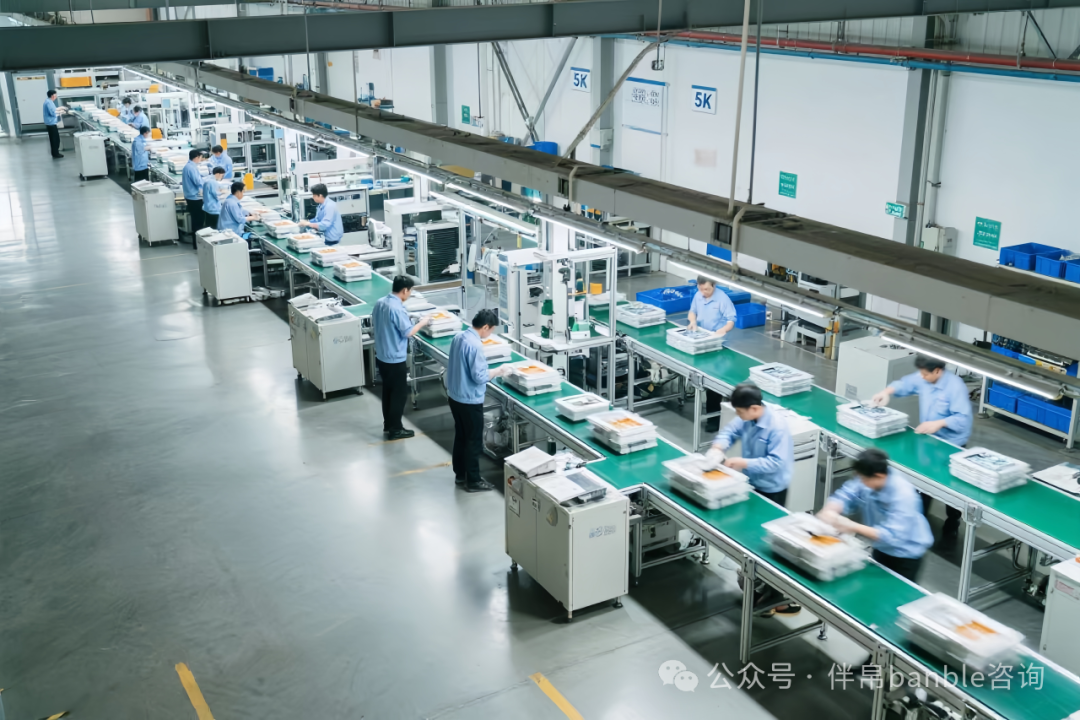
Workshop management has shifted from a reactive “firefighting” approach to a proactive prevention strategy, extinguishing hazards in their infancy; from relying on individual experience to operating based on the collective wisdom of the team. Ultimately, this leads to comprehensive breakthroughs in efficiency, quality, cost, and safety.
This process is reflected in the meticulous attention to detail. Returning tools to their places, ensuring every operation has a process to follow, making all types of information clearly displayed, allowing every employee to feel respected and have space to showcase their talents, treating every encountered anomaly as an opportunity for improvement.
When 5S becomes everyone’s habit; visual management integrates into daily routines, becoming the “universal language” of the workshop; adherence to standards becomes an instinctive action; equipment is in good operating condition every day; team morale is high and vibrant; the atmosphere of continuous improvement becomes increasingly strong.
True management wisdom is not hidden in loud slogans but is reflected in every tightened screw in the workshop, every clear sign, every efficient communication, and every small progress accumulated day by day.