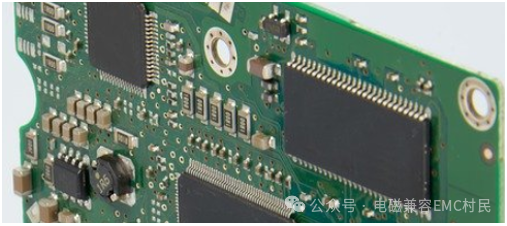
This article introduces an overview of semiconductor immunity standards and testing methods.
Types of Semiconductor Immunity Standards
Semiconductor immunity standards are divided into two types based on the type of noise they address: one is for “Continuous Wave” standards, and the other is for “Impulse Wave” standards.
The immunity standard for continuous waves is the “IEC62132 series.”
The immunity standard for impulse waves is the “IEC62215 series.”
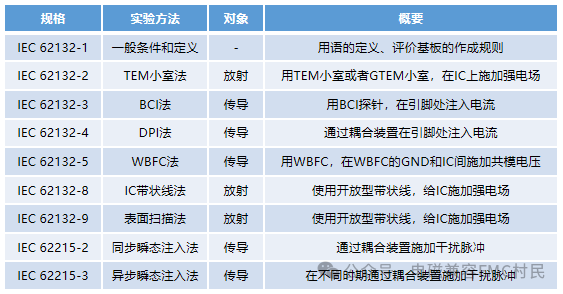
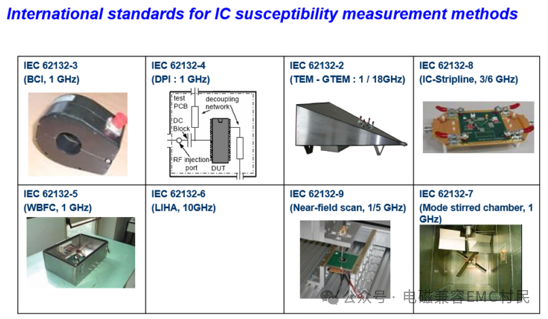
Similar to “IEC61967-1”, “IEC62132-1” only specifies the purpose, scope, and evaluation board specifications of the standard, so it will not be elaborated here.
Likewise, regarding “IEC62132-8 (IC stripline method)”, “IEC62132-9 (surface scan method)”, and “IEC62215-2 (synchronous transient injection method)”, due to lower test frequencies and limited information, they will also be omitted.
IEC62132-2 (TEM Cell Method)
This testing method evaluates the presence of malfunctions by installing the evaluation board on the side of a small TEM cell and applying continuous interference waves to the IC.
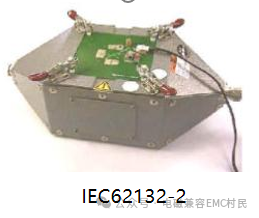
The design of the small TEM cell allows for the installation of the evaluation circuit board, ensuring that only the device under test is located inside the cell.
Interference signals are input under a 50Ω termination matching condition to evaluate the device’s immunity performance against this signal.
IEC62132-3 (BCI Method)
This method extends the automotive immunity standard “ISO11452-4 (BCI Method)” to semiconductor immunity testing.
Note: BCI stands for “Bulk Current Injection”, named for injecting common-mode current into the wiring harness.
Interference signals are applied through an injection probe while monitoring the injected current to confirm whether the IC experiences malfunctions.
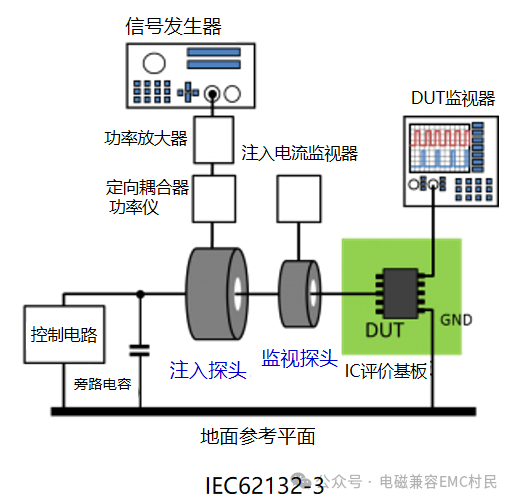
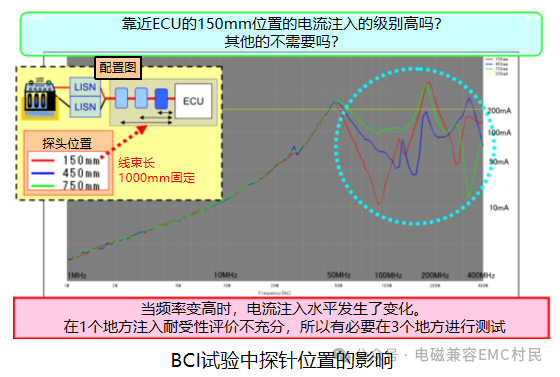
Similar to the automotive BCI test, as the frequency increases (wavelength shortens), the length, bundling method, and probe position of the wiring harness will affect the test results.
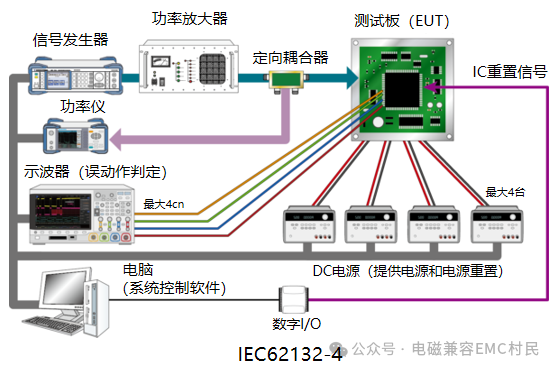
IEC62132-4 (DPI Method)
DPI stands for Direct RF Power Injection, which refers to a testing method that applies RF interference waves through capacitive coupling to evaluate the device’s noise immunity performance.
This testing method is also explicitly specified in the European automotive EMC general specification document “BISS” (mentioned in the emission standards).
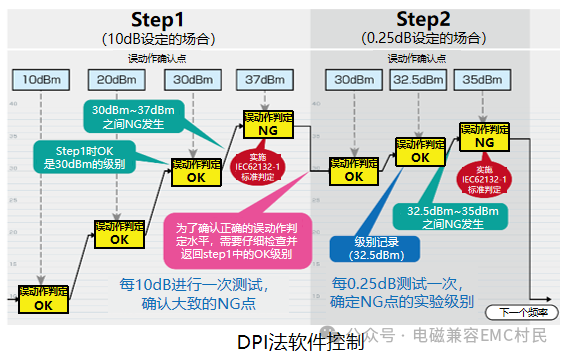
This test requires gradually increasing the test levels (power) across frequency bands and confirming device performance after each increase, making the operational process extremely time-consuming.
Therefore, there are also software available for reducing testing time.
The DPI method can be used to apply noise and visualize it on the board, verifying the noise reduction effect of decoupling capacitors.
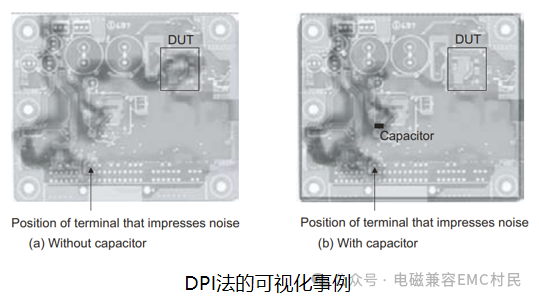
This can be considered the most frequently conducted test in semiconductor immunity testing.
IEC62132-5 (WBFC Method)
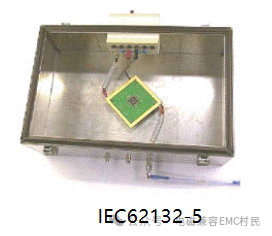
This is a testing method that applies noise in the opposite direction of the emission standard (IEC61967-5).
By applying common-mode noise, the grounding potential of the evaluation board is changed to assess whether the device experiences malfunctions.
IEC62215-3 (Asynchronous Transient Injection Method)
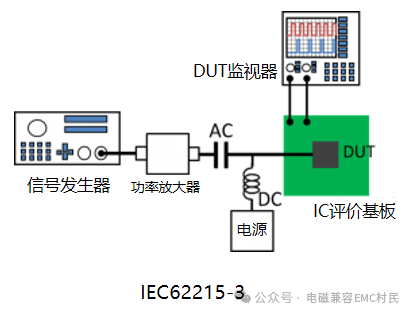
This is the only testing method in semiconductor immunity testing that uses “Impulse Wave”.
The test configuration is the same as that of IEC62132-4 (DPI Method).
Conclusion
We have introduced the overview of semiconductor immunity standards and testing methods.
Although the awareness of this testing is still relatively low and implementation opportunities are few, its importance will become increasingly prominent with the development of the automotive and safety fields. Information collection related to the standards mainly relies on the standard documents themselves.
“CISPR” and “IEC” related standard documents can be purchased online.
This concludes the content.
The evaluation center of Panasonic Appliances (China) Co., Ltd. can provide overall EMC solutions. If needed, please contact Manager Tao (email:[email protected]).
Note: Due to reader requests for establishing an EMC technical exchange WeChat group, the group has been created. If anyone wishes to join, please scan the code to add me on WeChat and indicate “Join EMC Technical Exchange Group”.